- Animals
- ›Chordates
- ›Vertebrates
- ›Birds
- ›Rollers, Kingfishers, and Allies
- ›Kingfishers
- ›River, Dwarf, and Pygmy Kingfishers
- ›Alcedo
On eBird ↗
Malaysian Blue-banded Kingfisher
Live sightings near you, the range map, bar charts of when it is seen, and Macaulay Library photos and recordings.
Malaysian Blue-banded Kingfisher
Alcedo peninsulae
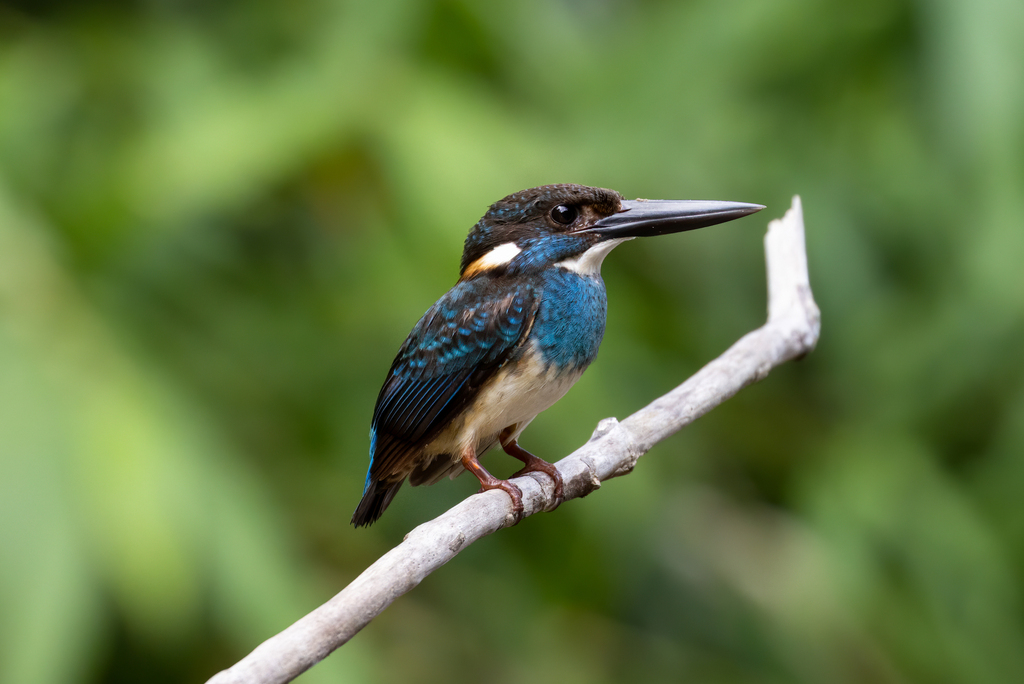
The Malaysian (or Malayan) blue-banded kingfisher (Alcedo peninsulae) is a species of kingfisher in the subfamily, Alcedininae. Its natural habitats are subtropical or tropical moist lowland forests, subtropical or tropical mangrove forests, and rivers. It is found in Myanmar, the Malay Peninsula, Sumatra, and Borneo.
From the article Malaysian blue-banded kingfisher on Wikipedia (CC BY-SA), quoted section by section
Description
It is a small-sized bird at 20 cm on average, but comparatively larger than other species of the kingfisher in similar regions, with a relatively long bill and a short tail. The bird is 17–20.5 cm in length with the bill measuring 45.0–50.8 mm and the tarsus 11.9–13.7 mm.
Plumage. Adults of this species can be identified by their white throat and a white patch on the neck that connects to a narrow collar of reddish-brown feathers at the back. Their crown, wings, and upper tail feathers are bluish-black and often have small speckles of bright blue or a light brownish yellow on the crown and shoulder feathers. The tail is 35–40 mm, and the wings are 79–92 mm. The back feathers are silvery-blue, which stands out from the rest of their upper body. The juvenile plumage of the Malaysian Blue-banded Kingfisher is similar to the adult, but duller in color.
Sexual dimorphism. This species shows sexual dimorphism, with males having a variable broad blue band across their chest on a white underbelly, whereas females have dull reddish-brown underparts and lack the distinctive breast band of the males. Both typically have a brighter blue patch of feathers on their cheeks compared to the crown, however, females may have some reddish feathers mixed in. …
Range & habitat
This bird is mainly found in Peninsular Malaysia and Borneo, specifically the Greater Sundas area. The birds may also be found in areas including Thailand, Brunei, Sumatra, and Myanmar. This bird can be seen near water and low to ground or in swamps. Typically the bird resides near streams and rivers within the forest. The bird dwells in evergreens, back-mangroves and other local trees. While predominantly found in lowlands, sightings have been recorded at elevations of up to 900 meters in Peninsular Malaysia and 1,400 meters in Borneo.
Wikipedia: “Distribution and habitat”
What it does
This species is described as behaving in a shy and secretive manner. The bird is often observed moving from one perch to another. Its flight is described as quick and direct, often flying low over the water's surface. It is a primarily solitary bird but has also been observed to spend time in pairs. This bird sleeps with its head tucked in, usually on a small branch.
Diet. Its diet consists mainly of fish, which is known as a piscivore diet. This bird specifically is known to eat Rasbora fish and shrimp, but also eats crustaceans, insects, larvae, and lizards. The bird hunts for fish on rocks and low branches. It then dives into the water and swallows the animal whole.
Breeding. Breeding activities for this species typically occur between January and March, although the breeding season can extend from January to mid-August. Nests are often situated along stream banks in forests, with some instances of nest excavation into stream banks. The eggs, typically ranging from 3-5 per brood, are white in color.
Wikipedia: “Behavior”
Listen
Looking for field recordings…
Where it lives
Recorded sightings
—
geo-referenced records in GBIF, from museums, herbaria and field observers.
Drag the globe to turn it. Dots are where records exist, not a range map; darker means more records.
In the stacks
Searching the stacks…
Every page naming Alcedo peninsulae in the Biodiversity Heritage Library →
This page is assembled live from iNaturalist, GBIF, Wikipedia, the Source Library and the Internet Archive. It is not yet part of the hand-edited codex. iNaturalist taxon 1435797.