On eBird ↗
Flame-crowned Manakin
Live sightings near you, the range map, bar charts of when it is seen, and Macaulay Library photos and recordings.
Flame-crowned Manakin
Heterocercus linteatus
The flame-crested manakin (Heterocercus linteatus) is a species of bird in the Pipridae family. It is found in Bolivia, Brazil, and Peru. Its natural habitats are subtropical or tropical moist lowland forests and subtropical or tropical swamps.
From the article Flame-crested manakin on Wikipedia (CC BY-SA), quoted section by section
Description
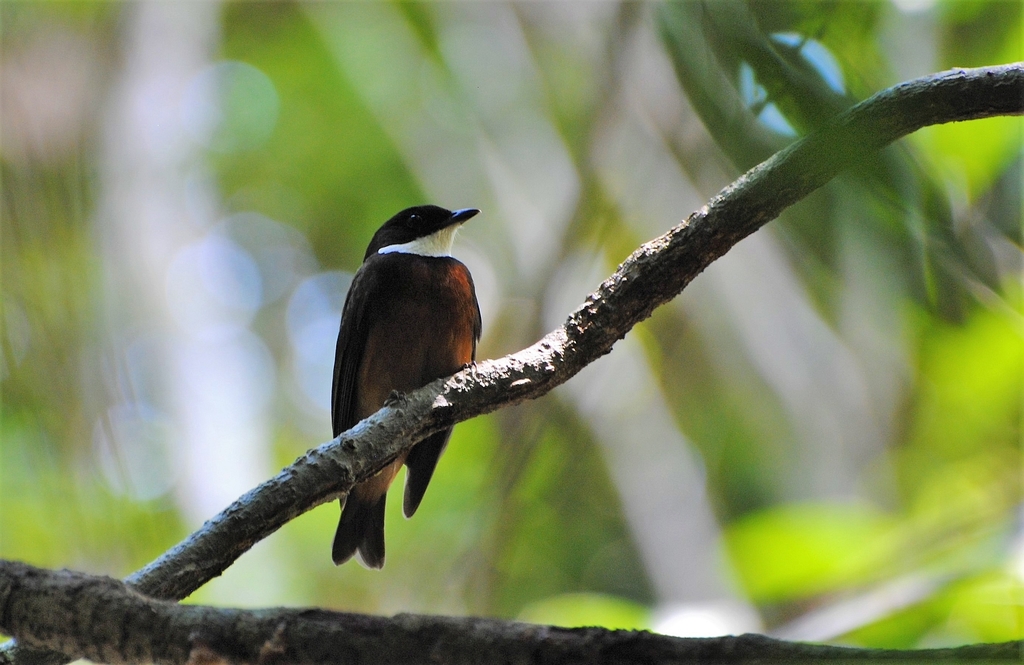
The flame-crested manakin is about 14 cm (5.5 in) long and weighs 20 to 24 g (0.71 to 0.85 oz). The species is sexually dimorphic. Adult males have a mostly black head with an often hidden red stripe on the crown and a white throat. The throat feathers are long and silky. Their upperparts and flanks are dark olive. They have a sooty olive upper breast and a deep chestnut lower breast that becomes cinnamon-rufous on the belly. Adult females have no red on their crown. The head is mostly the same dark olive as their upperparts though their face is duskier and their throat gray. Their flanks are grayish olive and their underparts cinnamon-buff. Both sexes have a dark brown iris, a long narrow dark bill, and dark legs and feet.
Range & habitat
By far the largest part of the flame-crested manakin's range is in central Brazil. There it is found south of the Amazon River from the basin of the Xingu River west to Peru and northern Bolivia and south to southeastern Mato Grosso. As of 2010 there were two records in Peru's extreme southeastern Madre de Dios Department on the Bolivian border. There apparently are records since then in Loreto Department in northeastern Peru. The flame-crested manakin inhabits humid várzea forest and woodlands along watercourses. In elevation it reaches up to about 500 m (1,600 ft).
Wikipedia: “Distribution and habitat”
What it does
The flame-crested manakin feeds on small fruits, insects, and spiders, though details are lacking. It forages in the forest's lower strata.
Wikipedia: “Feeding”
Listen
Looking for field recordings…
Where it lives
Recorded sightings
—
geo-referenced records in GBIF, from museums, herbaria and field observers.
Drag the globe to turn it. Dots are where records exist, not a range map; darker means more records.
In the stacks
Searching the stacks…
Every page naming Heterocercus linteatus in the Biodiversity Heritage Library →
This page is assembled live from iNaturalist, GBIF, Wikipedia, the Source Library and the Internet Archive. It is not yet part of the hand-edited codex. iNaturalist taxon 14360.