- Animals
- ›Chordates
- ›Vertebrates
- ›Cartilaginous Fishes
- ›Sharks and Rays
- ›Sharks
- ›Galean Sharks
- ›Ground Sharks
- ›Requiem Sharks
- ›Lamiopsis
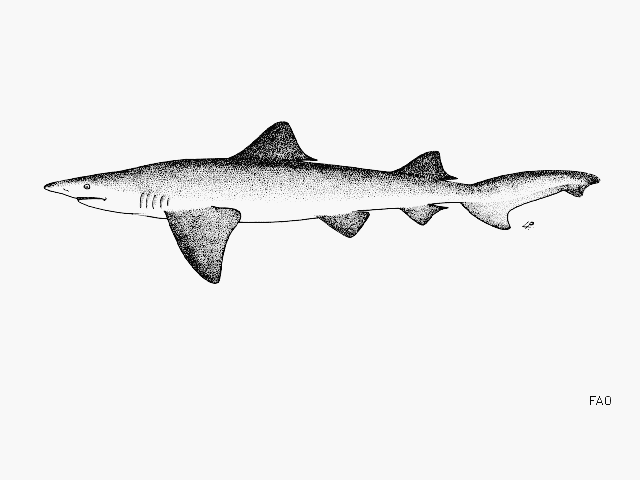
Broadfin Shark
Lamiopsis temminckii
The broadfin shark (Lamiopsis temminckii) is a tropical whaler shark, characterized by the broad shape of its pectoral fins. They are classified as requiem sharks of the family Carcharhinidae. This is one of two species in the genus Lamiopsis, the other being the Borneo broadfin shark (Lamiopsis tephrodes). The broadfin shark is native to the northern Indian Ocean, and is found close to shore. Its current status according to the IUCN is endangered.
From the article Broadfin shark on Wikipedia (CC BY-SA), quoted section by section
Description
Females and males of the broadfin shark species are sexually dimorphic. Females, on average, are larger than males, and it is reported that males mature at a smaller size than females. The reported size of females has decreased when compared with previous recordings of the species, with the new maximum size of females being around 175 cm (69 in), while the reported size of males has increased. Another way to tell males and females apart is by looking at the end of their pelvic fins, as males possess calcified claspers (external appendage that aid in reproduction) on the ends of their pelvic fins.
Range & habitat
The broadfin shark is found in both the Indian Ocean and the Pacific Ocean. Its distribution is sporadic, with sightings occurring off the coasts of Pakistan, India, Indonesia, Burma, China, and Sarawak. The species tends to spend most of its time in coastal waters, not far off the coast and within the continental shelf. Females and males are evenly distributed throughout their habitat range.
Wikipedia: “Distribution and habitat”
What it does
Lamiopsis temminckii is a placental viviparous species. This means that young have an umbilical scar left over at birth. Females of this species average two to four embryos per uterus at a time, and the typical amount of embryos total in a litter averages to be around eight at a time. Late term embryos are common in the summer (April–August), and births are estimated to occur most often during the pre southwest monsoon season and southwest monsoon season from March to September. At birth, the broadfin shark ranges in size from 41.8–65.0 cm (16.5–25.6 in). The shark has a low productivity rate, and therefore, a limited rebound potential.
Wikipedia: “Reproduction”
In human culture
The shark is named in honor of Coenraad Jacob Temminck, the director of the Rijksmuseum van Natuurlijke Historie in Leiden, Netherlands.
Wikipedia: “Etymology”
Where it lives
Recorded sightings
—
geo-referenced records in GBIF, from museums, herbaria and field observers.
Drag the globe to turn it. Dots are where records exist, not a range map; darker means more records.
In the stacks
Searching the stacks…
Every page naming Lamiopsis temminckii in the Biodiversity Heritage Library →
This page is assembled live from iNaturalist, GBIF, Wikipedia, the Source Library and the Internet Archive. It is not yet part of the hand-edited codex. iNaturalist taxon 143665.