On eBird ↗
Pin-tailed Manakin
Live sightings near you, the range map, bar charts of when it is seen, and Macaulay Library photos and recordings.
Pin-tailed Manakin
Ilicura militaris
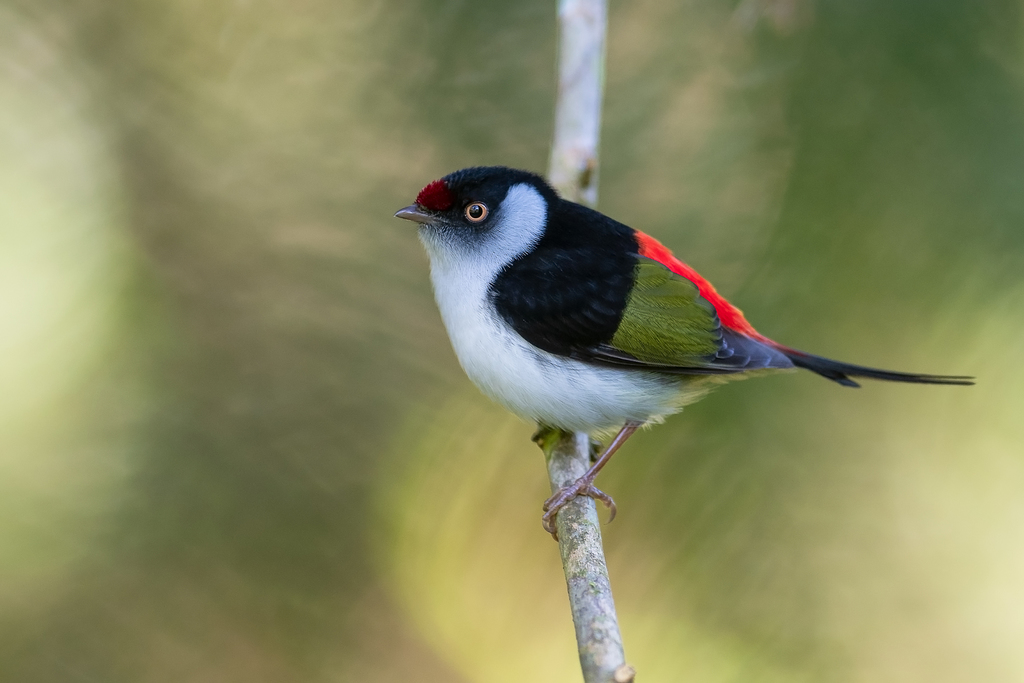
The pin-tailed manakin (Ilicura militaris) is a suboscine species of bird within the manakin family, Pipridae. This species is endemic to the Eastern coast of Brazil within the humid Atlantic Forest, and its range extends from the State of Bahia to the State of Rio Grande Do Sul. The pin-tailed manakin is monotypic within the genus Ilicura, and has no known subspecies. It is a relatively small species that has pronounced sexual dimorphism. Male birds of this species have a bright white neck, chest, auriculars, and flanks. They have black and dark-green wings, with a signature pin shape tail that has a small fork near the tip, helping to give it its common name in English. The males are most easily identified by their characteristically vibrant red fore-crown and rump. The females of this species are a muted green, except for their neck and auriculars—which are light grey, and their cream-colored chest. Both male and female birds of this species share a slightly elongated head shape that gives them a distinguished raised forehead. The pin-tailed manakin's vocalizations are quiet, but resemble a high-pitched "see-see-see" in descending tones.
There has been very little research conducted on this species of manakin, and it especially lacks information on its ecology and breeding habits. The pin-tailed manakin is a primary frugivore, but it has been recorded consuming small amounts of insects on occasion.
From the article Pin-tailed manakin on Wikipedia (CC BY-SA), quoted section by section
Description
Males measure 12.5 cm (4.9 in), while the females measure 11 cm (4.3 in) from tail to beak at full maturity. There is clear sexual dimorphism between mature adults of this species, but can be nearly impossible to identify the sex for certain if they do not have the adult male colorations, as both juvenile males and females resemble each other. All pin-tailed manakins share some common traits: a forking tail at the very end of their rectrices, a slightly elongated forehead, brownish black legs, and bright yellow-orange irises. Adult male pin-tailed manakins have a slightly longer tail, with a very uniquely pigmented red fore-crown and rump, black wings with green secondaries, and a white chest that extends from their under-tail coverts all the way to their auriculars. Females are an olive-green color everywhere except for their grey neck and auriculars, and their crème colored chest extending to its under-tail coverts
Vocalizations. Vocalizations from this bird are often very quiet, but high-pitched. Their songs sound like "see-see-see" in descending tones, with an average anywhere from 3-8 "see" sounds. Many local birdwatchers are fond of this bird, despite it not being particularly rare, because it is difficult to track in the forest through its songs.
Range & habitat
The pin-tailed manakin is endemic to Brazil, specifically inhabiting the Atlantic Forest range from the State of Bahia to the State of Rio Grande Do Sul. Its natural habitats are subtropical or tropical moist lowland forests and subtropical or tropical moist montane forests. They are not very commonly spotted within their range, but spend their time within the lower and middle strata of the rainforests. Their nests are built very similar to a cup, and holds a clutch of 2 to 3 eggs. Their distribution has not been studied in depth, and as a result there is not a firm grasp of where their populations may inhabit. Three pin-tailed manakins have been collected by the Museu Nacional in Rio de Janeiro that has their location of collection tagged as Nova Veneza, which is more inland and Northern than previously recorded, providing evidence for a possible extension of their range.
Wikipedia: “Distribution and habitat”
What it does
They feed mostly on small berries, but have been documented eating a few small insects as well. Like most manakins in the family Pipridae, they swallow their food whole. Most feeding observations of this bird have been located on the edges of forests, eating off of small fruit trees and shrubs. The fruits that it has been recorded eating most commonly are of the yellow magnolia (michelia champaca) and the ripe fruits of the chickweed plant (struthanthus polyrhysus). Food is plucked from the air in diving and snatching motions—they do not typically spend time on the plant picking berries to eat.
Wikipedia: “Feeding”
Listen
Looking for field recordings…
Where it lives
Recorded sightings
—
geo-referenced records in GBIF, from museums, herbaria and field observers.
Drag the globe to turn it. Dots are where records exist, not a range map; darker means more records.
In the stacks
Searching the stacks…
Every page naming Ilicura militaris in the Biodiversity Heritage Library →
This page is assembled live from iNaturalist, GBIF, Wikipedia, the Source Library and the Internet Archive. It is not yet part of the hand-edited codex. iNaturalist taxon 14372.