On eBird ↗
African Pitta
Live sightings near you, the range map, bar charts of when it is seen, and Macaulay Library photos and recordings.
African Pitta
Pitta angolensis
The African pitta (Pitta angolensis) is an Afrotropical bird of the family Pittidae. It is a locally common to uncommon species, resident and migratory in the west, and an intra-African migrant between equatorial and southeastern Africa. They are elusive and hard to observe despite their brightly coloured plumage, and their loud, explosive calls are infrequently heard. The plump, somewhat thrush-like birds forage on leaf litter under the canopy of riparian or coastal forest and thickets, or in climax miombo forest. They spend much time during mornings and at dusk scratching in leaf litter or around termitaria, or may stand motionless for long periods. Following rains breeding birds call and display from the mid-canopy.
From the article African pitta on Wikipedia (CC BY-SA), quoted section by section
Description
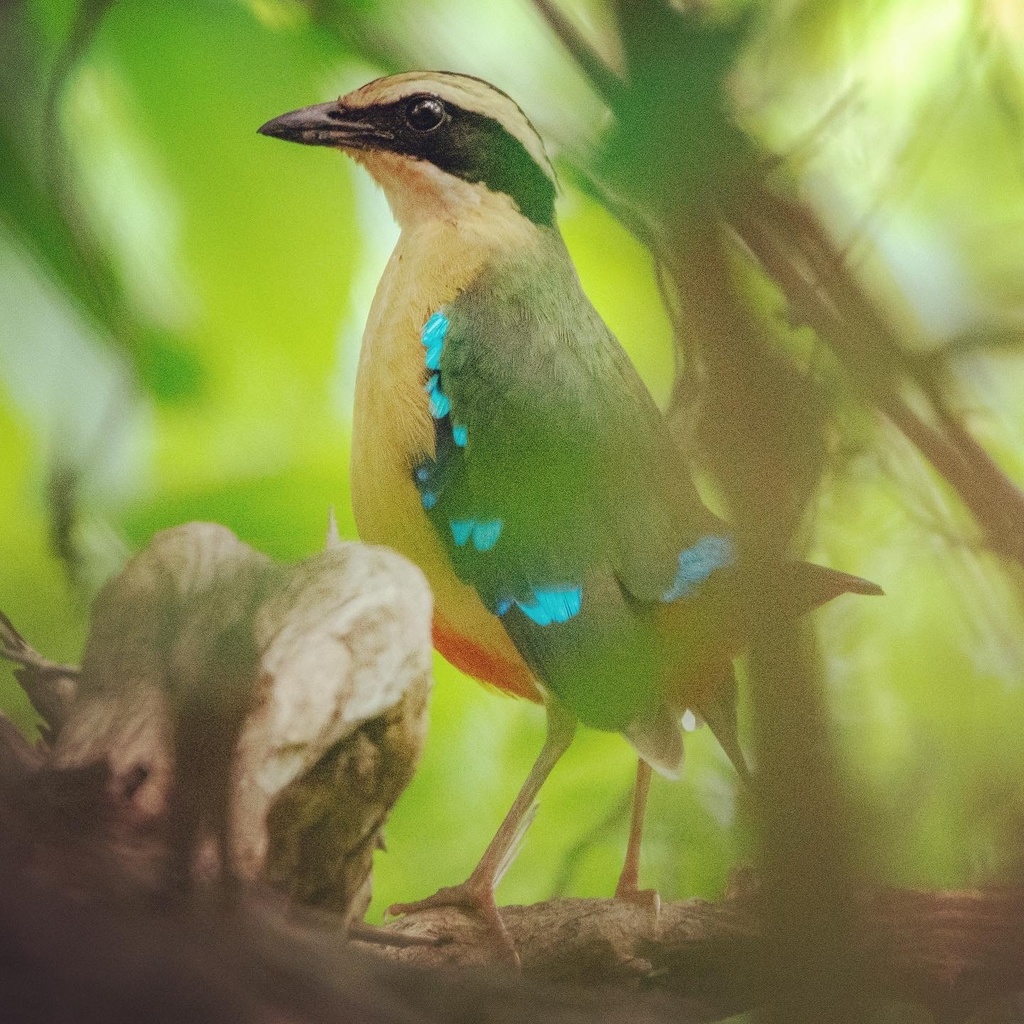
The sexes are alike. The crown, face, and ear coverts are solid black, and the throat is pale salmon pink. The broad eyebrow is buff to brownish buff. The flanks, breast, and side of the neck are a mustard yellow, washed olive on the upper breast. Some western birds have the breast very greenish. The wing coverts are deep green and tipped turquoise blue, or black and tipped turquoise and royal blue. The mantle and back are green, and the rump and upper tail coverts pale turquoise blue. The wings are rounded, and the primaries are black with pale and white tips. The bases of the central primaries form a white square, conspicuous in flight or display. The belly and undertail coverts are crimson red, and the legs are pink. Immature birds have a duller plumage with a buffy-pink vent and fawn-coloured throat.
Range & habitat
The African pitta is a migratory species to southeastern Africa and the Congo Basin. Its breeding habitat in southeastern Africa is deciduous, lowland riparian forest or thicket with intermittent dense understorey and small sub-canopy glades. On migration however, they may sojourn at any areas of bush or woodland. Fallen dead trees and open branches are favoured perches when performing their peculiar bouncing display. They are more numerous in undisturbed vegetation, and the opening up of the riparian woodland by elephants may reduce their habitat.
Migration. The race P. a. longipennis spends the austral winter in the western Ugandan forests as far north as Budongo, and coastal Kenya as far north as Gedi ruins. A bird found at Minziro Forest in northwestern Tanzania was in heavy moult, suggestive that the area is on the southeastern fringe of the non-breeding range. They arrive in southern Africa from late October, though mainly in November and early December. They seldom breed north of the Rukwa Valley and Rufiji River in Tanzania, and no further south than central Mozambique. They depart again in February, though occasionally as late as April. Ringing studies in the Pugu hills and Mufindi have confirmed the timing of northwestward migration. Exhausted and perished birds are regularly found during migration, especially November to December and April to June. …
Wikipedia: “Distribution and habitat”
Listen
Looking for field recordings…
Where it lives
Recorded sightings
—
geo-referenced records in GBIF, from museums, herbaria and field observers.
Drag the globe to turn it. Dots are where records exist, not a range map; darker means more records.
In the stacks
Searching the stacks…
Every page naming Pitta angolensis in the Biodiversity Heritage Library →
This page is assembled live from iNaturalist, GBIF, Wikipedia, the Source Library and the Internet Archive. It is not yet part of the hand-edited codex. iNaturalist taxon 14384.