On eBird ↗
Western Hooded Pitta
Live sightings near you, the range map, bar charts of when it is seen, and Macaulay Library photos and recordings.
Western Hooded Pitta
Pitta sordida
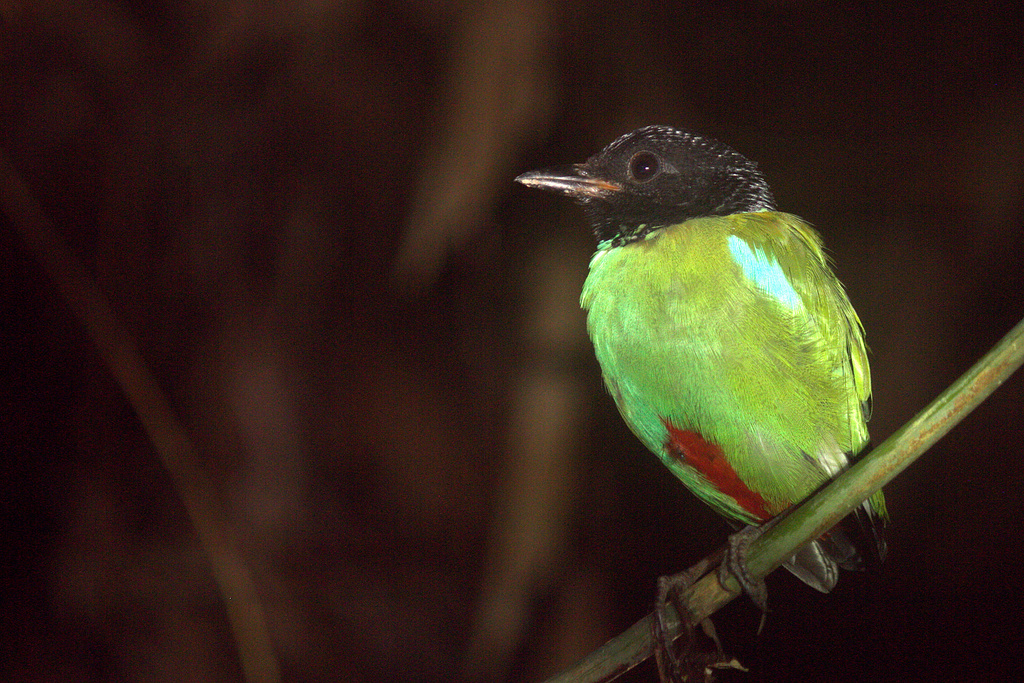
The western hooded pitta (Pitta sordida) is a passerine bird in the family Pittidae. It is common in eastern and southeastern Asia and maritime Southeast Asia, where it lives in several types of forests as well as on plantations and other cultivated areas. It is a green bird with a black head and chestnut crown. It forages on the ground for insects and their larvae, and also eats berries. It breeds between February and August, the pair being strongly territorial and building their nest on the ground. Incubation and care of the fledglings is done by both parents. The bird has a wide range, and the International Union for Conservation of Nature has assessed its conservation status as being of "least concern". It was formerly considered to be conspecific with the Nicobar hooded pitta, the Minahasa hooded pitta, the eastern hooded pitta and the Biak hooded pitta.
From the article Western hooded pitta on Wikipedia (CC BY-SA), quoted section by section
What it does
Western hooded pittas can reach a length of 16 to 19 cm (6.3 to 7.5 in) and a weight of 42 to 70 g (1.5 to 2.5 oz). It has a black head, chestnut crown and green body and wings. Its diet consists of various insects (including their larvae), which they hunt on the ground, and berries. In the breeding period, which lasts from February to August, they build nests on the ground; both parent take care of the eggs and the fledglings. They are highly territorial and their fluty double-noted whistle calls ("qweeek-qweeek") can be constantly heard from their territories, sometimes throughout the nights. The International Union for Conservation of Nature is concerned in particular about the ongoing loss of habitat that this bird suffers, which is reducing its numbers, but has rated it as being a "least concern species" because the rate of population decline is insufficient to warrant a threatened category.
Wikipedia: “Behaviour”
Listen
Looking for field recordings…
Where it lives
Recorded sightings
—
geo-referenced records in GBIF, from museums, herbaria and field observers.
Drag the globe to turn it. Dots are where records exist, not a range map; darker means more records.
In the stacks
Searching the stacks…
Every page naming Pitta sordida in the Biodiversity Heritage Library →
This page is assembled live from iNaturalist, GBIF, Wikipedia, the Source Library and the Internet Archive. It is not yet part of the hand-edited codex. iNaturalist taxon 14389.