On eBird ↗
Akun Eagle-Owl
Live sightings near you, the range map, bar charts of when it is seen, and Macaulay Library photos and recordings.
Akun Eagle-Owl
Ketupa leucosticta
The akun eagle-owl (Ketupa leucosticta) is a species of owl in the family Strigidae and is native to the African tropical rainforest.
From the article Akun eagle-owl on Wikipedia (CC BY-SA), quoted section by section
Description
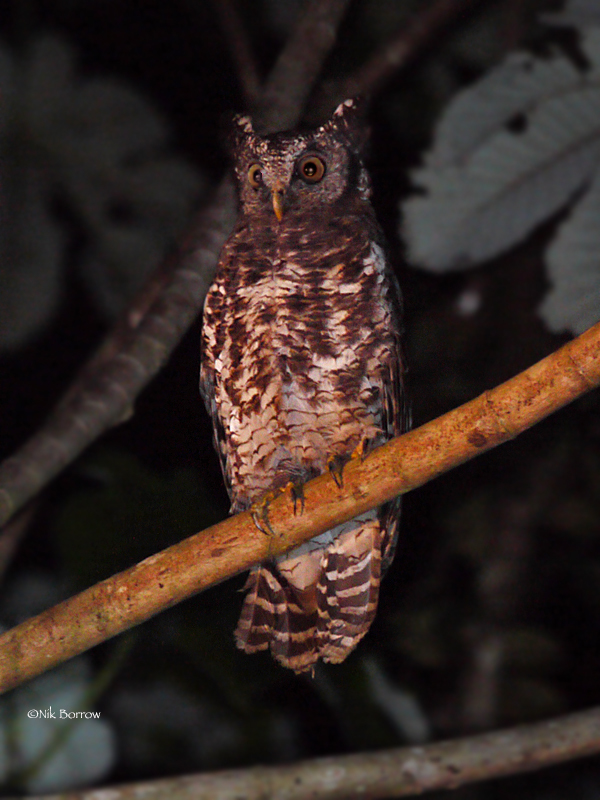
The akun eagle-owl is one of the smaller eagle-owls, with 40–46 cm length; and body weight of 486–536 g for males and 524–607 g for females. It has predominantly dark to reddish-brown head and upperparts, with pale, dusky brown bars on the wings and back, and white markings around the shoulders. There are two large "ear" tufts on the head which are dark brown accompanied with white spots, while the eyes are pale yellow. The upper breast is light reddish-brown and marked with dark bars, while the lower breast, belly and vent are white, with reddish-brown vermiculations and large blackish spots. Juveniles have a whitish head and body, with reddish-brown barring and brown wings and tail. The usual call is a low, accelerating, clucking rattle and when alarmed it produces an unusual quacking sound.
Range & habitat
The akun eagle-owl has a patchy range that extends through a number of the west African countries which have coastlines on the Gulf of Guinea, from Guinea east to Cameroon and south to Angola, extending inland into the southern Central African Republic, Congo and northern parts of the Democratic Republic of Congo. The Akun eagle-owl is found mainly in lowland primary and secondary rainforest, particularly around forest edges and clearings, and also along the edges of rivers and on forested river islands.
Wikipedia: “Distribution and habitat”
What it does
Like most owls the akun eagle-owl is a nocturnal species emerging from its daytime roost at dusk to hunt. It's unusual for an eagle owl in that it apparently feeds almost exclusively on insects, its small feet and a relatively weak bill prevent it from tackling larger prey. Its main prey are beetles, cicadas and locusts, which are either gleaned from foliage or taken in flight before being brought back to a perch, held in the feet and ripped into small pieces with the bill. Little is known regarding the breeding biology of the Akun eagle-owl. In west Africa it appears to lay eggs around the period from November to January, and young owlets have been recorded in the nest in Liberia between February and April. As in some other eagle-owls, the Akun eagle-owl builds its nest on the ground.
== References ==
Wikipedia: “Behaviour and ecology”
Listen
Looking for field recordings…
Where it lives
Recorded sightings
—
geo-referenced records in GBIF, from museums, herbaria and field observers.
Drag the globe to turn it. Dots are where records exist, not a range map; darker means more records.
In the stacks
Searching the stacks…
Every page naming Ketupa leucosticta in the Biodiversity Heritage Library →
This page is assembled live from iNaturalist, GBIF, Wikipedia, the Source Library and the Internet Archive. It is not yet part of the hand-edited codex. iNaturalist taxon 1441744.