On eBird ↗
Philippine Eagle-Owl
Live sightings near you, the range map, bar charts of when it is seen, and Macaulay Library photos and recordings.
Philippine Eagle-Owl
Ketupa philippensis
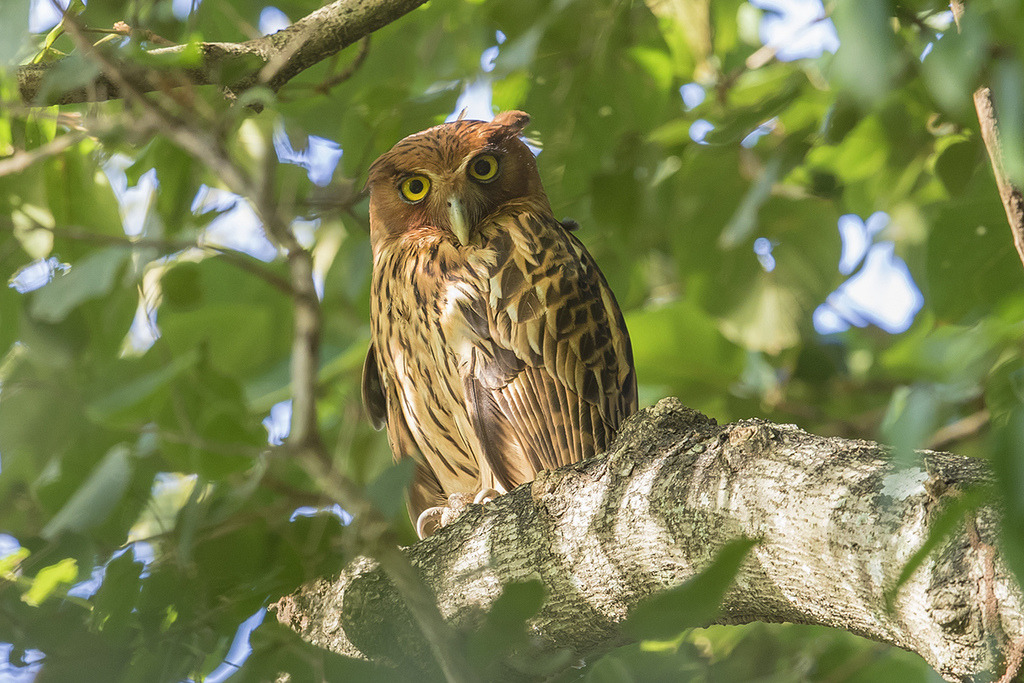
The Philippine eagle-owl (Ketupa philippensis) is a vulnerable species of owl belonging to the family Strigidae. It is endemic to the Philippines, where it is found in lowland forests on the islands of Catanduanes, Samar, Bohol, Mindanao, Luzon, Leyte and possibly Sibuyan. While it is the largest owl in the Philippines, it is relatively small compared to other members of its genus. It is a vulnerable species with its population on the decline. Its main threats are habitat destruction, hunting and poaching for the pet trade.
From the article Philippine eagle-owl on Wikipedia (CC BY-SA), quoted section by section
Description
The Philippine eagle-owl has a total wingspan of about 48 inches, and with a total length of 40–50 cm (15.5–19.5 in) and a wing-length of about 35 cm (14 in), (where typically a female would size larger than a male) it is the largest owl in the Philippines, but among the smallest members of the genus Ketupa. It is overall rufous with a lighter belly and yellow eyes. It has a warm brown coloring with many markings on its back, with a bird call pitch of a long whistle that rises shortly and falls at the end. It is also described as being incredibly bulky and having tufted ears, closely resembling the buffy fish-owl (Ketupa ketupu). The subspecies K. p. mindanensis is darker and more heavily streaked than the nominate form.
Range & habitat
This owl inhabits forest edges near streams. They rest in a tree during the day and hunt at dusk to feed on small vertebrates. The Philippine eagle-owl is the largest owl in the country.
Wikipedia: “Habitat”
What it does
Little is known about the behavior of this secretive species, but the powerful feet suggest it feeds on small mammals and birds. This eagle-owl lays one egg per clutch and has an incubation period of 35 days.
Breeding in captivity. In December 2005, Negros Forests and Ecological Foundation (NFEFI) in Bacolod was the first conservation center in the world to successfully hatch a Philippine eagle-owl (aptly nicknamed Bubo) in captivity and it has the only breeding pair of these owls in captivity anywhere in the world. On November 21, 2005, conservationists at the center made world history when it successfully bred a Philippine eagle-owl in captivity. Notably NFEFI had first secured the first-ever captive breeding loan between DENR-accredited institutions in the Philippines, consisting of three pairs of eagle-owls from the Avilon Montalban Zoological Park in Montalban, Rizal and transported them to Bacolod in December 2002. Two pairs showed attraction, and the couple Hinahon and Suplada—local terms for "calm" and "snob"—made courtship. It was on November 21, 2005, that an owlet was discovered in the nest, about three days old, and named Bubo. …
Wikipedia: “Behavior”
Listen
Looking for field recordings…
Where it lives
Recorded sightings
—
geo-referenced records in GBIF, from museums, herbaria and field observers.
Drag the globe to turn it. Dots are where records exist, not a range map; darker means more records.
In the stacks
Searching the stacks…
Every page naming Ketupa philippensis in the Biodiversity Heritage Library →
This page is assembled live from iNaturalist, GBIF, Wikipedia, the Source Library and the Internet Archive. It is not yet part of the hand-edited codex. iNaturalist taxon 1441892.