On eBird ↗
Stejneger's Scoter
Live sightings near you, the range map, bar charts of when it is seen, and Macaulay Library photos and recordings.
Stejneger's Scoter
Melanitta stejnegeri
The white-winged scoter (Melanitta deglandi) is a large sea duck. The genus name is derived from Ancient Greek melas "black" and netta "duck". The species name commemorates French ornithologist Côme Damien Degland.
From the article White-winged scoter on Wikipedia (CC BY-SA), quoted section by section
Description
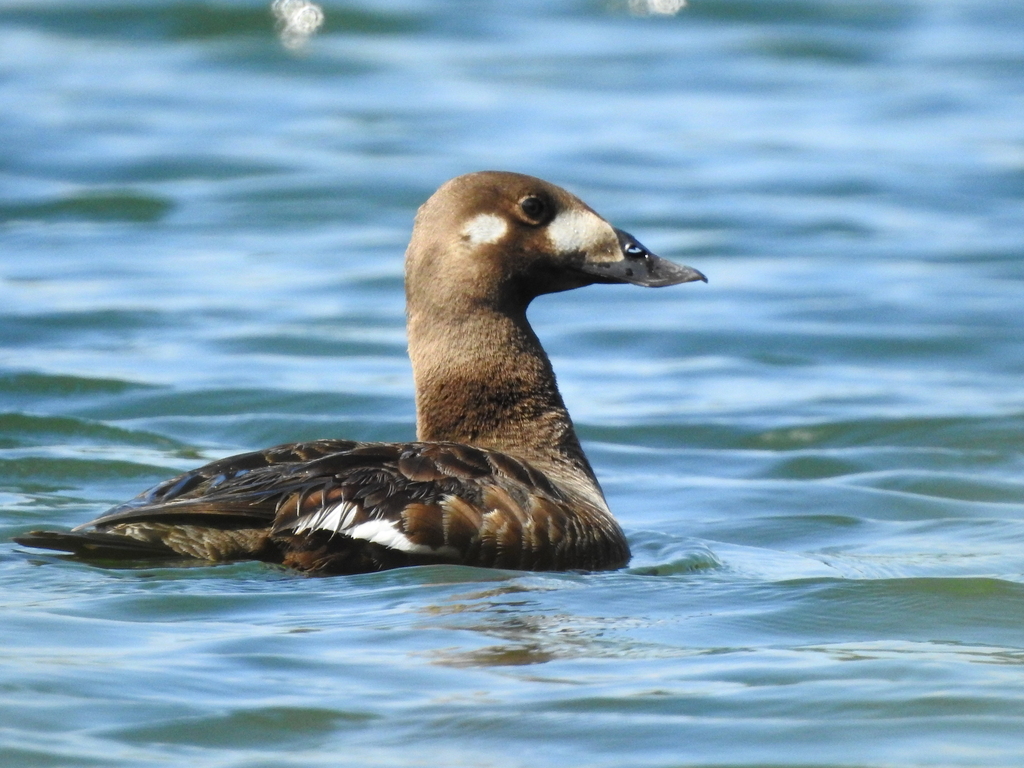
The white-winged scoter is one of three North American scoter species and the largest species of scoter. Females range from 950 to 1,950 g (2.09 to 4.30 lb) and 48 to 56 cm (19 to 22 in), averaging 1,180 g (2.60 lb) and 52.3 cm (20.6 in). The male ranges from 1,360 to 2,128 g (2.998 to 4.691 lb) and from 53 to 60 cm (21 to 24 in), averaging 1,380 g (3.04 lb) and 55 cm (22 in). The white-winged scoter has a wingspan of 31.5 in (80 cm). This species is characterized by its bulky shape and large bill, which is feathered at the gape unlike the blocky bill base of the surf scoter. The white secondary flight feathers by which the species is named is visible in flight, but may be concealed when swimming. The male is all black, except for white around the eye and a white speculum. The bill is orange and red with a large black knob at the base. It takes three years for definitive (adult) plumage to be attained – second-year males resemble adult males but exhibit reduced eye markings and have browner flanks. Females are brownish overall and best distinguished from other scoters by the feathered gape and body shape. The facial pattern in female-type birds is highly variable – younger individuals have conspicuous white spots in front and behind the eye, while adults may lack these patches and appear entirely chocolate brown in winter. …
Range & habitat
White-winged Scoters have the largest breeding range among North American scoters. They mainly breed in boreal forest from Alaska to Western Canada and are less common east towards the Hudson Bay and south towards the Canadian Prairies. It winters further south in temperate zones, on the Great Lakes, the coasts of the northern United States and the southern coasts of Canada. It forms large flocks on suitable coastal waters. These are tightly packed, and the birds tend to take off together. It has occurred as a vagrant in Europe, including Scotland, Iceland, Norway and Ireland,
Wikipedia: “Distribution”
What it does
White-winged scoters are benthic feeders and forage in open water diving between 5 and 20 m in wintering grounds and 1 and 3 m on breeding grounds. Their large size enables them to find larger prey and dive deeper than Surf or Black Scoters. In freshwater, this species primarily feeds on crustaceans and insects; while in saltwater areas, it feeds on molluscs and crustaceans. Their gizzards, which forms 8% of their body mass, are capable of crushing hard-shelled molluscs. The favorite foods are an amphipod (Hyalella azteca) in freshwater, and rock clams (Protothaca staminea), Atlantic razor clams (Siliqua spp.), and Arctic wedge clams (Mesodesma arctatum).
Wikipedia: “Diet”
Listen
Looking for field recordings…
Where it lives
Recorded sightings
—
geo-referenced records in GBIF, from museums, herbaria and field observers.
Drag the globe to turn it. Dots are where records exist, not a range map; darker means more records.
In the stacks
Searching the stacks…
Every page naming Melanitta stejnegeri in the Biodiversity Heritage Library →
This page is assembled live from iNaturalist, GBIF, Wikipedia, the Source Library and the Internet Archive. It is not yet part of the hand-edited codex. iNaturalist taxon 144233.