On eBird ↗
Xingu Scale-backed Antbird
Live sightings near you, the range map, bar charts of when it is seen, and Macaulay Library photos and recordings.
Xingu Scale-backed Antbird
Willisornis vidua
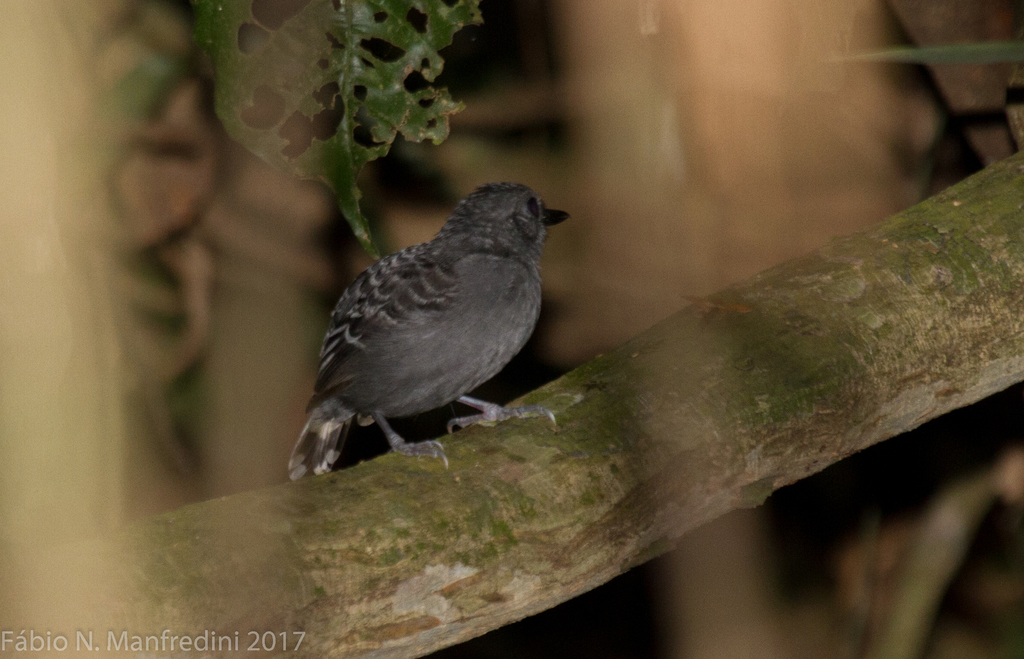
The Xingu antbird (Willisornis vidua), also known as the Xingu scale-backed antbird, is a species of antbird from the south-eastern Amazon in Brazil. Until 2011, it was usually included as a subspecies of the scale-backed antbird. Its English name refers to the Xingu River. In addition to the nominate subspecies, it includes the subspecies W. v. nigrigula.
From the article Xingu scale-backed antbird on Wikipedia (CC BY-SA), quoted section by section
Description
The Xingu scale-backed antbird is 12 to 13 cm (4.7 to 5.1 in) long and weighs 14 to 19.5 g (0.49 to 0.69 oz). Adult males of the nominate subspecies are mostly gray; their upperparts are darker than their underparts. They have a white patch between the scapulars. Their lower back has white-edged black patches that give it its English name. Their wings and tail are black with white edges and tips on many feathers. Adult females have a warm brown crown and a gray face. Their upperparts are warm brown and their underparts are gray. Their throat is white. Both sexes have a grayish iris, a black bill, and pale gray legs and feet. Males of subspecies W. v. nigrigula have a black throat and slightly darker upperparts than the nominate. Females of nigrigula have a larger white patch between the scapulars than the nominate but are otherwise identical.
Range & habitat
The Xingu scale-backed antbird is found in south-central and eastern Amazonian Brazil south of the Amazon River. The nominate subspecies occurs between the Rio Xingu and western Maranhão state and south into northern Tocantins state. Subspecies W. v. nigrigula occurs further west, between the rios Tapajós and Xingu and south into northern Mato Grosso state. The species primarily inhabits the understorey of humid terra firme evergreen forest and also occurs in várzea forest. In elevation it ranges from sea level to 800 m (2,600 ft).
Wikipedia: “Distribution and habitat”
What it does
The Xingu scale-backed antbird feeds mostly on a wide variety of arthropods. It typically forages individually, in pairs, and in family groups, usually within about 1 m (3 ft) of the ground though sometimes as high as 3 m (10 ft) and rarely to 5 m (16 ft). It follows swarms of army ants that pass through its territory to capture prey fleeing the ants, but it just as often forages away from ant swarms. It captures prey mostly by short sallies from a perch to the ground but also to foliage, branches, and vines. It sometimes stays on the ground probing and flicking leaf litter.
Wikipedia: “Feeding”
Listen
Looking for field recordings…
Where it lives
Recorded sightings
—
geo-referenced records in GBIF, from museums, herbaria and field observers.
Drag the globe to turn it. Dots are where records exist, not a range map; darker means more records.
In the stacks
Searching the stacks…
Every page naming Willisornis vidua in the Biodiversity Heritage Library →
This page is assembled live from iNaturalist, GBIF, Wikipedia, the Source Library and the Internet Archive. It is not yet part of the hand-edited codex. iNaturalist taxon 144251.