On eBird ↗
Great Skua
Live sightings near you, the range map, bar charts of when it is seen, and Macaulay Library photos and recordings.
Great Skua
Stercorarius skua
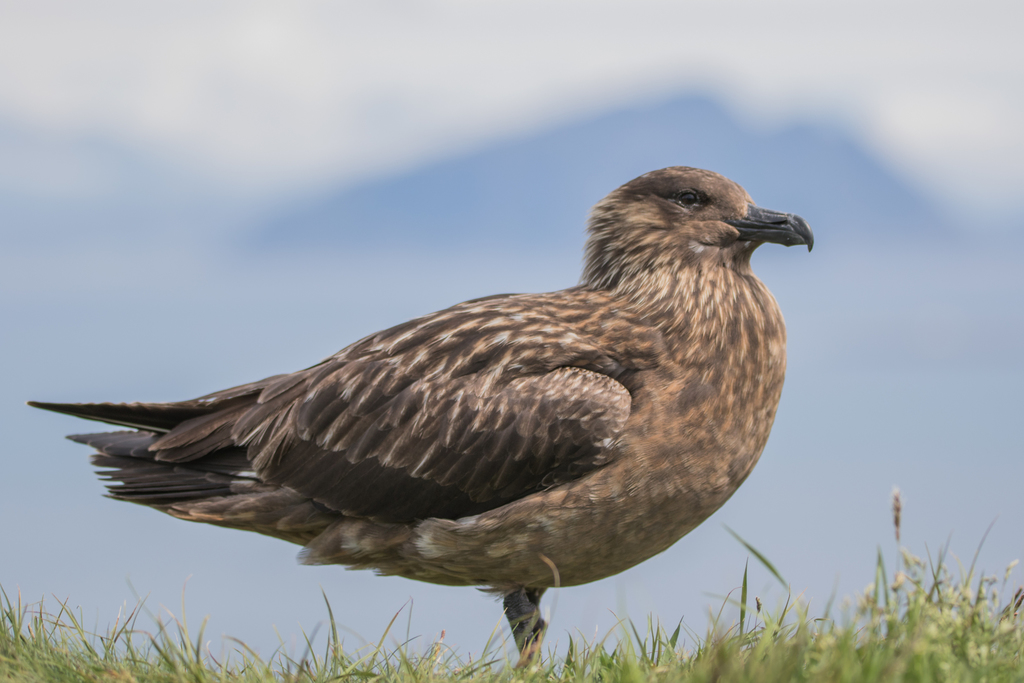
The great skua (Stercorarius skua) is a large seabird in the skua family Stercorariidae. The English name and species name "skua" is believed to originate from the Faroese skúvur or skúgvur and is the only known bird name to originate from the Faroes that has come into regular use elsewhere. In Britain, it is sometimes known by the name bonxie, a Shetland name of Norse origin. The genus name Stercorarius is Latin and means "of dung";
From the article Great skua on Wikipedia (CC BY-SA), quoted section by section
Description
Great skuas measure 50–58 cm (20–23 in) long and have a 125–140 cm (49–55 in) wingspan. One study found that 112 males weighed an average of 1.27 kg (2 lb 13 oz) and that 125 females weighed an average of 1.41 kg (3 lb 2 oz). Adults are a streaked greyish brown, with a black cap, while juveniles are a warmer brown and unstreaked below. They have a short, blunt tail, and a powerful flight. The great skua's call is a harsh hah-hah-hah-hah; quacking and croaking noises have also been heard. Distinguishing this skua from the other North Atlantic skuas (parasitic jaeger, pomarine jaeger and long-tailed jaeger) is relatively straightforward. The herring gull size, massive barrel chest and white wing flashes of this bird are distinctive even at a distance. It is sometimes said to give the impression of a common buzzard. Identification of this skua is only complicated when it is necessary to distinguish it from the closely related large southern-hemisphere skuas. Despite its name, the great skua is marginally smaller on average than the other 3 large southern-hemisphere skuas, although not by enough to distinguish them by size in the field. Some authorities still regard the great skua as conspecific with some of these southern skuas, and as a group they have sometimes been separated in the genus Catharacta, although currently this taxonomy is not commonly followed.
What it does
It eats mainly fish, other seabirds, their eggs, carrion and occasionally berries and small mammals, particularly young rabbits. It has been known to prey on lambs, and even pony foals. Probably its most prolific food source is by-catch abandoned by fishing vessels.
It will often obtain fish by robbing gulls, terns and even northern gannets of their catches. It will also directly attack and kill other seabirds, up to the size of herring gulls. Like most other skua species, it continues this piratical behaviour throughout the year, showing less agility and more brute force than the smaller skuas when it harasses its victims. A common technique is to fly up to a gannet in mid-air and grab it by the wing, so that it stalls and falls into the sea, where the great skua then physically attacks it until it surrenders its catch. Due to its size, aggressive nature and fierce defence of its nest, the great skua has little to fear from other predators. While fledglings can fall prey to rats, cats or the Arctic fox, healthy adults are threatened only by greater raptors such as the golden eagle, the white-tailed eagle, and more rarely, at sea by the orca.
Wikipedia: “Diet”
Listen
Looking for field recordings…
Where it lives
Recorded sightings
—
geo-referenced records in GBIF, from museums, herbaria and field observers.
Drag the globe to turn it. Dots are where records exist, not a range map; darker means more records.
In the old herbals & bestiaries

In the stacks
Searching the stacks…
Every page naming Stercorarius skua in the Biodiversity Heritage Library →
This page is assembled live from iNaturalist, GBIF, Wikipedia, the Source Library and the Internet Archive. It is not yet part of the hand-edited codex. iNaturalist taxon 144297.