On eBird ↗
Beach Thick-knee
Live sightings near you, the range map, bar charts of when it is seen, and Macaulay Library photos and recordings.
Beach Stone-curlew
Esacus magnirostris
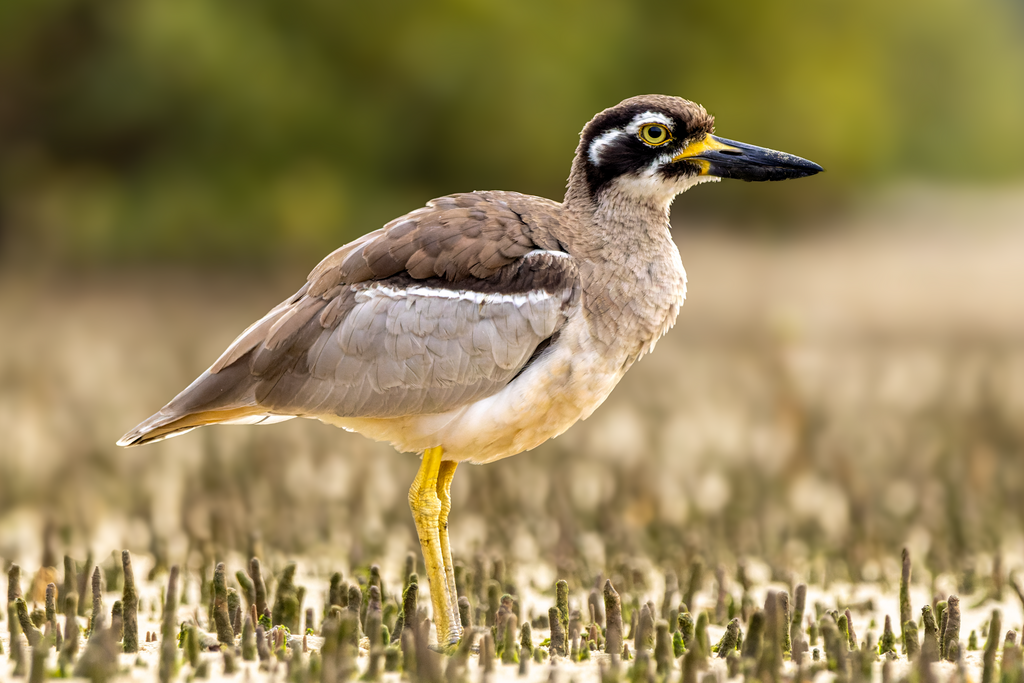
The beach stone-curlew (Esacus magnirostris) or beach thick-knee is a large, ground-dwelling bird that occurs in Australasia, the islands of South-east Asia. At 55 cm (22 in) and 1 kg (2.2 lb), it is one of the world's largest shorebirds.
It is less strictly nocturnal than most stone-curlews, and can sometimes be seen foraging by daylight, moving slowly and deliberately, with occasional short runs. It tends to be wary and fly off into the distance ahead of the observer, employing slow, rather stiff wingbeats..
From the article Beach stone-curlew on Wikipedia (CC BY-SA), quoted section by section
Description
The beach stone-curlew is 54-56 cm (21-22 in) long. At a mean of 1,032 g (2.275 lb) in males and 1,000 g (2.2 lb) in females, it is the heaviest living member of the Charadriiformes outside of the gull and skua families. They have black and white face patterning, yellow eyes and a grey-brown upper body.
Range & habitat
The beach stone-curlew is a resident of undisturbed open beaches, exposed reefs, mangroves, and tidal sand or mudflats over a large range, including coastal eastern Australia as far south as far eastern Victoria, the northern Australian coast and nearby islands, New Guinea, New Caledonia, Indonesia, Malaysia, and the Philippines. It is uncommon over most of its range, and rare south of Cairns.
Wikipedia: “Distribution”
What it does
Beach stone-curlew forage on low tide muddy sand for invertebrates, mostly crabs.
Breeding. The breeding season spans from September to November. Birds form a nest in sand, laying one egg per season just above the high tide line on the open beach, where it is vulnerable to predation and human disturbance. Both parents care for the young until they reach 7-12 months of age.
Call. As an alarm, the bird will make a chwip-chwip to ward creatures away from their territory.
Wikipedia: “Ecology”
Listen
Looking for field recordings…
Where it lives
Recorded sightings
—
geo-referenced records in GBIF, from museums, herbaria and field observers.
Drag the globe to turn it. Dots are where records exist, not a range map; darker means more records.
In the stacks
Searching the stacks…
Every page naming Esacus magnirostris in the Biodiversity Heritage Library →
This page is assembled live from iNaturalist, GBIF, Wikipedia, the Source Library and the Internet Archive. It is not yet part of the hand-edited codex. iNaturalist taxon 144483.