On eBird ↗
Yellow-wattled Lapwing
Live sightings near you, the range map, bar charts of when it is seen, and Macaulay Library photos and recordings.
Yellow-wattled Lapwing
Vanellus malabaricus
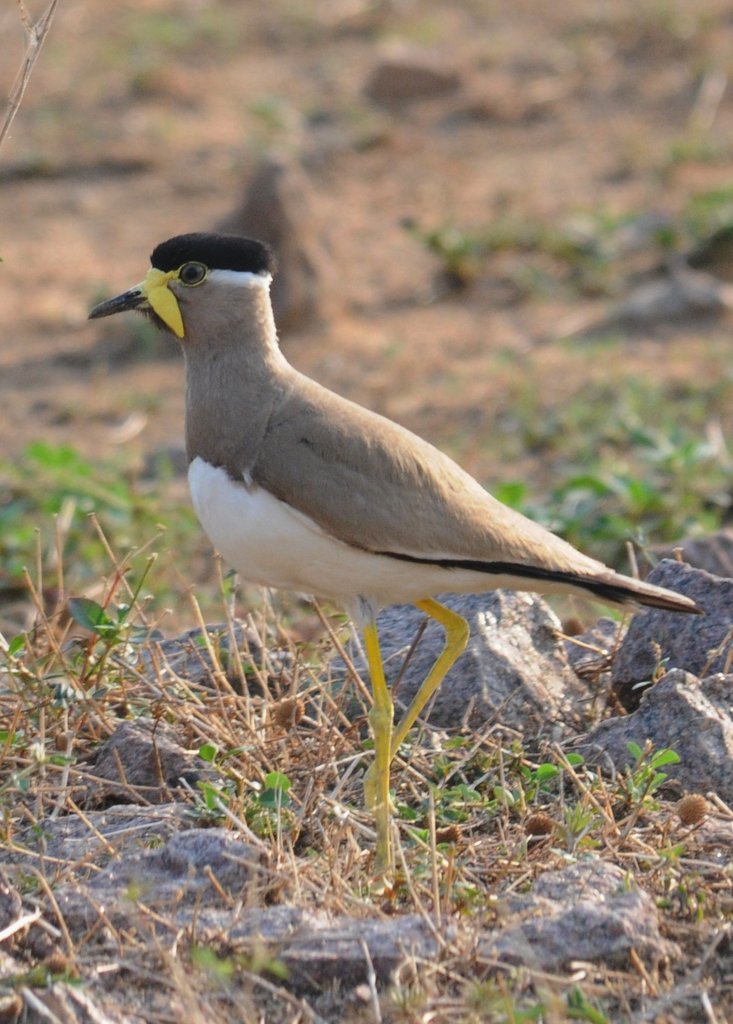
The yellow-wattled lapwing (Vanellus malabaricus) is a lapwing that is endemic to the Indian subcontinent. It is found mainly on the dry plains of peninsular India and has a sharp call and is capable of fast flight. Although they do not migrate, they are known to make seasonal movements in response to rains. They are dull grey brown with a black cap, yellow legs and a triangular wattle at the base of the beak. Like other lapwings and plovers, they are ground birds and their nest is a mere collection of tiny pebbles within which their well camouflaged eggs are laid. The chicks are nidifugous, leaving the nest shortly after hatching and following their parents to forage for food.
From the article Yellow-wattled lapwing on Wikipedia (CC BY-SA), quoted section by section
Description
These are conspicuous and unmistakable birds found in dry stony and open grassland or scrub habitats. They are medium-sized pale brown waders with a black crown which is separated from the brown on the neck by a narrow white band and large yellow facial wattles. The chin and throat are black and the brown neck and upper breast is separated from the white belly by a narrow blackish line. The tail has a subterminal black band which does not extend into the outer tail-feathers. There is a white wingbar on the inner half of the wing. The bill is yellow at the base. They have tiny yellow carpal spurs. The crown feathers can be raised slightly in displays. They are mostly sedentary but populations make long-distance movements in response to the monsoons. They are occasional visitors to the Kathmandu valley in Nepal and a vagrant was seen in Malaysia. There are no recognized subspecies, but there is a size increase from south to north. They are 260-280mm long with a wing of 192-211mm, bill 23-26mm, tarsus 57-66mm and tail 71-84mm. Juveniles have a brown crown and the sexes are alike but males have slightly longer wings and tarsi. …
Range & habitat
This species is common in much of India, being seen in a variety of open lowland habitats. It tends to be seen in drier habitats than the red-wattled lapwing, Vanellus indicus. They are found in most parts of India, parts of Pakistan, Nepal, Bangladesh and Sri Lanka. They make short-distance movements in response to rain but the exact pattern is not known.
Wikipedia: “Habitat and distribution”
What it does
These lapwings breed in the dry season with peak breeding in March to May ahead of the monsoons. The nest territory has been estimated, based on the distance to nearest neighbours, to be about 2.7 acres. They lay four eggs in a ground scrape. A nest in a clump of grass has been noted as exceptional. Parents visit water and wet their breast feathers ("belly soaking"; they may stay for as much as 10 minutes to soak water) which may then be used to cool the eggs or chicks. The four eggs typically hatch simultaneously, even though they are laid with a difference of a few days. The nidifugous young are well camouflaged as they forage with the parents. Chicks squat flat on the ground and freeze when parents emit an alarm call. A second brood may be raised, particularly when the first fails and young from a previous brood have been seen along with parent birds incubating a second clutch. Simultaneous courtship displays among several pairs in close proximity has been noted. In one study more than 60% of the nests had 4 eggs-clutches with the rest having 3 eggs. Hatching success was found to be about 27.58% and egg loss was due to predation and nest damage. The incubation period was 27–30 days. …
Wikipedia: “Behaviour and ecology”
Listen
Looking for field recordings…
Where it lives
Recorded sightings
—
geo-referenced records in GBIF, from museums, herbaria and field observers.
Drag the globe to turn it. Dots are where records exist, not a range map; darker means more records.
In the stacks
Searching the stacks…
Every page naming Vanellus malabaricus in the Biodiversity Heritage Library →
This page is assembled live from iNaturalist, GBIF, Wikipedia, the Source Library and the Internet Archive. It is not yet part of the hand-edited codex. iNaturalist taxon 144484.