- Animals
- ›Chordates
- ›Vertebrates
- ›Birds
- ›Shorebirds and Allies
- ›Gulls, Terns, and Skimmers
- ›Gulls
- ›Chroicocephalus
On eBird ↗
Bonaparte's Gull
Live sightings near you, the range map, bar charts of when it is seen, and Macaulay Library photos and recordings.
Bonaparte's Gull
Chroicocephalus philadelphia
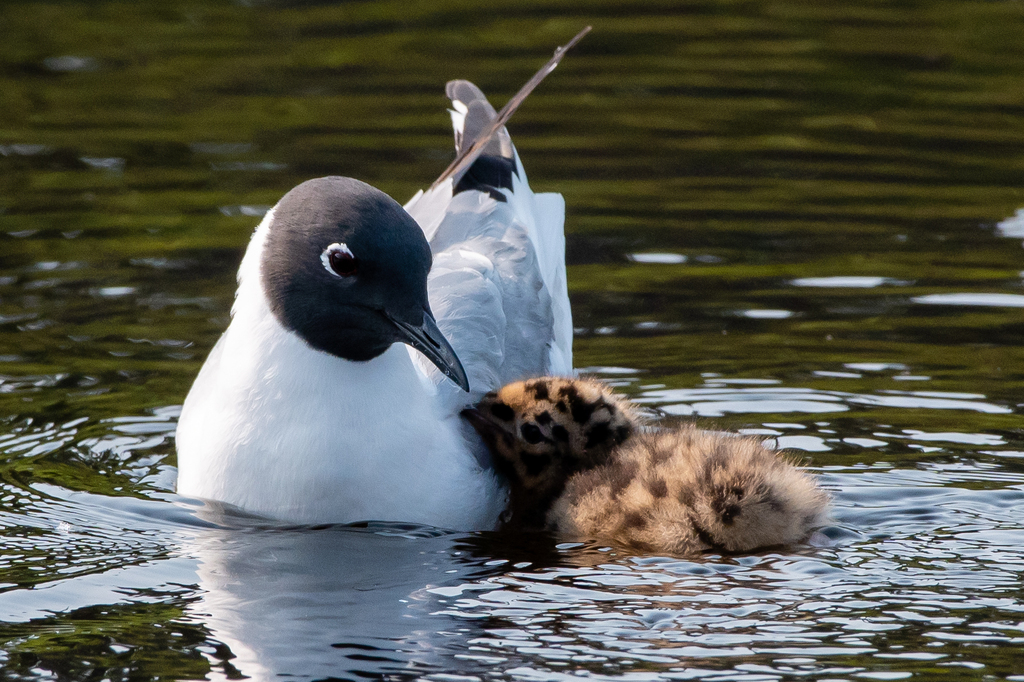
Bonaparte's gull (Chroicocephalus philadelphia) is a gull found mainly in northern North America. At 28 to 38 cm (11 to 15 in) in length, it is one of the smallest species of gull. Its plumage is mainly white with grey upperparts. During breeding season, Bonaparte's gull gains a slaty-black hood. The sexes are similar in appearance.
From the article Bonaparte's gull on Wikipedia (CC BY-SA), quoted section by section
Description
Bonaparte's gull is among the smallest of the gull species; only little gull and Saunders's gull are smaller. Adults range from 28 to 38 cm (11 to 15 in) in length, with a wingspan of 76–84 cm (30–33 in) and a weight of 180–225 g (6.3–7.9 oz). There is no difference in plumage or bare part colour between the sexes, though males tend to be heavier than females. Bonaparte's gull is smaller-bodied, smaller-headed, and smaller-billed than the other common hooded gulls of North America. The adult has grey upperparts and white underparts, with, unlike other Chroicocephalus gulls, the grey extending up the rear of the neck to just below the head; its wingtips are black and white striped above with the outer four primary feathers white with a black tip, and the other primary feathers grey with a black tip; the whole wing is very pale below. In breeding plumage, it has a slaty black hood, which it loses in non-breeding plumage. Its short, thin bill is black, and its legs are pinkish-red in winter, orangish-red in summer. The juvenile plumage, usually only seen on the breeding grounds, is scalloped brown on the back, and patchy brown on the head; they moult into first-winter plumage in August mostly before migrating south. …
Range & habitat
Bonaparte's gull breeds in boreal forest across southern Alaska and much of interior western Canada, as far east as central Quebec and south to within 320 km (200 mi) of the Canada – United States border. It avoids dense stands of conifers, instead choosing more open areas, such as the treed edges of bogs, fens, marshes, ponds, or islands. It typically nests within 60 m (200 ft) of open water. It winters along the coasts of North America, and in the Great Lakes.
Vagrancy. It is a rare but annual visitor to western Europe and the Azores, where it generally associates with black-headed gulls. In Great Britain, the number of records increased from averages of six per year at the start of the 21st century to around 12 per year by 2018–2022; the reason for this increase is unknown. Individuals often return to particular sites over a number of years; one at Bamburgh in Northumberland returned for its 12th autumn in 2024. In 2017 a breeding pair was found in northwestern Iceland. Bonaparte's gull is an occasional non-breeding vagrant to the Hawaiian Islands, and vagrants have also been recorded west to Japan and south to Brazil and Senegal.
Wikipedia: “Distribution and habitat”
What it does
They are migratory and most move southeast or southwest to coastal waters, also the Great Lakes. They are graceful in flight, more like terns than most other gulls.
Feeding. Like most gulls, Bonaparte's gull has a varied diet, with prey items changing over the course of the year, and from year to year. During the breeding season, it is largely insectivorous. It is known to quickly congregate in large numbers to take advantage of termite dispersal flights, circling over the emerging swarm and hovering briefly to take the insects in flight. It also gathers in large numbers to feed on the eggs of spawning salmon, alighting on the water and, if necessary, diving to take drifting eggs. During migration and into the winter, insects are first supplemented, then replaced by other food items, including fish, small crustaceans, mollusks, euphausiids, marine worms, and other invertebrates. At least one immature bird has been recorded as having fed on walnut meat. Bonaparte's gulls are known to engage in kleptoparasitism, and have been observed stealing earthworms from foraging dunlins and black-bellied plovers.
Breeding. Bonaparte's gulls begin breeding at two years of age; they are thought to be monogamous. The breeding season begins in mid-June. Courting pairs perform swooping display flights, calling loudly and diving at each other, and then drop down to perch on a branch. …
Wikipedia: “Behaviour”
In human culture
When George Ord first described Bonaparte's gull in 1815, he gave it the scientific name Sterna philadelphia, and the English name 'Banded-tail Tern'; the description clearly identifies it as a bird in first-winter plumage, while "The slender and tern-like form of the bill probably induced Mr. Ord to put it in Sterna". Most later taxonomists assigned it to the genus Larus, a longtime catch-all for most of the gull species. However, in 1858, George Newbold Lawrence moved the species to the genus Chroicocephalus, and some taxonomists followed suit. Subsequent molecular DNA studies have shown that this species fits neatly into a clade with other Chroicocephalus "hooded" gulls, and that it is in a close-to-basal position in that grouping. Based on these studies, the American Ornithologists' Union, which had previously assigned the species to the genus Larus, restored it to Chroicocephalus in 2008. It is monotypic across its range. The species is named after Charles Lucien Bonaparte, a French ornithologist (and nephew to the former French emperor Napoleon Bonaparte) who spent eight years in America, contributing to the understanding of the taxonomy and nomenclature of birds there and elsewhere. Its genus name, Chroicocephalus, is a combination of the Greek words chroikos, an adjective form of chroa meaning "colour", and kephalē meaning "head". …
Wikipedia: “Taxonomy and etymology”
Listen
Looking for field recordings…
Where it lives
Recorded sightings
—
geo-referenced records in GBIF, from museums, herbaria and field observers.
Drag the globe to turn it. Dots are where records exist, not a range map; darker means more records.
In the stacks
This page is assembled live from iNaturalist, GBIF, Wikipedia, the Source Library and the Internet Archive. It is not yet part of the hand-edited codex. iNaturalist taxon 144502.