- Animals
- ›Chordates
- ›Vertebrates
- ›Birds
- ›Shorebirds and Allies
- ›Gulls, Terns, and Skimmers
- ›Gulls
- ›Leucophaeus
On eBird ↗
Gray Gull
Live sightings near you, the range map, bar charts of when it is seen, and Macaulay Library photos and recordings.
Gray Gull
Leucophaeus modestus
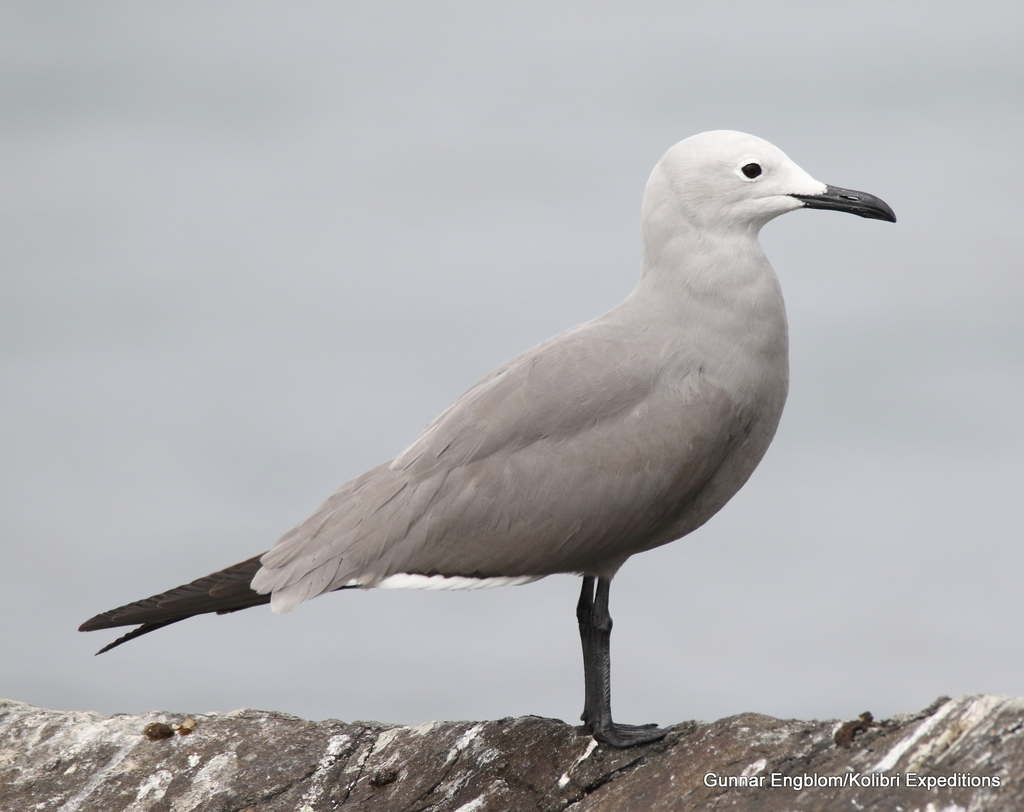
The grey gull, also known as garuma gull (Leucophaeus modestus), is a medium-sized gull native to South America. Unusual among gulls, it breeds inland in the extremely dry Atacama Desert in northern Chile, although it is present as a non-breeding bird along much of the Pacific coast of South America.
From the article Grey gull on Wikipedia (CC BY-SA), quoted section by section
Description
The sexes are similar in grey gulls. Adults grow to a length of about 45 cm (18 in) and weigh some 360 to 400 g (13 to 14 oz). The head is white in summer but brownish-grey in winter. The body and wings are grey with the dorsal surface rather darker than the ventral region. The flight feathers are black and the inner primaries and the secondaries have white tips, visible in flight. The tail has a band of black with a white trailing edge. The legs and beak are black and the iris is brown. The call is similar to that of the laughing gull (Leucophaeus atricilla).
Range & habitat
The grey gull breeds inland in the Atacama Desert in northern Chile. Its non-breeding range includes Costa Rica, Colombia, Ecuador, Peru and Chile, and it has been recorded in the Falkland Islands, South Georgia and the South Sandwich Islands. It is a vagrant to Panama and Florida; an earlier report of it in Louisiana, from 1987, has not been accepted by a birdwatching authority.
Wikipedia: “Distribution”
What it does
The typical habitat of the grey gull is sandy beaches and mudflats along the western coasts of South America where it probes with its beak in the sediment for invertebrate prey, particularly mole crabs. It also eats fish and ragworms, scavenges for offal and sometimes follows fishing boats.
Wikipedia: “Feeding”
Listen
Looking for field recordings…
Where it lives
Recorded sightings
—
geo-referenced records in GBIF, from museums, herbaria and field observers.
Drag the globe to turn it. Dots are where records exist, not a range map; darker means more records.
In the stacks
Searching the stacks…
Every page naming Leucophaeus modestus in the Biodiversity Heritage Library →
This page is assembled live from iNaturalist, GBIF, Wikipedia, the Source Library and the Internet Archive. It is not yet part of the hand-edited codex. iNaturalist taxon 144513.