- Animals
- ›Chordates
- ›Vertebrates
- ›Birds
- ›Shorebirds and Allies
- ›Gulls, Terns, and Skimmers
- ›Gulls
- ›Leucophaeus
On eBird ↗
Laughing Gull
Live sightings near you, the range map, bar charts of when it is seen, and Macaulay Library photos and recordings.
Laughing Gull
Leucophaeus atricilla
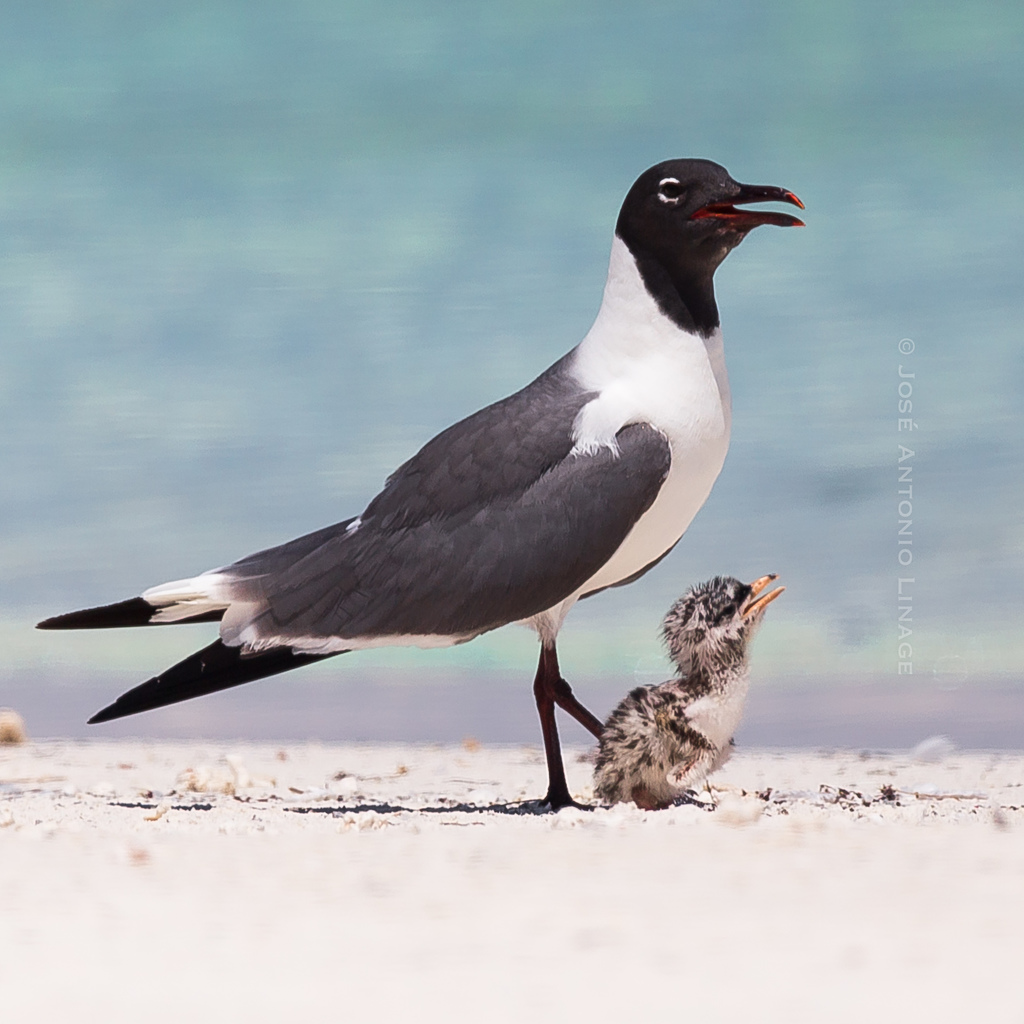
The laughing gull (Leucophaeus atricilla) is a medium-sized gull of North and South America. Named from its laugh-like call, it is an opportunistic omnivore and scavenger. It breeds in large colonies mostly along the Atlantic coast of North America, the Caribbean, and northern South America. Two subspecies are accepted, L. a. atricilla, which occurs from the West Indies to the Venezuelan islands, and L. a. megalopterus, which occurs from southeast Canada down to Central America. The laughing gull was long placed in the genus Larus until its present placement in Leucophaeus.
From the article Laughing gull on Wikipedia (CC BY-SA), quoted section by section
Description
This species is 36–41 cm (14–16 in) long with a 98–110 cm (39–43 in) wingspan and a weight range of 203–371 grams (7.2–13.1 oz). The summer adult's body is white apart from the dark grey back and wings and black head. Its wings are much darker grey than all other gulls of similar size except the smaller Franklin's gull, and they have black tips without the white crescent shown by Franklin's. The beak is long and red. The black hood is mostly lost in winter. Laughing gulls take three years to reach adult plumage. Immature birds are always darker than most similar-sized gulls other than Franklin's. First-year birds are greyer below and have paler heads than first-year Franklin's, and have an all-black tail. Second-year birds can be distinguished by the wing pattern, with more extensive black on the primary coverts, and sometimes still some black on the tail. The laughing gull's English name is derived from its raucous kee-agh call, which sounds like a high-pitched laugh "ha... ha... ha...".
Range & habitat
It breeds on the Atlantic coast of North America, the Caribbean, and northern South America. Northernmost populations migrate farther south in winter, and this species occurs as a rare vagrant to western Europe.
Wikipedia: “Distribution and habitat”
Listen
Looking for field recordings…
Where it lives
Recorded sightings
—
geo-referenced records in GBIF, from museums, herbaria and field observers.
Drag the globe to turn it. Dots are where records exist, not a range map; darker means more records.
In the stacks
Searching the stacks…
Every page naming Leucophaeus atricilla in the Biodiversity Heritage Library →
This page is assembled live from iNaturalist, GBIF, Wikipedia, the Source Library and the Internet Archive. It is not yet part of the hand-edited codex. iNaturalist taxon 144514.