- Animals
- ›Chordates
- ›Vertebrates
- ›Birds
- ›Shorebirds and Allies
- ›Gulls, Terns, and Skimmers
- ›Gulls
- ›Leucophaeus
On eBird ↗
Lava Gull
Live sightings near you, the range map, bar charts of when it is seen, and Macaulay Library photos and recordings.
Lava Gull
Leucophaeus fuliginosus
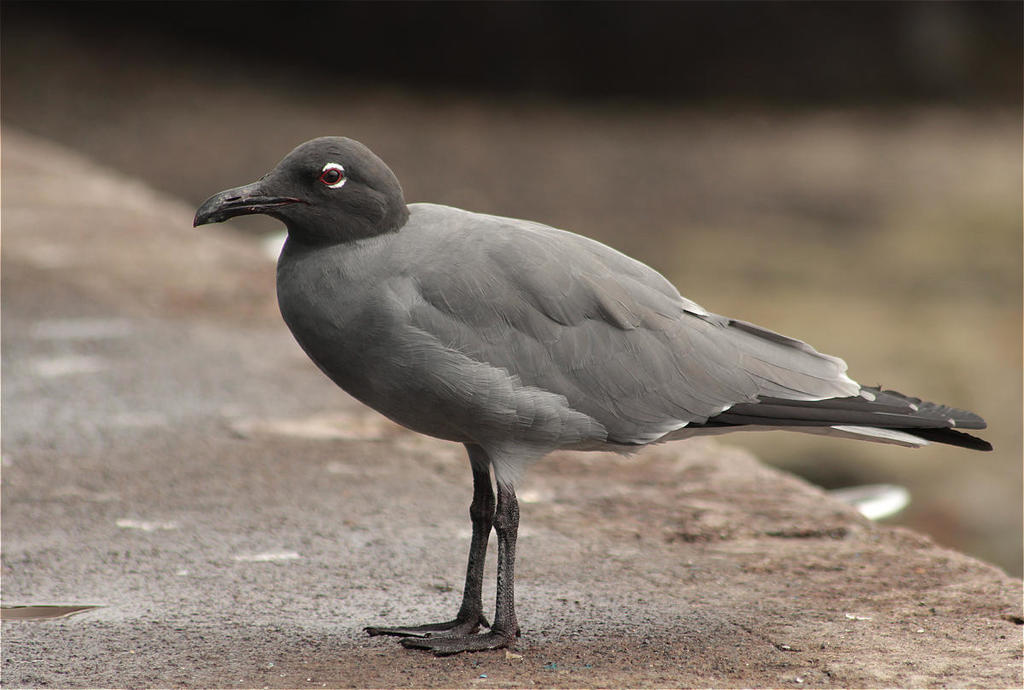
The lava gull (Leucophaeus fuliginosus), also known as the dusky gull, is a medium-sized gull and a member of the "hooded gull" group. It is most closely related to the Laughing gull and Franklin's gull and is the rarest gull in the world. It is endemic to the Galapagos Islands.
From the article Lava gull on Wikipedia (CC BY-SA), quoted section by section
Description
The lava gull is a distinctive gull, 51 to 55 cm (20–22 in) and weighs 380 g (13 oz). The adult plumage consists of a sooty brown to black head, which unlike other dark hooded gulls doesn't vary by season. The wings are dark gray with a contrasting white line on the leading edge, thought to play a function in displays and camouflage. Its dark gray body contrasts with a paler gray belly. The uppertail is white and grey lower down. The bill and legs are black, and the inside of the mouth is scarlet. It has white upper and lower eyebrows, with red lids. Immature gulls are generally dark brown.
Range & habitat
The entire population lives on the Galapagos Islands where it is found predominantly on the islands of Santa Cruz, Isabela, San Cristobal and Genovesa. Previously its population was estimated at 300–400 pairs; this estimate was revised downwards to 300-600 individuals in 2015. It is currently considered the rarest gull in the world.
Wikipedia: “Distribution”
What it does
They are omnivores like most Larus gulls, generally scavenging or stealing from nests and from fishers, but will also catch fish, small crustaceans, and newly hatched lizards, iguanas, and turtles. They also feed on sea lion placenta. On Genovesa they exploit the kleptoparasitic behavior of the Magnificent frigatebird, capitalizing on the botched attempts by these frigatebirds to steal fish from various nesting seabirds. Potential nest predators include owls, frigatebirds and other lava gulls, as well as introduced mammals.
Wikipedia: “Diet and feeding”
Listen
Looking for field recordings…
Where it lives
Recorded sightings
—
geo-referenced records in GBIF, from museums, herbaria and field observers.
Drag the globe to turn it. Dots are where records exist, not a range map; darker means more records.
In the stacks
Searching the stacks…
Every page naming Leucophaeus fuliginosus in the Biodiversity Heritage Library →
This page is assembled live from iNaturalist, GBIF, Wikipedia, the Source Library and the Internet Archive. It is not yet part of the hand-edited codex. iNaturalist taxon 144516.