- Animals
- ›Chordates
- ›Vertebrates
- ›Birds
- ›Cuckoos
- ›Cuckoos
- ›Typical Cuckoos, Malkohas, and allies
- ›Hierococcyx
On eBird ↗
Moustached Hawk-Cuckoo
Live sightings near you, the range map, bar charts of when it is seen, and Macaulay Library photos and recordings.
Moustached Hawk-Cuckoo
Hierococcyx vagans
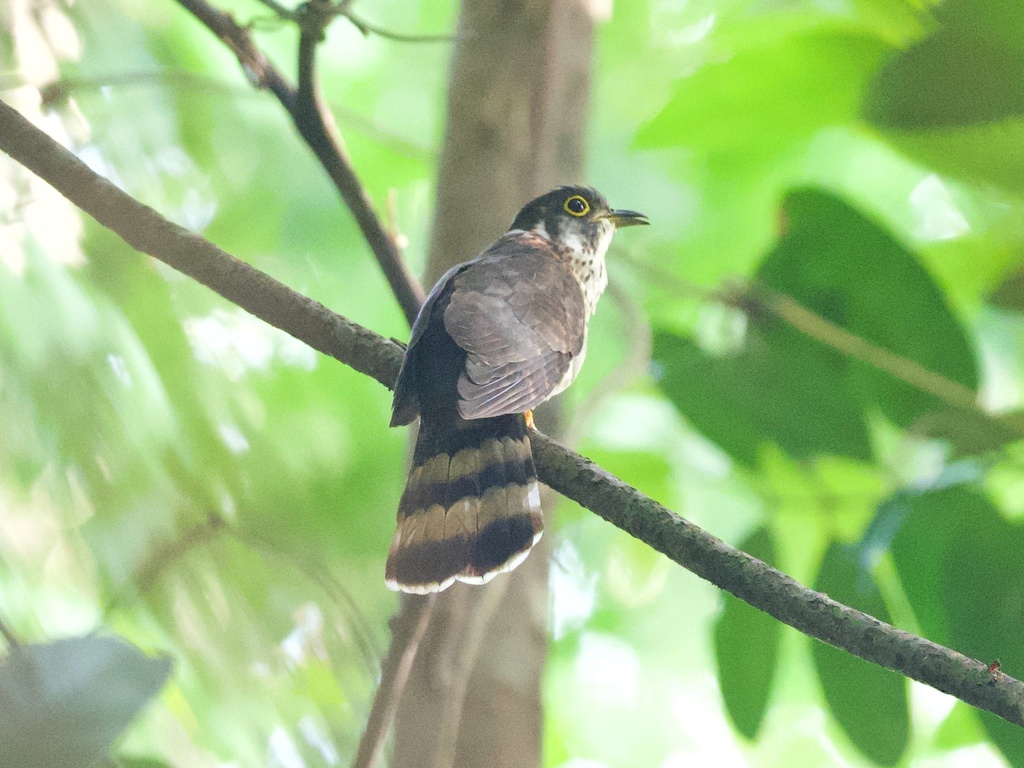
The moustached hawk-cuckoo (Hierococcyx vagans) is a species of cuckoo in the family Cuculidae.
It is found in Brunei, Indonesia, Laos, Malaysia, Myanmar, and Thailand. Its natural habitat is evergreen and secondary forests. Threatened by habitat loss, it has been assessed as a near-threatened species.
From the article Moustached hawk-cuckoo on Wikipedia (CC BY-SA), quoted section by section
Description
The moustached hawk-cuckoo is 25–30 cm (9.8–11.8 in) long, and it weighs about 58–63 g (2.0–2.2 oz). The crown and nape are grey. The ear coverts are white, and there is a blackish moustache. The back is brown, and the tail has brown bands and a buffy or white tip. The flight feathers have buffy bars. The underparts are creamy-white, with blackish streaks. The eye is dark brown or grey, with a yellow eye-ring around it. The beak is black, and the feet are orange-yellow. The juvenile bird's back and wings are blackish, and it has black streaks on its breast. The fledgling also has a moustache.
Range & habitat
The moustached hawk-cuckoo is found in southern Myanmar, Thailand, southern Laos, Malaysia, Singapore, Brunei, and Kalimantan, Sumatra and Java of Indonesia. Its habitat is evergreen and secondary forests and forest edges, especially on hills and in alluvial and bamboo forests. It occurs at elevations up to 915 m (3,002 ft).
Wikipedia: “Distribution and habitat”
What it does
This cuckoo eats insects and small fruits. It has been seen in mixed-species foraging flocks. It is usually found in thick canopy. Males sing at fixed locations in the canopy, its call being chu-chu or kang-koh repeated every two seconds. It also gives a whistling peu peu that becomes hi-hi and then stops. It has been observed parasitising Abbott's babbler and the rufous-winged philentoma. In mainland Southeast Asia, the breeding season is June to August.
Wikipedia: “Behaviour”
Listen
Looking for field recordings…
Where it lives
Recorded sightings
—
geo-referenced records in GBIF, from museums, herbaria and field observers.
Drag the globe to turn it. Dots are where records exist, not a range map; darker means more records.
In the stacks
Searching the stacks…
Every page naming Hierococcyx vagans in the Biodiversity Heritage Library →
This page is assembled live from iNaturalist, GBIF, Wikipedia, the Source Library and the Internet Archive. It is not yet part of the hand-edited codex. iNaturalist taxon 144576.