On eBird ↗
Japanese Scops-Owl
Live sightings near you, the range map, bar charts of when it is seen, and Macaulay Library photos and recordings.
Japanese Scops-Owl
Otus semitorques
The Japanese scops-owl (Otus semitorques) is a small owl species in the family Strigidae, or true owl family. It is a member of the genus Otus, the scops owl genus. It is resident to Japan, China, Korea, and Russia.
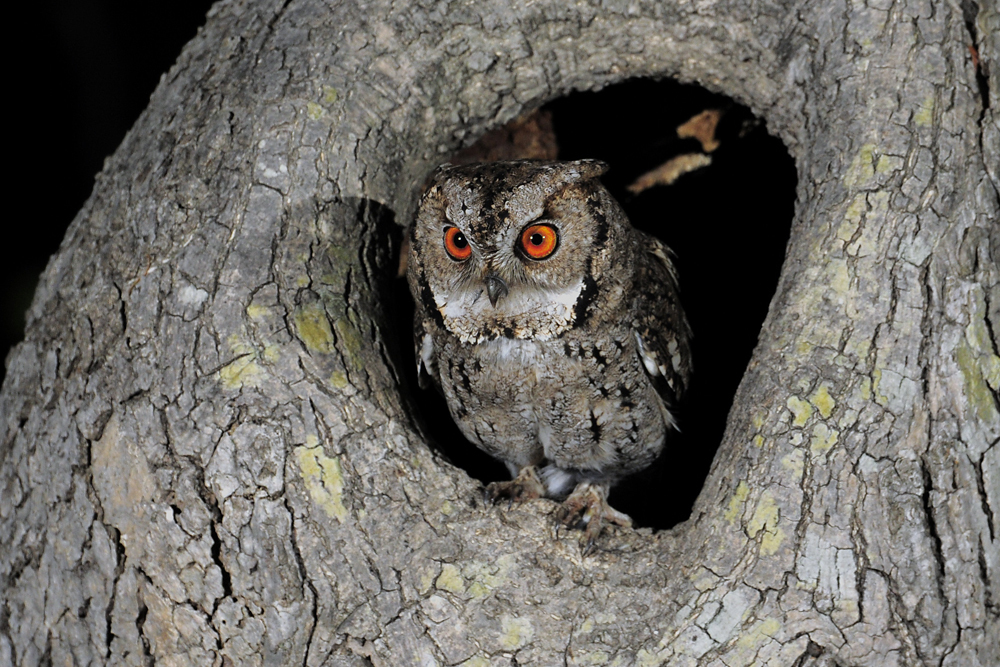
Japanese scops-owls have a grey-brown plumage, red eyes, and prominent ear tufts. They resides in forests, woodlands, and mountains. They are carnivorous, mainly feeding on invertebrates and small rodents. They nest in tree hollows and raise a small brood. Males use their vocalizations to attract mates or deter predators.
From the article Japanese scops owl on Wikipedia (CC BY-SA), quoted section by section
Description
Japanese scops-owls are 16.5–30 cm (6.5–11.8 in) tall, and their wingspan is 60–66 cm (23.5–26 in). They weigh 130–200 g (4.6–7.1 oz). Their plumage is gray and brown, resembling the bark of a tree which helps them camouflage in their environment. Their wings are long, around 153–196 mm (6.0–7.7 in), and pointed. Furthermore, like most scops-owls, they have prominent ear tufts. This species has a pale grey-brown facial disc, intense red eyes, green feet, with feathered toes, and a green bill. It is often confused with the collared scops-owl which is smaller and whiter than the Japanese scops-owl. It is also confused with the northern white-faced owl which is also whiter than the Japanese scops-owl but relatively the same size. This species can reach flight speeds of 80 kph (50 mph).
Range & habitat
Japanese scops-owls live in forested habitats such as lowland forests, wooded plain and forested hillsides, as well as woodlands and mountains. They can be found in habitats at elevations between sea-level and 900 meters. They can also be found in the parks and gardens of villages. This species is resident, but it can do small-scale migrations. Japanese scops-owls can move locally depending on the seasons, coming at lower elevations in winter. Japanese scops-owls are found in Japan, Korea, China, and Russia. O. s. ussriensis is found in Sakhalin, Primorsky Krai and Northeastern China. O. s. semitorques is resident to the Korean Peninsula, Jeju Island, Kuril Islands, Sado Island, Tsushima Island, Goto Islands, Hokkaido and Yakushima. O. s. pryeri inhabits Izu Islands and Ryukyu Islands.
Wikipedia: “Habitat and distribution”
What it does
Japanese scops-owls feed primarily on invertebrates (insects, millipedes, centipedes, crustaceans) then followed by small rodents (voles and mice). They can also feed on small birds, frogs, lizards, snakes and fish. They are active predators meaning they mostly search for prey while flying. Still, they sometimes perch to hunt. When consuming rodents, they most often go for juveniles as it is easier to find sedentary prey such as juveniles in a nest. They hunt in open areas and rely on auditory cues to detect prey and prey nests. Their eyes are adapted to nocturnal living which explains why they hunt at night.
Wikipedia: “Hunting and feeding”
In human culture
In Japanese culture, owls symbolize good luck, wisdom and protection against misfortune. Scops-owls can be found represented in Japanese art such as pottery and paintings. They are also often depicted in literature and films due to their unique and mysterious appearance.
== References ==
Wikipedia: “Cultural significance”
Listen
Looking for field recordings…
Where it lives
Recorded sightings
—
geo-referenced records in GBIF, from museums, herbaria and field observers.
Drag the globe to turn it. Dots are where records exist, not a range map; darker means more records.
In the stacks
Searching the stacks…
Every page naming Otus semitorques in the Biodiversity Heritage Library →
This page is assembled live from iNaturalist, GBIF, Wikipedia, the Source Library and the Internet Archive. It is not yet part of the hand-edited codex. iNaturalist taxon 144588.