On eBird ↗
White-nest Swiftlet
Live sightings near you, the range map, bar charts of when it is seen, and Macaulay Library photos and recordings.
White-nest Swiftlet
Aerodramus fuciphagus
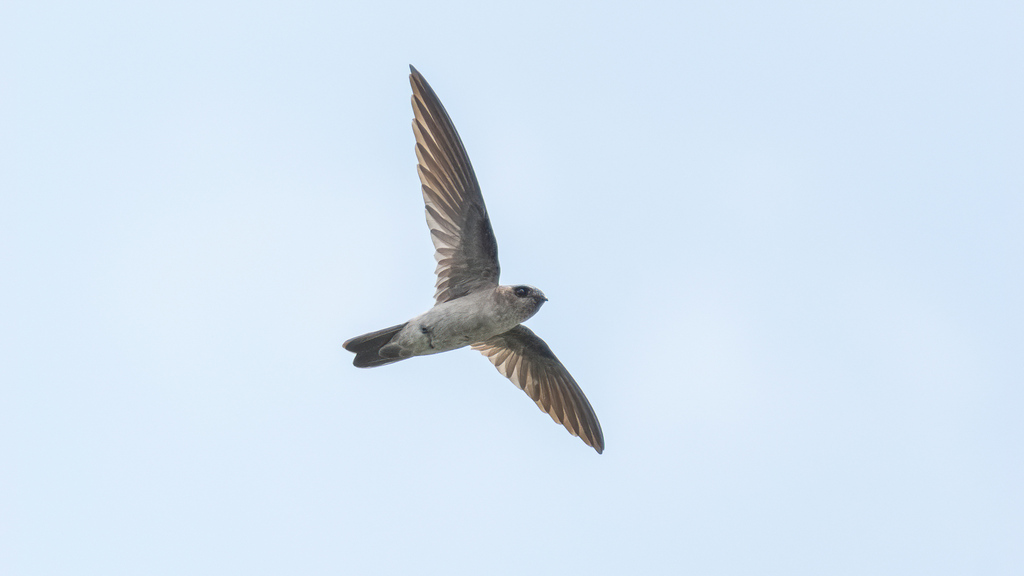
The edible-nest swiftlet (Aerodramus fuciphagus), also known as the white-nest swiftlet, is a small bird of the swift family which is found in Southeast Asia. Its opaque and whitish nest is made exclusively of solidified saliva and is the main ingredient of bird's nest soup, a delicacy of Chinese cuisine. Germain's swiftlet (Aerodramus germani) is now treated as conspecific with this species.
From the article Edible-nest swiftlet on Wikipedia (CC BY-SA), quoted section by section
Description
The edible-nest swiftlet, generally with a body length of 14 cm (5.5 in), is a medium-sized representative of the salanganes. The upper part of the slender body is blackish-brown; the under part of the body ranges in colour from white to blackish-brown. The tail is short and has a slight notch. The bill and feet are black. Legs are very short and tarsi are usually unfeathered or lightly feathered. It weighs 15 to 18 g (0.53 to 0.63 oz) and the wings are long and narrow. In flight the swept-back wings resemble a crescent. The subspecies micans is paler and greyer than the nominate while vestitus is dark with a rump that is less obviously paler. Subspecies germani has much paler underparts with a broad whitish rump, amechanus is similar to germani but has a greyer rump.
What it does
The edible-nest swiftlet feeds over a range of habitats from coastal areas to the mountains, occurring up to 2,800 metres above sea-level on Sumatra and Borneo. These birds generally occur above forests, the forest edge, but also in open country. These birds spend most of their lives in the air. Their diet consists of flying insects that are caught on the wing. They also drink on the wing. They often feed in large flocks with other species of swiftlet and swallow. They breed in colonies in coastal areas, in limestone caves, in rock crevices, in a cleft in a cliff or sometimes on a building. The bracket-shaped nest is built on a vertical surface and the long legs are used for clinging. These swifts never settle voluntarily on the ground. The nest is white and translucent and is made of layers of hardened saliva attached to the rock. A nest typically measures about 6 cm across with a depth of 1.5 cm and a weight of about 14 grams. Two white, oval, non-glossy eggs are laid. At breeding colonies, the birds emit high-pitched and burbling calls. They also emit a rattling call used for echolocation, which enables them to look for their nesting sites in the darkness of caves.
Wikipedia: “Behavior”
Listen
Looking for field recordings…
Where it lives
Recorded sightings
—
geo-referenced records in GBIF, from museums, herbaria and field observers.
Drag the globe to turn it. Dots are where records exist, not a range map; darker means more records.
In the stacks
Searching the stacks…
Every page naming Aerodramus fuciphagus in the Biodiversity Heritage Library →
This page is assembled live from iNaturalist, GBIF, Wikipedia, the Source Library and the Internet Archive. It is not yet part of the hand-edited codex. iNaturalist taxon 144631.