On eBird ↗
Blyth's Swift
Live sightings near you, the range map, bar charts of when it is seen, and Macaulay Library photos and recordings.
Blyth's Swift
Apus leuconyx
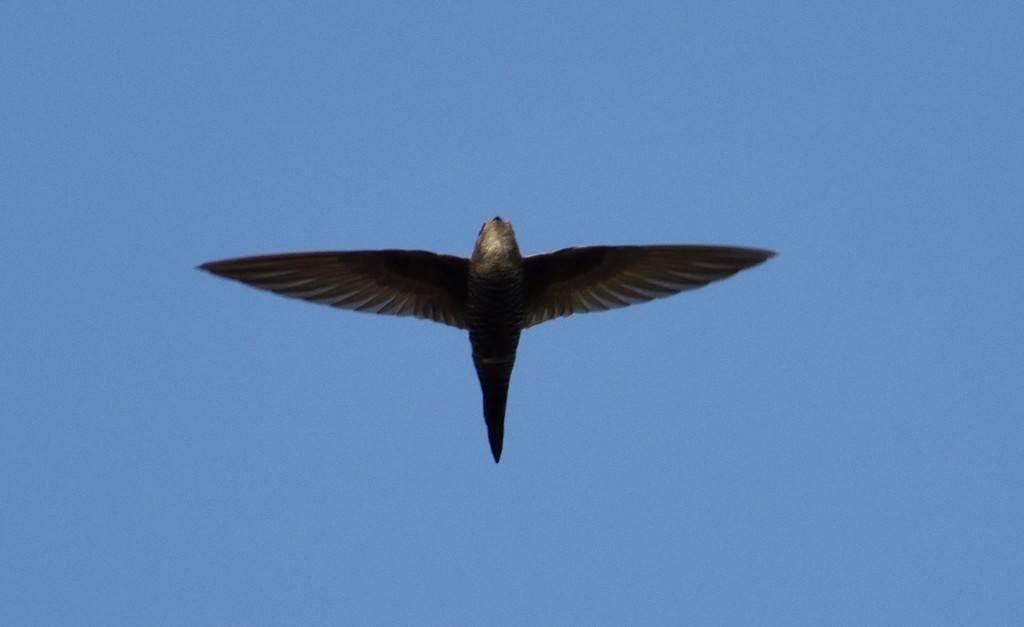
The Blyth's swift (Apus leuconyx), is a small bird, superficially similar to a house martin. It is, however, completely unrelated to those passerine species, since swifts are in the order Apodiformes. The resemblances between the groups are due to convergent evolution reflecting similar life styles.
From the article Blyth's swift on Wikipedia (CC BY-SA), quoted section by section
Description
Blyth's swifts are similar in size to common swift, and they are black except for a white rump. They can be distinguished from a partially leucistic common swift by the deeper tail fork, longer wings, bigger head and larger white throat patch.
Range & habitat
Blyth's swifts breeds from the outer Himalayas through the Assam hills. This species is migratory, and winters in India and Sri Lanka.
Wikipedia: “Distribution and habitat”
What it does
Blyth's swifts have very short legs which they use only for clinging to vertical surfaces. They never settle voluntarily on the ground. Blyth's swifts spend most of their lives in the air, living on the insects they catch in their beaks. These birds build their nests on cliffs, laying 2–3 eggs. A swift will return to the same site year after year, rebuilding its nest when necessary.
== References ==
Wikipedia: “Behaviour and ecology”
Listen
Looking for field recordings…
Where it lives
Recorded sightings
—
geo-referenced records in GBIF, from museums, herbaria and field observers.
Drag the globe to turn it. Dots are where records exist, not a range map; darker means more records.
In the stacks
Searching the stacks…
Every page naming Apus leuconyx in the Biodiversity Heritage Library →
This page is assembled live from iNaturalist, GBIF, Wikipedia, the Source Library and the Internet Archive. It is not yet part of the hand-edited codex. iNaturalist taxon 144637.