On eBird ↗
Trinidad Motmot
Live sightings near you, the range map, bar charts of when it is seen, and Macaulay Library photos and recordings.
Trinidad Motmot
Momotus bahamensis
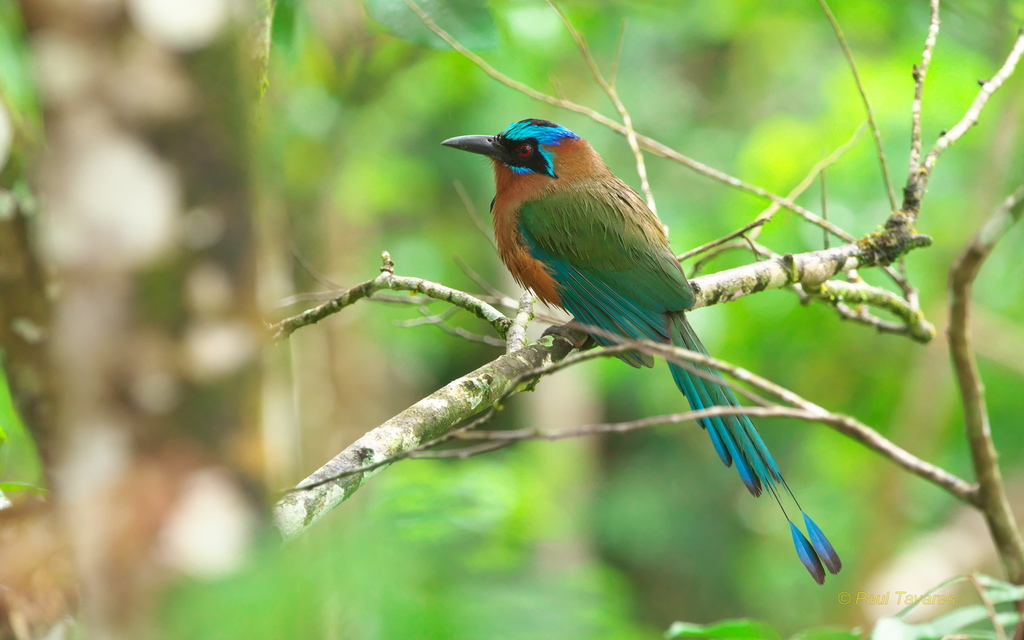
The Trinidad and Tobago motmot (Momotus bahamensis) is a colourful Coraciiform afroavian endemic to the forests and woodlands of Trinidad and Tobago. It is a nonmigratory member of the Momotidae family and the Momotus genus. This species and the blue-capped motmot, Lesson's motmot, whooping motmot, Amazonian motmot, and Andean motmot were all considered conspecific. Though found on both islands, this bird is more abundant in Tobago than it is in Trinidad.
These birds are characterised by their colourful plumage, heavy bills, and low owl-like "hoot" call. Their underparts are a deep, rufous colour, with a slightly paler breast and an olive-green wash. The black eye-mask and blue-black racquet tails are also distinguishable features for this species.
From the article Trinidad motmot on Wikipedia (CC BY-SA), quoted section by section
Description
The Trinidad motmot is much more deeply and uniformly rufous below than other species in Momotus. Its throat is a deep, intense reddish-brown, while its breast is slightly paler and often has a faint, lateral olive-green wash. These birds' abdomens are almost as dark as their breasts, and their thighs contrast sharply with their green or blue-green colouring. The contrast between the two is much stronger compared to other species. Their black pectoral feathers have broad and conspicuous turquoise borders, while the tibial feathers are green to blue-green. Adults have a short black streak across their breast, a characteristic absent in juveniles (as well as blue breast feathers), making them identifiable. Males and females look similar, and the Trinidad motmot does not typically exhibit sexual dimorphism. The extensive blue areas around the Trinidad motmot's mask distinguish it from all other members of the genus. Some individuals may have a noticeable blue-to-turquoise border that fades into green just before the diadem, while others have fainter feathers that are less prominent.
Diadem and Plumage. Its diadem, or crown-like marking on its head, consists of a broad, light turquoise blue circle that transitions to dark blue across the nape. The outer part from the eye backwards is violet, and a narrow black border outlines the rear portion. …
Range & habitat
The Trinidad motmot is a nonmigratory bird that resides exclusively on the islands of Trinidad and Tobago, although it is more abundant in Tobago than it is in Trinidad. They primarily inhabit forested habitats and wooded regions, including both lowland and coastal forests. The species is adaptable and can also be found in marine intertidal zones, where wooded environments are present. This species is unique, as its geographic isolation is more pronounced than that of any other member of the Momotidae family, due its island restriction. Its nonmigratory behaviour also suggests that the species is unlikely to expand beyond its current estimated extent of occurrence of 11,700 square kilometres. There is a significant lack of information regarding the distribution of Trinidad motmot populations across the islands, including the exact number of mature individuals and if there has been an increase or decrease in numbers in recent years. Despite this, the current population is thought to be stable with no significant fragmentation, and it is estimated that the average generation is approximately 3.6 years. …
Wikipedia: “Habitat and Distribution”
What it does
Trinidad motmots are opportunistic, adaptable feeders and generally eat berries, large invertebrates (including beetles, centipedes, millipedes, scorpions, and cockroaches), and small vertebrates like frogs, and small birds and lizards. This varied diet reflects the bird's adaptability to different environments and availability of prey. Research has shown that Trinidad Motmots occasionally use rocks as anvils to break open terrestrial snail shells, a behavior that indicates borderline tool use—a behavior previously unrecorded in this species and family. The use of rocks as anvils may allow these birds to access nutrient-rich food sources that would otherwise be inaccessible, potentially enhancing their survival during periods when other food sources are scarce. Other Momotidae species like the blue-capped motmot have been observed striking live animal prey against tree branches and other hard objects to kill before consumption. In addition to incapacitating the prey, this practice may make it easier to feed to their young.
Wikipedia: “Diet and Foraging”
Listen
Looking for field recordings…
Where it lives
Recorded sightings
—
geo-referenced records in GBIF, from museums, herbaria and field observers.
Drag the globe to turn it. Dots are where records exist, not a range map; darker means more records.
In the stacks
Searching the stacks…
Every page naming Momotus bahamensis in the Biodiversity Heritage Library →
This page is assembled live from iNaturalist, GBIF, Wikipedia, the Source Library and the Internet Archive. It is not yet part of the hand-edited codex. iNaturalist taxon 144644.