- Animals
- ›Chordates
- ›Vertebrates
- ›Birds
- ›Perching Birds
- ›Ovenbirds and Woodcreepers
- ›Woodcreepers
- ›Drymotoxeres
On eBird ↗
Greater Scythebill
Live sightings near you, the range map, bar charts of when it is seen, and Macaulay Library photos and recordings.
Greater Scythebill
Drymotoxeres pucheranii
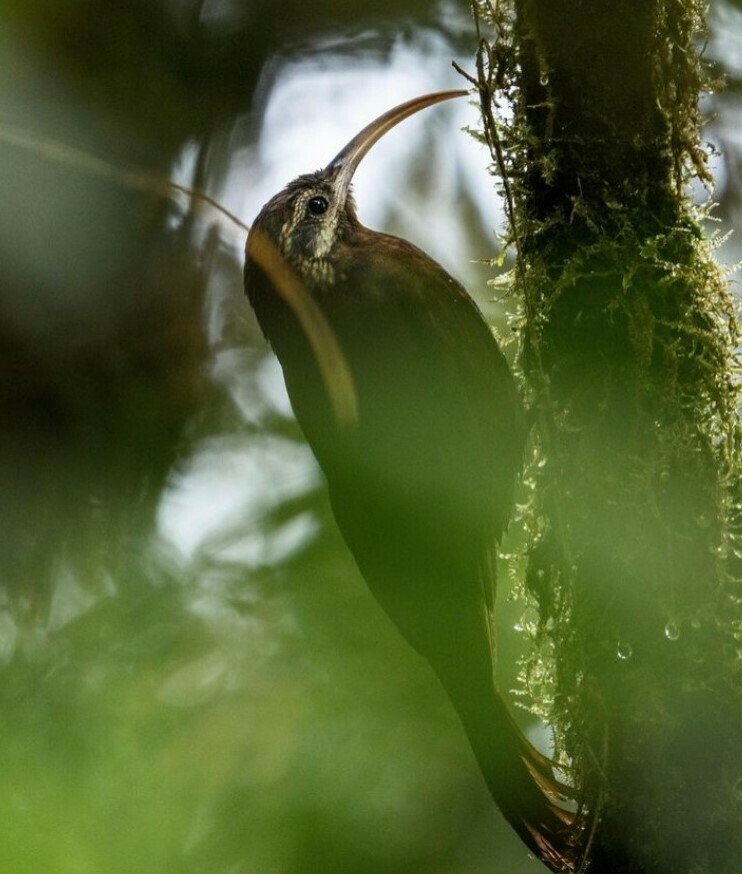
The greater scythebill (Drymotoxeres pucheranii) is a species of bird in the Dendrocolaptinae subfamily. This species is found at very low densities in highland forest in the Andes, ranging from southern Colombia to far northern Peru. It has traditionally been included in Campylorhamphus together with the other scythebills, but it is closer to the scimitar-billed woodcreeper, leading to the description of the new genus Drymotoxeres.
From the article Greater scythebill on Wikipedia (CC BY-SA), quoted section by section
Description
The greater scythebill is 24 to 30 cm (9.4 to 12 in) long and weighs 63 to 78 g (2.2 to 2.8 oz). It is the largest and heaviest scythebill with a shorter, stouter, and less curved bill than the others. The sexes have the same plumage. Adults have blackish brown ear coverts, a distinct whitish supercilium, and an even bolder whitish moustachial stripe. Their upperparts are dull rufous brown to chestnut with a darker crown. Their crown and nape have thin buff streaks that sometimes continue onto the upper back. Their rump, wings, and tail are dark rufous-chestnut. Their underparts are rufous-brown to chestnut with grayish streaks on the throat, breast, and sometimes the upper belly. Their iris is dark brown, their bill dull pinkish horn to creamy gray with a blackish base to the culmen, and their legs and feet brownish gray to dark brown. Juveniles are more rufescent than adults with coarser but less well defined streaking above and below.
Range & habitat
The greater scythebill is found only locally, in the Andes of central and southwestern Colombia, on the western slope of the Ecuadoran Andes south to Pichincha Province, and all along the eastern slope of the Ecuadoran Andes into Peru as far as the Department of Cuzco. It inhabits humid montane forest in the subtropical to temperate zones. It favors the interior of evergreen forest, cloudforest, and elfin forest; it does occur at the forest edges and occasionally in banana plantations. In elevation it ranges between 900 and 3,250 m (3,000 and 10,700 ft) but most often between 1,000 and 3,000 m (3,300 and 9,800 ft) in Colombia and 2,000 and 2,800 m (6,600 and 9,200 ft) in Ecuador and Peru.
Wikipedia: “Distribution and habitat”
What it does
The greater scythebill's diet is not known in detail but is believed to be mostly arthropods. It is almost always seen singly and readily joins mixed-species feeding flocks. It typically forages in the forest's lower and middle levels. It hitches up trunks and branches, gleaning prey from the surface and probing into crevices and moss.
Wikipedia: “Feeding”
Listen
Looking for field recordings…
Where it lives
Recorded sightings
—
geo-referenced records in GBIF, from museums, herbaria and field observers.
Drag the globe to turn it. Dots are where records exist, not a range map; darker means more records.
In the stacks
Searching the stacks…
Every page naming Drymotoxeres pucheranii in the Biodiversity Heritage Library →
This page is assembled live from iNaturalist, GBIF, Wikipedia, the Source Library and the Internet Archive. It is not yet part of the hand-edited codex. iNaturalist taxon 144693.