On eBird ↗
Fulvous Antshrike
Live sightings near you, the range map, bar charts of when it is seen, and Macaulay Library photos and recordings.
Fulvous Antshrike
Frederickena fulva
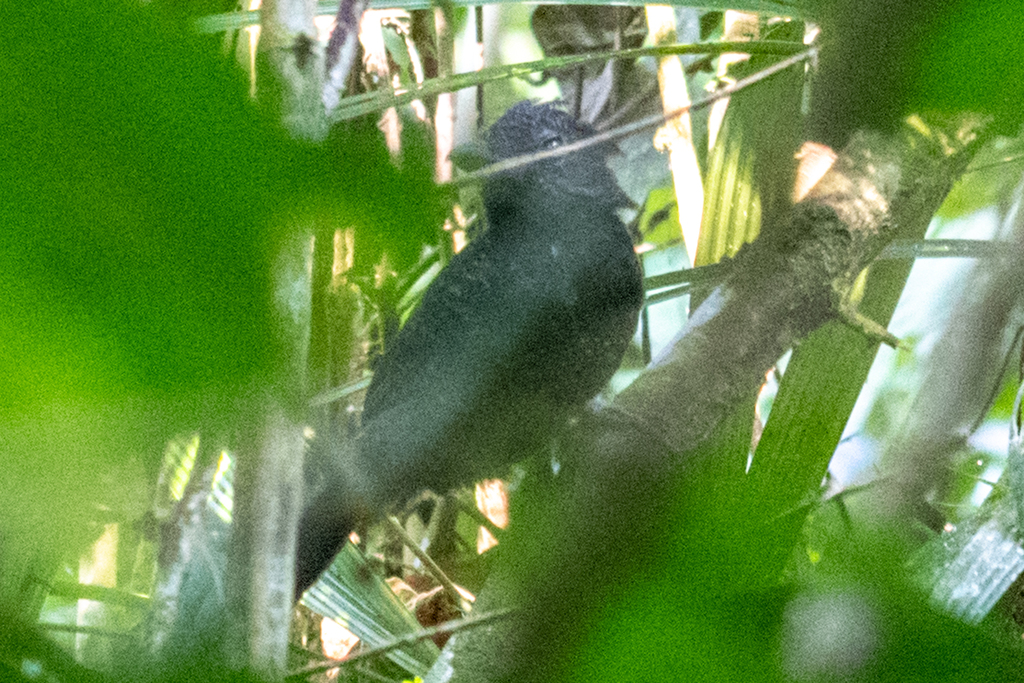
The fulvous antshrike (Frederickena fulva) is a monotypic species of antbird in the family Thamnophilidae. Formerly considered to be a subspecies of the undulated antshrike, it was determined to be a distinct species based on vocal differences. The species occurs from the western Amazon in eastern Ecuador, south-eastern Colombia, north-eastern Peru, and possibly extreme western Brazil. Only the female is overall fulvous with dark barring; the male is black with whitish barring.
From the article Fulvous antshrike on Wikipedia (CC BY-SA), quoted section by section
Description
The fulvous antshrike is a large dark antbird, 22 to 25 cm (8.7 to 9.8 in) long and weighing 75 to 85 g (2.6 to 3.0 oz). The species exhibits significant sexual dimorphism, though both sexes have a crest, a brown to orange-yellow iris, a heavy black bill with a hook at the end like true shrikes, and black or dark gray legs and feet. Adult males are mostly black with irregular thin white bars everywhere but the throat. The bars on the face and crest are broken and appear as small spots. Adult females are mostly rich cinnamon with wavy black bars; their forehead and crest are darker cinnamon-rufous with black bars and their tail and uppertail coverts are black with thin gray bars.
Range & habitat
The fulvous antshrike is a bird of the far western Amazon Basin. It is found in southern Colombia's departments of Caquetá, Putumayo, and Amazonas; in the eastern half of Ecuador; and in northern Peru south at least to the Río Marañón and perhaps further to the rios Ucayali and Cushabatay. Though some maps show its range extending into far western Brazil, the SACC has no records from that country. Sightings are sparse except in northeastern Ecuador. It inhabits lowland evergreen forest such as terra firme. It greatly favors dense, viny, vegetation in the understorey, especially at openings such as those formed by fallen trees and along watercourses. In elevation it ranges up to about 700 m (2,300 ft) in most of its range but may reach 1,100 m (3,600 ft) in Peru.
Wikipedia: “Distribution and habitat”
What it does
The fulvous antshrike's diet has not been detailed but is assumed to include large insects and other arthropods. It forages singly or in pairs in dense foliage and vine tangles, mostly near the ground. It hops from branch to branch and reaches and hops to glean prey. It typically jerks its tail sideways while foraging. It occasionally joins mixed-species feeding flocks that pass through its territory, and there is only one record of it following an army ant swarm.
Wikipedia: “Feeding”
Listen
Looking for field recordings…
Where it lives
Recorded sightings
—
geo-referenced records in GBIF, from museums, herbaria and field observers.
Drag the globe to turn it. Dots are where records exist, not a range map; darker means more records.
In the stacks
Searching the stacks…
Every page naming Frederickena fulva in the Biodiversity Heritage Library →
This page is assembled live from iNaturalist, GBIF, Wikipedia, the Source Library and the Internet Archive. It is not yet part of the hand-edited codex. iNaturalist taxon 144694.