On eBird ↗
Collared Antshrike
Live sightings near you, the range map, bar charts of when it is seen, and Macaulay Library photos and recordings.
Collared Antshrike
Thamnophilus bernardi
The collared antshrike (Thamnophilus bernardi) is a species of bird in the family Thamnophilidae. It is found in Ecuador and Peru. Its natural habitats are subtropical or tropical dry forests, subtropical or tropical dry shrubland, and subtropical or tropical moist shrubland. It has recently been proposed that it more properly belongs to the genus Thamnophilus (Brumfield et al., 2007).
From the article Collared antshrike on Wikipedia (CC BY-SA), quoted section by section
Description
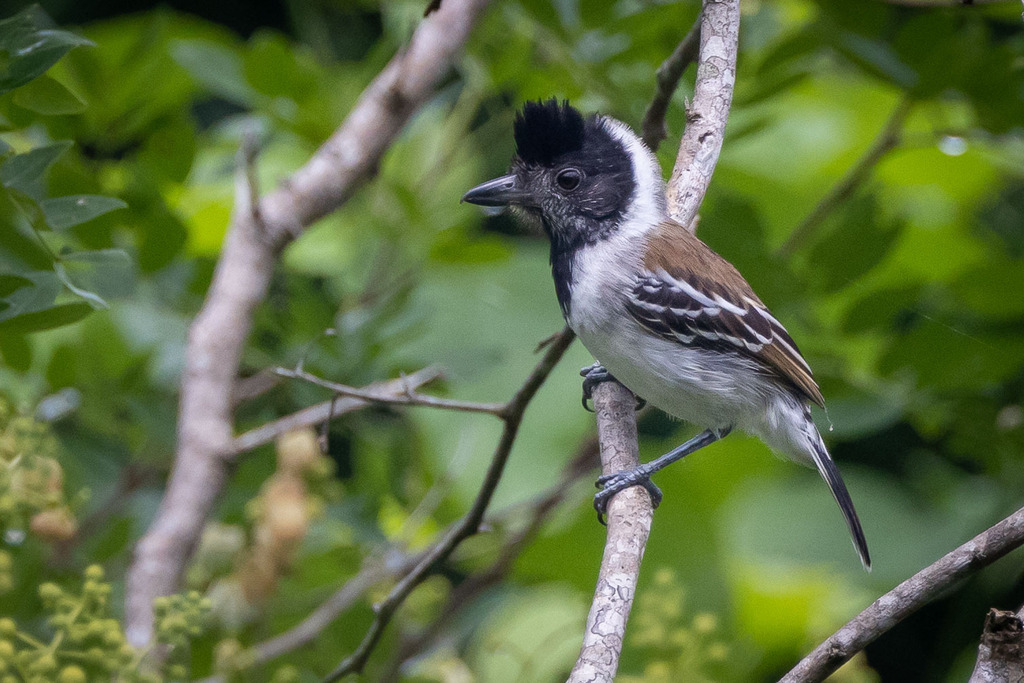
The collared antshrike is 16.5 to 18 cm (6.5 to 7.1 in) long and weighs 30 to 38 g (1.1 to 1.3 oz). Members of genus Thamnophilus are largish members of the antbird family; all have stout bills with a hook like those of true shrikes. Both sexes of this species have a bushy crest. Adult males of the nominate subspecies have a black crown and crest; their forehead has white spots. Their lores are grayish white on an otherwise black face. They have a white collar that connects to the white underparts. Their upperparts are mostly dull rufous brown with a hidden white patch between the scapulars. Their wings are dark brown with white or buffy brown edges on the coverts and flight feathers. Their tail is black with white tips on the feathers and white edges on the outermost pair. Their throat is black with white scaling on its upper part and sides; the black extends onto the breast as a point. The rest of their underparts are mostly white with a buff wash on the flanks. Adult females have a black and white forehead, a dark rufous brown crest, and a black rear crown. (Some individuals have an almost entirely black crown.) Their face is dark gray with thin white streaks. Their collar is buff and like the male's connects to their upperparts. …
Range & habitat
The collared antshrike has a disjunct distribution. The nominate subspecies has by far the larger range. It is found along the Pacific slope from west-central Ecuador's Manabí and Guayas provinces south into northwestern and north-central Peru as far as northern Ancash Department. Subspecies T. b. shumbae is found in north-central Peru in the watersheds of the Marañón River and its tributary the Chinchipe River. The species inhabits deciduous forest, arid scrublands, and shrubby secondary forest. In elevation it mostly ranges up to 1,500 m (4,900 ft) but locally to 1,850 m (6,100 ft) in Ecuador, to 1,200 m (3,900 ft) in western Peru, and to 1,950 m (6,400 ft) in the Marañón Valley.
Wikipedia: “Distribution and habitat”
What it does
The collared antshrike's diet is primarily insects and probably also includes other small invertebrates. It forages mostly in pairs and sometimes as part of a mixed-species feeding flock. It forages mostly on and near the ground, though it will feed as high as 10 m (33 ft) above it. It feeds by gleaning and often with quick stabs as well.
Wikipedia: “Feeding”
Listen
Looking for field recordings…
Where it lives
Recorded sightings
—
geo-referenced records in GBIF, from museums, herbaria and field observers.
Drag the globe to turn it. Dots are where records exist, not a range map; darker means more records.
In the stacks
Searching the stacks…
Every page naming Thamnophilus bernardi in the Biodiversity Heritage Library →
This page is assembled live from iNaturalist, GBIF, Wikipedia, the Source Library and the Internet Archive. It is not yet part of the hand-edited codex. iNaturalist taxon 144695.