On eBird ↗
Banded Honeyeater
Live sightings near you, the range map, bar charts of when it is seen, and Macaulay Library photos and recordings.
Banded Honeyeater
Cissomela pectoralis
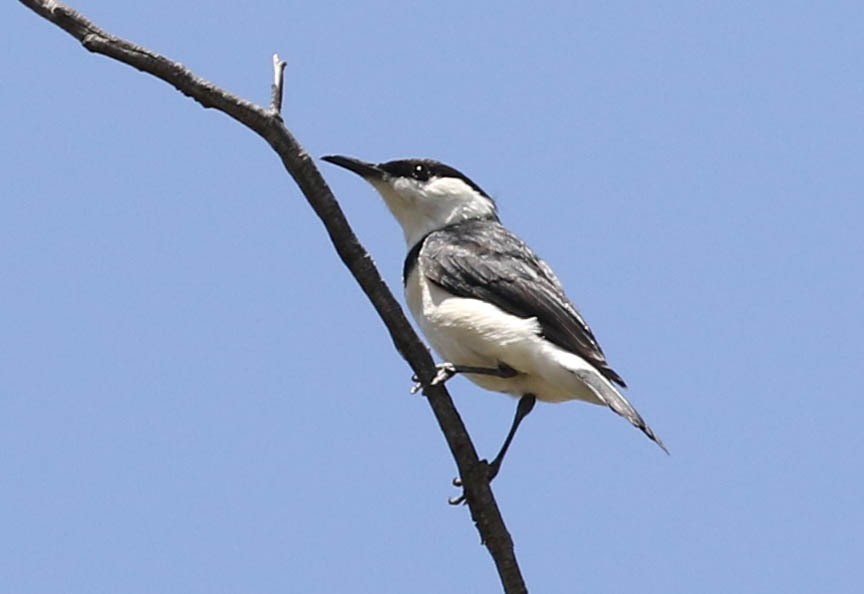
The banded honeyeater (Cissomela pectoralis) is a species of honeyeater in the family Meliphagidae with a characteristic narrow black band across its white underparts. It is endemic to tropical northern Australia.
From the article Banded honeyeater on Wikipedia (CC BY-SA), quoted section by section
Description
The banded honeyeater is a small, pied honeyeater with a distinctive black breast band across white underparts. It has a black back, tail and head, a long curved bill and long legs. It has a wingspan of 12–14 cm (4.7–5.5 in), the bill measures 14–18 mm (0.6–0.7 in), the body length is 11.5–13.5 cm (4.5–5.3 in) and it weighs 8–13 g (0.3–0.5 oz).
What it does
The IUCN Red List rating, the Northern Territory Conservation Status and Queensland Conservation Status for this species is Least Concern (LC). The banded honeyeater inhabits tropical grassy woodland, open forests, mangroves and Melaleuca swamps. It feeds on the nectar of eucalypts and some other open flowers, such as Grevilleas, paperbarks and Bauhinias, plus insects. It usually moves in pairs or small groups, but large groups can gather when blossom is plentiful. It is a blossom nomad or can have seasonal movements in various parts of its range, which is restricted to tropical northern Australia.
Wikipedia: “Behaviour and ecology”
Listen
Looking for field recordings…
Where it lives
Recorded sightings
—
geo-referenced records in GBIF, from museums, herbaria and field observers.
Drag the globe to turn it. Dots are where records exist, not a range map; darker means more records.
In the stacks
Searching the stacks…
Every page naming Cissomela pectoralis in the Biodiversity Heritage Library →
This page is assembled live from iNaturalist, GBIF, Wikipedia, the Source Library and the Internet Archive. It is not yet part of the hand-edited codex. iNaturalist taxon 144711.