On eBird ↗
Rufous-bellied Helmetshrike
Live sightings near you, the range map, bar charts of when it is seen, and Macaulay Library photos and recordings.
Rufous-bellied Helmetshrike
Prionops rufiventris
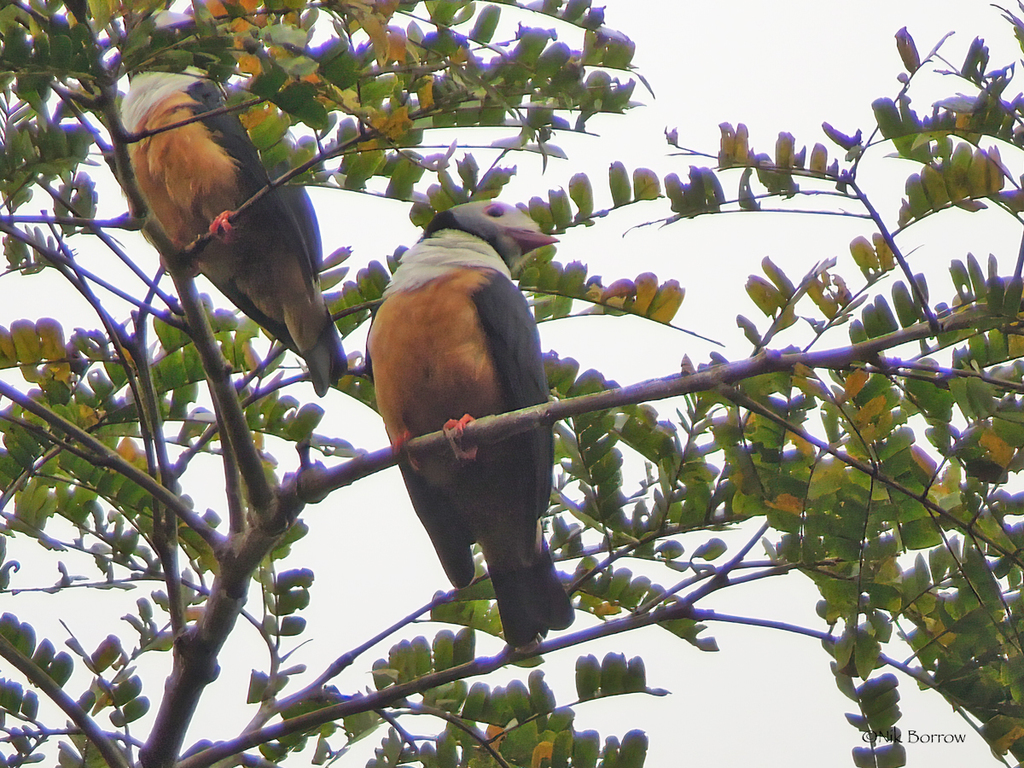
The rufous-bellied helmetshrike or Gabon helmetshrike (Prionops rufiventris) is a passerine bird belonging to the helmetshrike family, Prionopidae. It inhabits tropical forest in Central Africa. It is sometimes included within the chestnut-bellied helmetshrike (P. caniceps) of West Africa.
From the article Rufous-bellied helmetshrike on Wikipedia (CC BY-SA), quoted section by section
Description
It is 20–22 cm long. The adult has glossy black upperparts and throat and reddish-brown underparts with a narrow white breastband. The top and sides of the head and the chin are pale blue-grey and there are bushy whitish feathers on the forehead. The wings are broad and rounded with a white band across the primaries. The bill, legs and feet are orange-red and the eye is yellow with a bare orange-red ring around it. The eastern subspecies P. r. mentalis has darker underparts and a grey-brown eye. Juvenile birds are duller than the adults and have a pale buff-white breast and belly and a largely whitish head. The bill is blackish and the legs and feet are dark orange. It is a noisy bird with a variety of complex chattering and whistling calls. Birds often call together in a duet or chorus. They also make bill-snapping sounds and the wings produce a sound during flight.
Range & habitat
The western subspecies P. r. rufiventris is found in southern Cameroon, mainland Equatorial Guinea, south-west Central African Republic, northern and western Gabon, Cabinda and parts of the Republic of Congo and north-western Democratic Republic of Congo. P. r. mentalis occurs in central and eastern Democratic Republic of Congo and western Uganda and formerly occurred in Rwanda. The species is found mainly in lowland forest up to 1,450 m above sea-level. It occurs in primary and mature secondary forest and in gallery forest along rivers. It is locally common and does not appear to be threatened.
Wikipedia: “Distribution and habitat”
What it does
Its behaviour has been little-studied. It typically feeds in pairs or small groups and often joins mixed-species feeding flocks. It most often forages around the middle level of trees at 10–30 m above the ground. It makes short flights to catch prey or gleans items from small branches. The diet consists of insects and other arthropods. The bird appears to breed in groups with one dominant pair helped by the others.
Wikipedia: “Behaviour”
Listen
Looking for field recordings…
Where it lives
Recorded sightings
—
geo-referenced records in GBIF, from museums, herbaria and field observers.
Drag the globe to turn it. Dots are where records exist, not a range map; darker means more records.
In the stacks
Searching the stacks…
Every page naming Prionops rufiventris in the Biodiversity Heritage Library →
This page is assembled live from iNaturalist, GBIF, Wikipedia, the Source Library and the Internet Archive. It is not yet part of the hand-edited codex. iNaturalist taxon 144717.