On eBird ↗
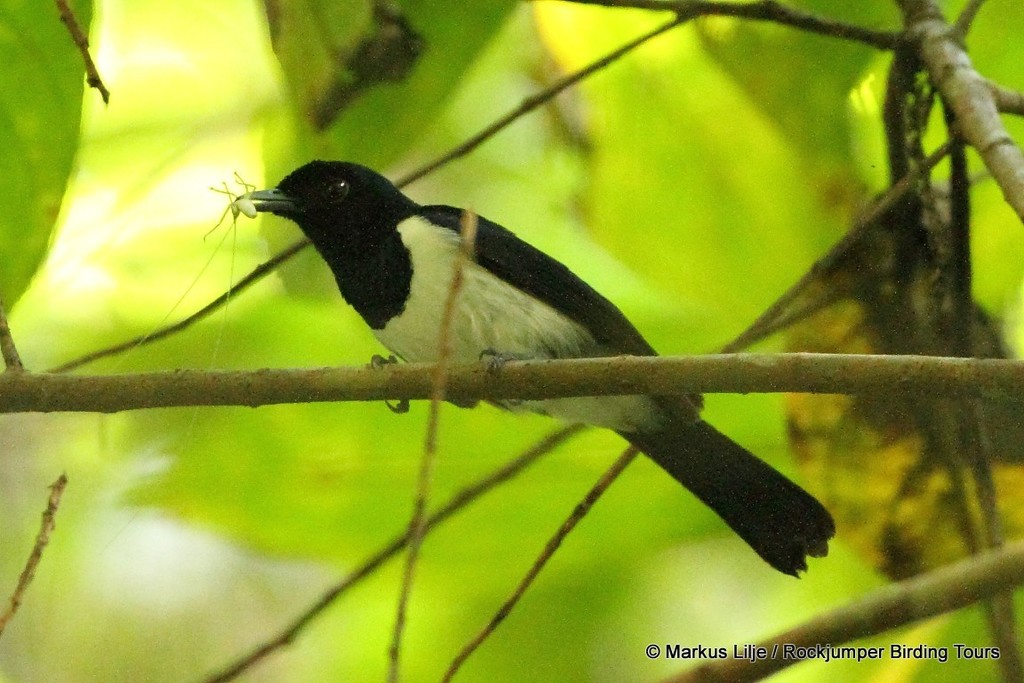
Hooded Monarch
Live sightings near you, the range map, bar charts of when it is seen, and Macaulay Library photos and recordings.
Hooded Monarch
Symposiachrus manadensis
The hooded monarch (Symposiachrus manadensis) is a species of bird in the family Monarchidae.
It is found on New Guinea. Its natural habitat is subtropical or tropical moist lowland forests. It is identified as jet black and with a white belly and feeds on small invertebrates and larvae.
From the article Hooded monarch on Wikipedia (CC BY-SA), quoted section by section
Range & habitat
As of 2024 the Hooded Monarch population is estimated to cover 950,000 km2 and are found between elevations up to 1,200m. Hooded Monarchs are recorded to stay inside of tropical and subtropical habitats, when foraging Hooded Monarchs are observed to hide within the middle level and underbrush of the forest . Hooded Monarchs have been recorded in the Lowlands and Hill Forest of New Guinea and Indonesia and have been observed to eat small invertebrates and larvae. They are irregularly distributed and may be absent from habitats identical to their own habitat due to their resident behaviors. Hooded Monarch sightings are most numerous in flat areas of their habitat.
Wikipedia: “Diet and Habitat”
What it does
Hooded Monarchs are observed to be solitary; most interactions that have been recorded between Hooded Monarchs were during their breeding season. With the exception that they have been recorded in mixed species flocks foraging for invertebrates and larvae In a mixed species flock setting Hooded Monarchs have been recorded associating with Timalidae and Pitohui uropygialis. Hooded Monarchs are classified as “residents” as they have not been recorded to migrate far from a specific location they make monotone whistles sounding like, “swee dee dee” or “dee-yuu, dewi dewi”. They can also make a single low-pitched note that has been compared to the sound of a Symposiachrus guttula.
Wikipedia: “Behaviors”
Listen
Looking for field recordings…
Where it lives
Recorded sightings
—
geo-referenced records in GBIF, from museums, herbaria and field observers.
Drag the globe to turn it. Dots are where records exist, not a range map; darker means more records.
In the stacks
Searching the stacks…
Every page naming Symposiachrus manadensis in the Biodiversity Heritage Library →
This page is assembled live from iNaturalist, GBIF, Wikipedia, the Source Library and the Internet Archive. It is not yet part of the hand-edited codex. iNaturalist taxon 144748.