On eBird ↗
Bornean Treepie
Live sightings near you, the range map, bar charts of when it is seen, and Macaulay Library photos and recordings.
Bornean Treepie
Dendrocitta cinerascens
The Bornean treepie (Dendrocitta cinerascens) is a passerine bird belonging to the treepies genus, Dendrocitta, of in the crow family, Corvidae. It is endemic to the island of Borneo. It is sometimes treated as a subspecies of the Sumatran treepie (D. occipitalis).
From the article Bornean treepie on Wikipedia (CC BY-SA), quoted section by section
Description
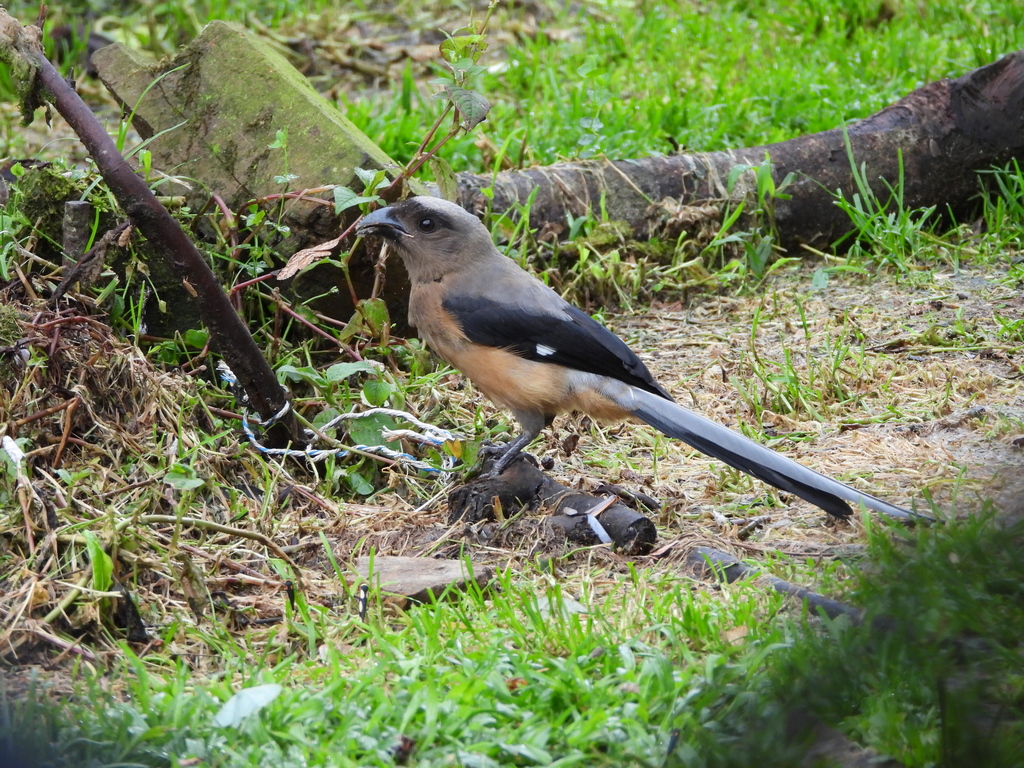
It is a fairly large bird, 40 centimetres in length, including a long graduated tail, broad rounded wings and short weak legs. The underparts are pinkish-brown. The head is also pinkish-brown with a pale silver crown and a dark stripe over the eye and across the forehead. The back is greyish and the rump is pale. The wings are black with a white patch and the tail is grey with black tips to the feathers. The bill and legs are grey-black and the eyes are reddish. The Sumatran treepie differs in having a pale brown back, a dark brown head with a white nape and a thinner bill. The Bornean treepie is a noisy bird with a variety of loud, explosive calls including a bell-like whistle and various grunting and chattering calls. It is able to mimic the calls of other birds.
What it does
It is fairly common in most mountain ranges in the northern and central parts of Borneo. It mainly occurs between 300 and 2,800 metres above sea-level, being most common in valleys and foothills at the lower end of that range. It inhabits forest, forest edge, bamboo thickets and scrubland and is sometimes seen in cultivated areas. It forages in the tree canopy, alone or in small groups, searching for small fruit, seeds and large insects such as beetles and cockroaches. It can become tame, visiting villages to feed on scraps. Little is known about its breeding habits. The nest is shallow, built of fine twigs and placed in a low tree. The eggs are greenish-white with brown markings concentrated in a ring at the wider end.
Wikipedia: “Ecology”
Listen
Looking for field recordings…
Where it lives
Recorded sightings
—
geo-referenced records in GBIF, from museums, herbaria and field observers.
Drag the globe to turn it. Dots are where records exist, not a range map; darker means more records.
In the stacks
Searching the stacks…
Every page naming Dendrocitta cinerascens in the Biodiversity Heritage Library →
This page is assembled live from iNaturalist, GBIF, Wikipedia, the Source Library and the Internet Archive. It is not yet part of the hand-edited codex. iNaturalist taxon 144755.