On eBird ↗
Thick-billed Lark
Live sightings near you, the range map, bar charts of when it is seen, and Macaulay Library photos and recordings.
Thick-billed Lark
Ramphocoris clotbey
The thick-billed lark (Ramphocoris clotbey) is a species of lark in the family Alaudidae native to north Africa and the far southwest of Asia, in the northern Sahara and Arabian Deserts.
From the article Thick-billed lark on Wikipedia (CC BY-SA), quoted section by section
Description
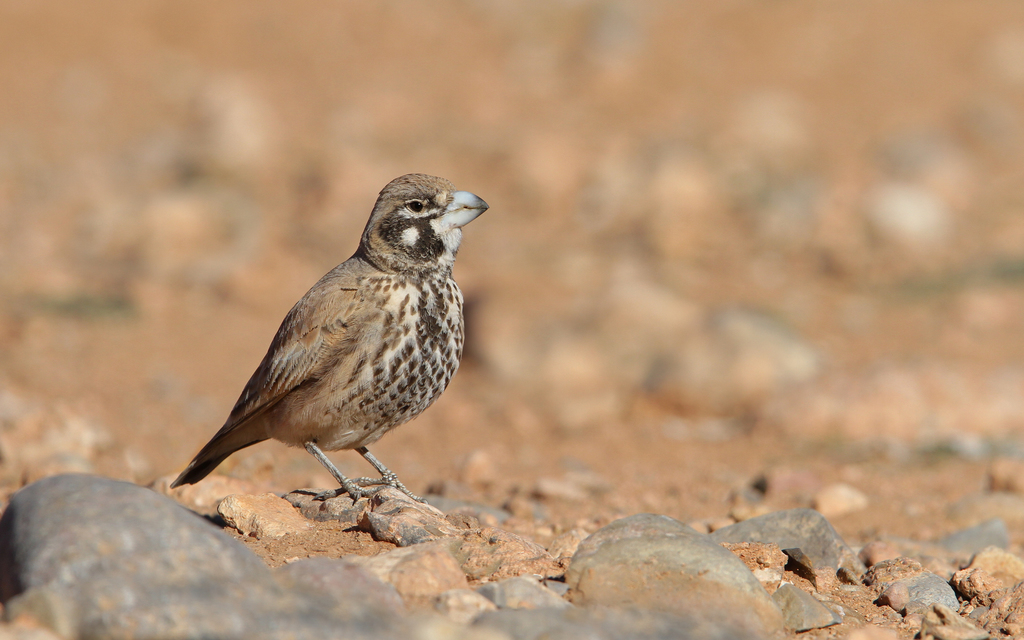
It is a large, stoutly-built lark, 17–18 cm long, with males weighing 52–55 g and females 45 g. The bill is exceptionally stout (the thickest of any lark), pale blue-grey with a darker grey tip and a bulbous curved culmen. The wing has a white trailing edge, conspicuous in flight, reminiscent of white-winged lark though with less extensive white than that species. Adult males have extensive black spots on the breast and a black face mask with white chin and spots below and round the eye; in females, the black markings are smaller and less well marked. Juveniles are even paler and sandy coloured, with little or no black.
Range & habitat
It is found in the northern Sahara Desert south of the Atlas Mountains, from Western Sahara and northern Mauritania through southern Morocco, central Algeria and southern Tunisia to Libya, also in central regions of the Arabian Peninsula north to Jordan, and more rarely in southern Syria. Its natural habitats are subtropical or tropical arid hot deserts.
Wikipedia: “Distribution and habitat”
What it does
It is resident or nomadic, noted for being mysteriously elusive, often hard to find; it lives singly or in small flocks, exceptionally up to 50 together. It feeds mainly on seeds, but also takes insects, including ants and locusts, these particularly being fed to nestlings. It breeds from February to May, laying 3–5 eggs in a nest on the ground lined with vegetation, often in shelter behind a stone or a shrub. Males have a territorial song delivered in flight.
Wikipedia: “Behaviour”
Listen
Looking for field recordings…
Where it lives
Recorded sightings
—
geo-referenced records in GBIF, from museums, herbaria and field observers.
Drag the globe to turn it. Dots are where records exist, not a range map; darker means more records.
In the stacks
Searching the stacks…
Every page naming Ramphocoris clotbey in the Biodiversity Heritage Library →
This page is assembled live from iNaturalist, GBIF, Wikipedia, the Source Library and the Internet Archive. It is not yet part of the hand-edited codex. iNaturalist taxon 144775.