On eBird ↗
Dusky Tit
Live sightings near you, the range map, bar charts of when it is seen, and Macaulay Library photos and recordings.
Dusky Tit
Melaniparus funereus
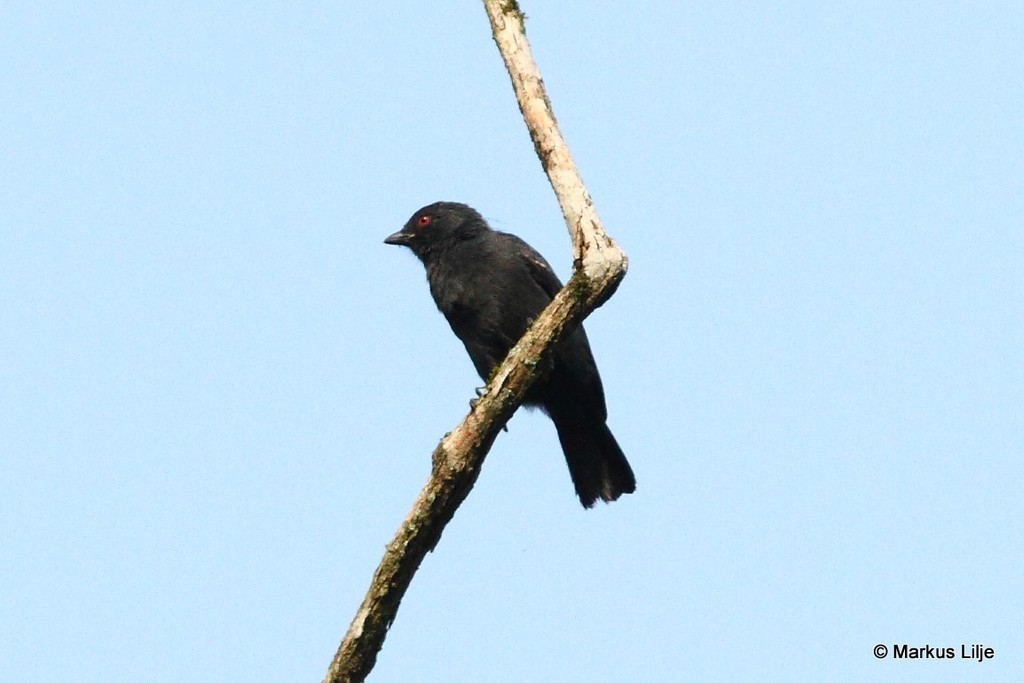
The dusky tit (Melaniparus funereus) is a species of bird in the tit family Paridae. It is found in Angola, Cameroon, Central African Republic, Republic of the Congo, Democratic Republic of the Congo, Ivory Coast, Gabon, Ghana, Guinea, Kenya, Liberia, Rwanda, Sierra Leone, South Sudan, and Uganda. Its natural habitat is subtropical or tropical moist lowland forests.
From the article Dusky tit on Wikipedia (CC BY-SA), quoted section by section
Description
The males are mostly black, and the only distinct color resides in the eyes. The eyes will almost always be primarily red, but can vary from red to orange-red. Another key feature is its bill, which is smaller and thus easier to identify. In general, the male is the dominant sex. Therefore, its length will vary more towards the 14-15 cm mark. The female has similar characteristics as the male; however, the upper body parts are more blackish-gray. Their tail is fringed gray and brown; however, the bill is still small, and they have red or orange eyes. In general, the females have lighter features than the males, as the females' underparts and faces are relatively more gentle than those of a male. The female's size is between 13 and 14 cm. The dusky tit juvenile holds the same characteristics as the male; however, its upper parts are more blackish brown, and no glossy feathers are portrayed in the females.
Wikipedia: “Characteristics”
Range & habitat
The birds primarily live in humid forests around central Africa, including Angola, the DR Congo, South Sudan, Uganda, Liberia, Ghana, and Kenya. They are mostly found in old plantations, edges of cultivation, and forests.
Wikipedia: “Range and habitat”
What it does
The dusky tit mainly feeds on small invertebrates, beetles, and orthopterans, micro-lepidopterans, but also consumes seeds and fruits.
Wikipedia: “Diet”
Listen
Looking for field recordings…
Where it lives
Recorded sightings
—
geo-referenced records in GBIF, from museums, herbaria and field observers.
Drag the globe to turn it. Dots are where records exist, not a range map; darker means more records.
In the stacks
Searching the stacks…
Every page naming Melaniparus funereus in the Biodiversity Heritage Library →
This page is assembled live from iNaturalist, GBIF, Wikipedia, the Source Library and the Internet Archive. It is not yet part of the hand-edited codex. iNaturalist taxon 144839.