On eBird ↗
Sinaloa Wren
Live sightings near you, the range map, bar charts of when it is seen, and Macaulay Library photos and recordings.
Sinaloa Wren
Thryophilus sinaloa
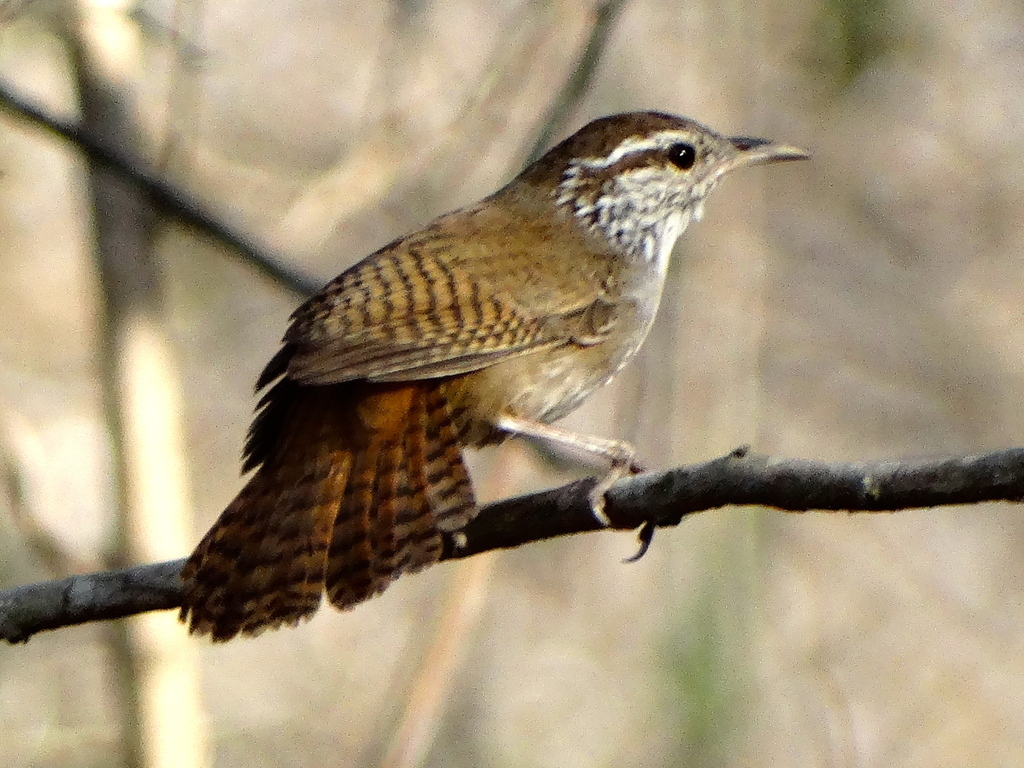
The Sinaloa wren (Thryophilus sinaloa) is a species of bird in the family Troglodytidae. It is endemic to Mexico, with two documented sightings in the United States, both in Arizona.
From the article Sinaloa wren on Wikipedia (CC BY-SA), quoted section by section
Description
The Sinaloa wren is 11.8 to 14 cm (4.6 to 5.5 in) long and weighs 10.9 to 19.8 g (0.38 to 0.70 oz). The nominate adults have dull brown upperparts that become more rufescent on the rump. The tail is rufous brown with black or dusky bars. They have a white to buffy white supercilium, a black streak behind the eye, and dusky-striped white cheeks. The sides of the neck have broad black and white streaks. The throat and breast are white darkening to pale brown on the flanks. Juveniles are similar but their flanks are paler and more cinnamon and the facial markings less distinct. The adult T. s. cinereus is paler and grayer than the nominate. T. s. russeus' upperparts are a deep russet brown.
Range & habitat
The Sinaloa wren is endemic to Mexico though individuals are seen almost annually in southern Arizona. T. s. cinereus is the northernmost subspecies; it is found from northeastern Sonora south to northern Sinaloa and western Chihuahua and as a visitor to Arizona. T. s. sinaloa is found from central Sinaloa and western Durango south to Michoacán. T. s. russeus is found from central Guerrero east to western Oaxaca. The species inhabits the understory of deciduous forest and its edges, both undisturbed and second growth. It also occurs in plantations.
Wikipedia: “Distribution and habitat”
What it does
Though no specifics have been published, the Sinaloa wren is known to be insectivorous. It forages mostly near the ground but occasionally as high as 10 m (33 ft) above it. It is assumed to capture its prey mostly by gleaning.
Wikipedia: “Feeding”
Listen
Looking for field recordings…
Where it lives
Recorded sightings
—
geo-referenced records in GBIF, from museums, herbaria and field observers.
Drag the globe to turn it. Dots are where records exist, not a range map; darker means more records.
In the stacks
Searching the stacks…
Every page naming Thryophilus sinaloa in the Biodiversity Heritage Library →
This page is assembled live from iNaturalist, GBIF, Wikipedia, the Source Library and the Internet Archive. It is not yet part of the hand-edited codex. iNaturalist taxon 144868.