On eBird ↗
Stripe-breasted Wren
Live sightings near you, the range map, bar charts of when it is seen, and Macaulay Library photos and recordings.
Stripe-breasted Wren
Cantorchilus thoracicus
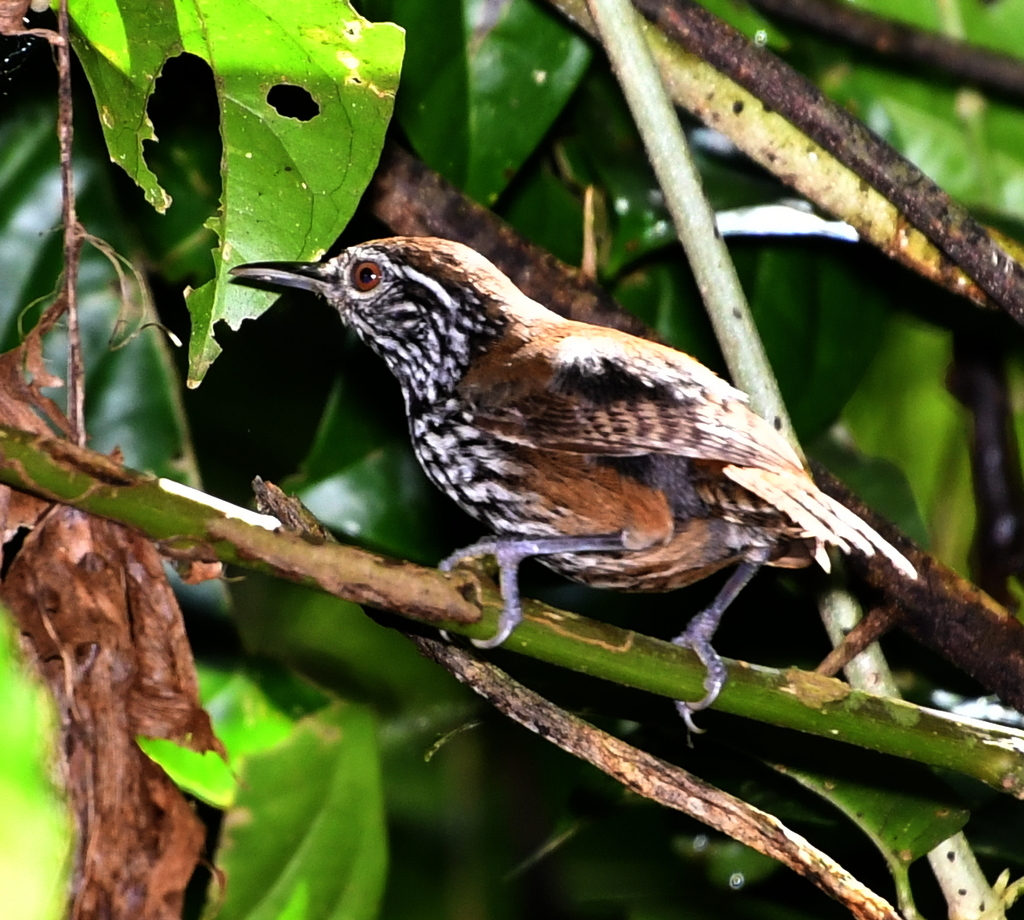
The stripe-breasted wren (Cantorchilus thoracicus) is a species of bird in the family Troglodytidae. It is found in Honduras, Nicaragua, Costa Rica, and Panama. Its natural habitats are subtropical or tropical moist lowland forests and heavily degraded former forest.
From the article Stripe-breasted wren on Wikipedia (CC BY-SA), quoted section by section
Description
The stripe-breasted wren is 11.5 to 12.5 cm (4.5 to 4.9 in) long and has a mean weight of 17.6 g (0.62 oz). Adults have a gray-brown crown, dark umber shoulders, back, and rump, and a dull blackish tail with buffy bars. Their face and sides of the neck have white streaks over a blackish base. Their throat and chest have black, white, and gray lengthwise streaks that stop abruptly at the plain olive-brown lower belly. Juveniles' upperparts are more russet than the adults' and the throat and chest have grayish brown, white, and dusky stripes.
Range & habitat
The stripe-breasted wren is found on the Caribbean slope of Middle America from eastern Honduras south through northeastern Nicaragua and eastern Costa Rica into Panama almost to the Canal Zone. It inhabits thick vegetation along woodland edges, in clearings, and along streams; in Costa Rica it is also found in cacao and shade coffee plantations. In elevation it ranges from sea level to 1,100 m (3,600 ft).
Wikipedia: “Distribution and habitat”
What it does
The stripe-breasted wren usually forages in low dense vegetation. Its diet has not been fully documented but is known to include insects and spiders.
Wikipedia: “Feeding”
Listen
Looking for field recordings…
Where it lives
Recorded sightings
—
geo-referenced records in GBIF, from museums, herbaria and field observers.
Drag the globe to turn it. Dots are where records exist, not a range map; darker means more records.
In the stacks
Searching the stacks…
Every page naming Cantorchilus thoracicus in the Biodiversity Heritage Library →
This page is assembled live from iNaturalist, GBIF, Wikipedia, the Source Library and the Internet Archive. It is not yet part of the hand-edited codex. iNaturalist taxon 144872.