On eBird ↗
Riverside Wren
Live sightings near you, the range map, bar charts of when it is seen, and Macaulay Library photos and recordings.
Riverside Wren
Cantorchilus semibadius
The riverside wren (Cantorchilus semibadius) is a species of bird in the Troglodytidae family. It is found in Costa Rica and Panama. Its natural habitat is subtropical or tropical moist lowland forests.
From the article Riverside wren on Wikipedia (CC BY-SA), quoted section by section
Description
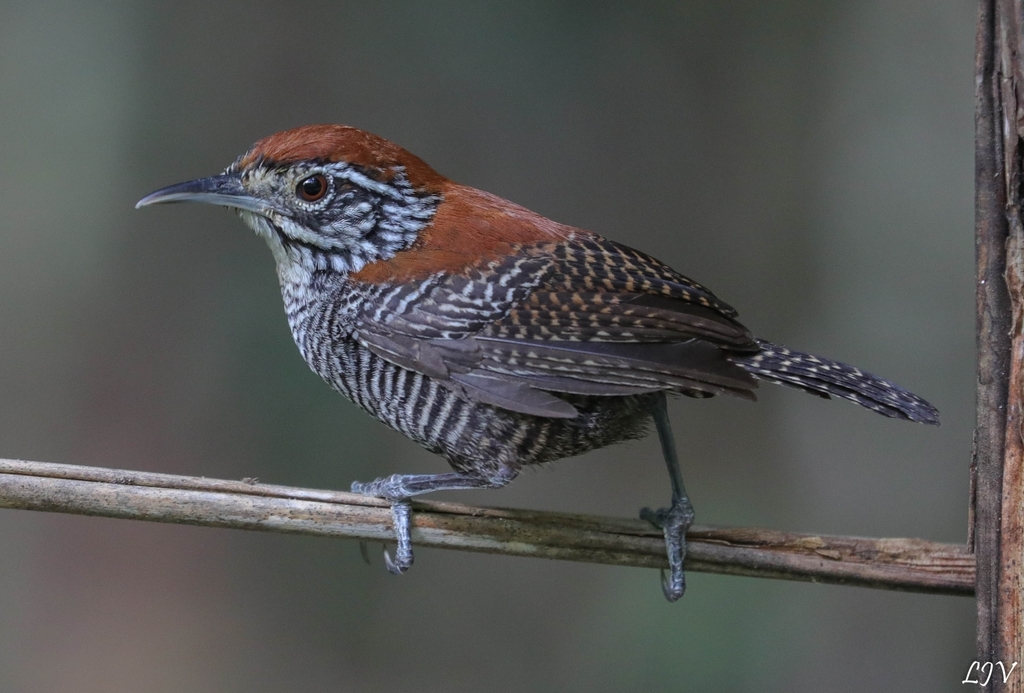
The riverside wren is 13 to 14 cm (5.1 to 5.5 in) long and weighs 17 g (0.60 oz). The adults have a bright orange-brown crown; chestnut nape, back, and rump; and a blackish tail with buff-white bars. They have a black-over-white supercilium and the rest of the face is streaked and spotted black and white. From throat to vent their underparts are pale gray with narrow black bars; the gray becomes somewhat buffy to the rear. Juveniles are duller overall, have fine black scaling on the crown, and the underparts' black bars are not as crisp.
Range & habitat
The riverside wren is found along the Pacific slope from Costa Rica's Gulf of Nicoya into western Panama. It inhabits dense vegetation, preferably along watercourses, swampy edges of woodlands, or on steep precipices. In elevation it ranges from sea level to 1,200 m (3,900 ft).
Wikipedia: “Distribution and habitat”
What it does
The riverside wren forages near the ground, usually in pairs or family groups. It sometimes briefly joins other species at army ant swarms. Its diet includes insects and other invertebrates.
Wikipedia: “Feeding”
Listen
Looking for field recordings…
Where it lives
Recorded sightings
—
geo-referenced records in GBIF, from museums, herbaria and field observers.
Drag the globe to turn it. Dots are where records exist, not a range map; darker means more records.
In the stacks
Searching the stacks…
Every page naming Cantorchilus semibadius in the Biodiversity Heritage Library →
This page is assembled live from iNaturalist, GBIF, Wikipedia, the Source Library and the Internet Archive. It is not yet part of the hand-edited codex. iNaturalist taxon 144875.