On eBird ↗
Bay Wren
Live sightings near you, the range map, bar charts of when it is seen, and Macaulay Library photos and recordings.
Bay Wren
Cantorchilus nigricapillus
The bay wren (Cantorchilus nigricapillus) is an attractive and highly vocal wren species, readily observed in forested areas, especially along watercourses, in the lowlands and foothills of parts of southern Central America and northwestern South America. Its distinctive vocalizations draw attention to this inquisitive species, which is nevertheless an expert skulker.
From the article Bay wren on Wikipedia (CC BY-SA), quoted section by section
Description
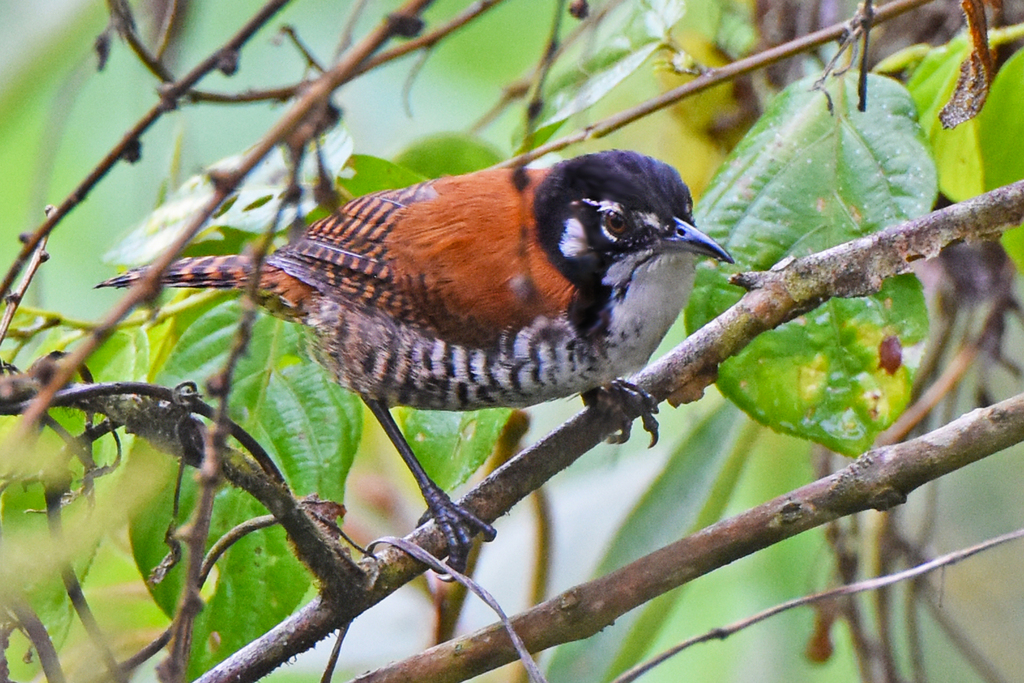
The bay wren is 12.6 to 15.6 cm (5.0 to 6.1 in) long. Eight specimens from Panama weighed 17.7 to 26.3 g (0.62 to 0.93 oz). Adults of the nominate subspecies have a black face with a narrow white supercilium, a partial eyering, and a white patch at the back of the cheek. Their crown and nape are black and the rest of the upperparts are rich chestnut. The tail is a rich brown with bold black bars. The throat and breast are white, transitioning to rufous brown on the lower belly and flanks. Black bars cross the underparts from the breast to the vent area. Juveniles have essentially the same pattern but are paler and with less well defined markings. The other subspecies vary from the nominate in the extent and intensity of some colors and the thickness and amount of barring.
Range & habitat
The bay wren's range spans from Nicauagua to Ecuador. The subspecies are found thus:
C. n. costaricensis, from northeastern Nicaragua through Caribbean Costa Rica into western Panama C. n. castaneus, from west-central Panama's Veraguas Province to the Canal Zone C. n. odicus, Isla Escudo de Veraguas off the Caribbean coast of western Panama C. n. reditus, the Caribbean slope of eastern Panama C. n. schottii, from eastern Panama's Darién Province into Antioquia and Chocó Departments of northwestern Colombia C. n. connectens from Cauca and Nariño Departments in southwestern Colombia into Esmeraldas Province in far northern Ecuador C. n. nigricapillus western Ecuador from Esmeraldas south to El Oro Province The bay wren is closely tied to water over most of its range, though in Nicaragua the habitat is drier. It inhabits dense, fairly low, vegetation such as thickets along watercourses, overgrown clearings, roadsides, and the understory of secondary forest. It will occur in forest interiors if the undergrowth is sufficient.
Wikipedia: “Distribution and habitat”
What it does
The bay wren's diet appears to be entirely invertebrates. They forage by gleaning from foliage and branches and by probing hanging vegetation and tangles of vines.
Wikipedia: “Feeding”
Listen
Looking for field recordings…
Where it lives
Recorded sightings
—
geo-referenced records in GBIF, from museums, herbaria and field observers.
Drag the globe to turn it. Dots are where records exist, not a range map; darker means more records.
In the stacks
Searching the stacks…
Every page naming Cantorchilus nigricapillus in the Biodiversity Heritage Library →
This page is assembled live from iNaturalist, GBIF, Wikipedia, the Source Library and the Internet Archive. It is not yet part of the hand-edited codex. iNaturalist taxon 144876.