On eBird ↗
Fawn-breasted Wren
Live sightings near you, the range map, bar charts of when it is seen, and Macaulay Library photos and recordings.
Fawn-breasted Wren
Cantorchilus guarayanus
The fawn-breasted wren (Cantorchilus guarayanus) is a species of bird in the family Troglodytidae, the wrens. It is found in Bolivia, Brazil, and Paraguay. Its natural habitats are subtropical or tropical dry forests, subtropical or tropical moist lowland forests, subtropical or tropical swamps, and heavily degraded former forest.
From the article Fawn-breasted wren on Wikipedia (CC BY-SA), quoted section by section
Description
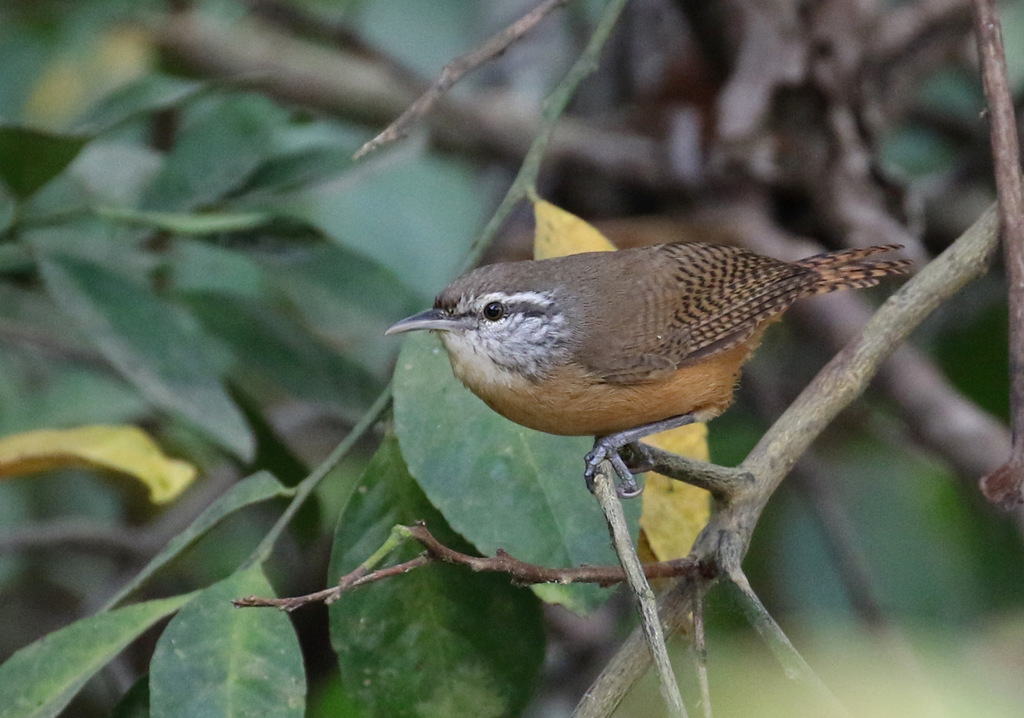
The fawn-breasted wren is 13.5 cm (5.3 in) long and weighs 13 to 14 g (0.46 to 0.49 oz). Adults have a plain medium brown crown and upperparts that becomes rufescent on the lower back and rump. Their tail is reddish brown with crisp black bars. They have a narrow white supercilium mostly behind the eye, cheeks mottled gray-white and blackish, and black malar and moustachial stripes. Their chin is whitish, the chest a warm orange-buff, and the belly and vent area a deeper orange-buff. Juveniles are similar but their facial markings are less distinct.
Range & habitat
The fawn-breasted wren is found across much of northeastern Bolivia, a fairly thin slice of adjacent western Brazil, and a small part of northeastern Paraguay. It inhabits várzea scrubland and secondary forest, mostly near water. In elevation it ranges up to approximately 400 m (1,300 ft).
Wikipedia: “Distribution and habitat”
What it does
The fawn-breasted wren forages in pairs during the dry season and small family groups after nesting. It hunts in dense growth, usually from the ground up to 4 m (13 ft) above it, but sometimes as high as 10 m (33 ft). Its diet has not been documented.
Wikipedia: “Feeding”
Listen
Looking for field recordings…
Where it lives
Recorded sightings
—
geo-referenced records in GBIF, from museums, herbaria and field observers.
Drag the globe to turn it. Dots are where records exist, not a range map; darker means more records.
In the stacks
Searching the stacks…
Every page naming Cantorchilus guarayanus in the Biodiversity Heritage Library →
This page is assembled live from iNaturalist, GBIF, Wikipedia, the Source Library and the Internet Archive. It is not yet part of the hand-edited codex. iNaturalist taxon 144880.