On eBird ↗
White-browed Babbler
Live sightings near you, the range map, bar charts of when it is seen, and Macaulay Library photos and recordings.
White-browed Babbler
Pomatostomus superciliosus
The white-browed babbler (Pomatostomus superciliosus) is a small, gregarious species of bird in the family Pomatostomidae. They are endemic to the open woodlands and shrubby areas of central and southern Australia. The Latin name superciliosus refers to the supercilium, or 'eyebrow', which is a feature synonymous with the pomatostomine babblers (Hall's babbler, chestnut-crowned babbler, grey-crowned babbler, and white-browed babbler).
From the article White-browed babbler on Wikipedia (CC BY-SA), quoted section by section
Description
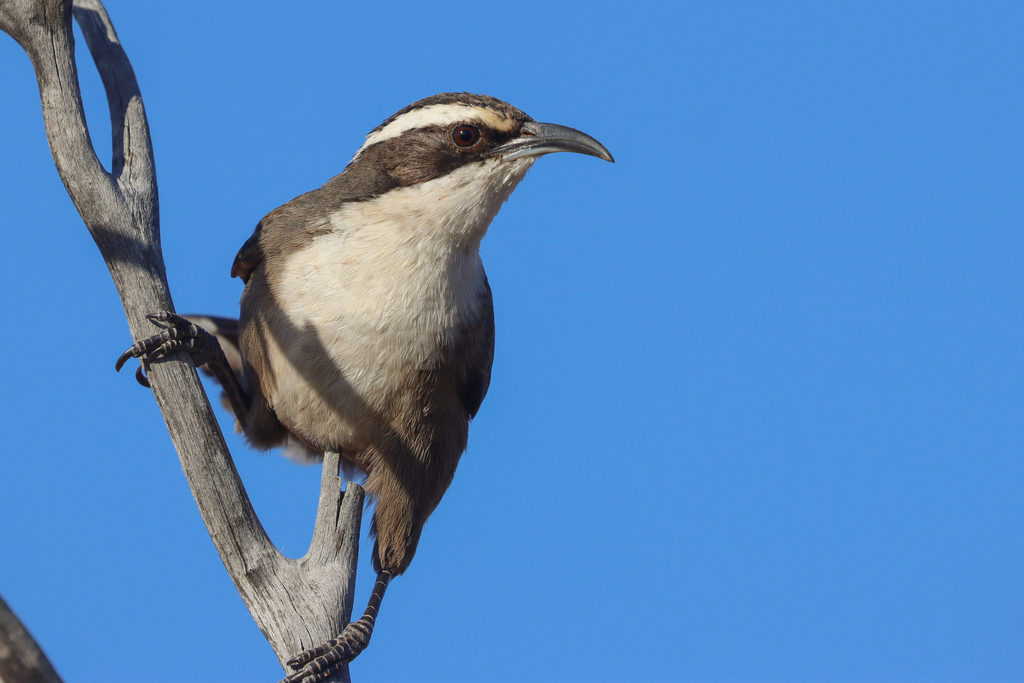
Ranging from 17 cm to 21 cm in length, the white-browed babbler is the smallest of the Australian babblers. It is a medium-sized terrestrial bird with a long and decurved bill. The wings are short and rounded in shape, adjacent to a plump, full body which is similar but slightly smaller than the chestnut-crowned or Hall's babbler. The tail is long and graduated, ending with a rounded tip. The gregarious nature of this species means that the tail is often fanned, raised, or a mix of the two. There are many variations to colour; however, the adult babbler generally varies from a dark grey-brown to solid dark brown with distinguished white supercilium and dark brown eye stripe. The underside is usually lighter in colour, varying from light grey or white to light brown; sometimes lighter for females, but generally sexes are similar. Juveniles often have more pronounced dark plumage with a chestnut or cinnamon motif, especially on the underside. Breeding adult males may sometimes have a more pronounced brown 'cap' compared to females or juveniles.
Similar species. Hall's babbler is the species most often confused with the white-browed babbler because of their similarity in size. The two can best be distinguished by comparing the supercilium. Hall's babbler has a narrow and very dark brown crown-stripe with a much broader, vivid white supercilium. …
Range & habitat
The habitat for the white-browed babbler varies across the southern regions of Australia, from dry sclerophyll woodlands, shrublands, heathland, semiarid grasslands and open forests. They prefer areas with a dense understory of shrubs or spinifex for protection and nesting. Their range extends through arid and semiarid areas all the way across the South Australian coastline to Western Australia, and by doing so, it crosses many different ecological vegetation classes (EVCs). No preference seems to be shown with the overall composition of habitat, only that when the understory provides good quality protection from the environment and predators, the species is more successful. Populations have been found in many locations across southern Australia, including dry, rocky gibber desert, mulga, eucalyptusor acacia woodlands Studies have also found many populations in and around human-related infrastructure (see below). Babblers spend the majority of their time foraging through leaf litter on the ground, although during nesting periods they retreat to nests inside hollowed logs, grass clumps, fallen branches or shrubs.
Wikipedia: “Habitat”
What it does
The diet of the white-browed babbler varies depending on the area that they live in and the availability of food sources. Insects, spiders, amphibians, crustaceans, reptiles, fruit, seeds and nuts have been found to be part of their diet, most commonly varieties of these which can be found on the ground where they spend the majority of their time. Adult feeding individuals have a log or branch from which they hide in and return, rarely venturing from their nest or feeding areas that are known to them. Juveniles without partners tend to be more adventurous while feeding or searching for partners, although they still move between safe areas.
Wikipedia: “Feeding and diet”
Listen
Looking for field recordings…
Where it lives
Recorded sightings
—
geo-referenced records in GBIF, from museums, herbaria and field observers.
Drag the globe to turn it. Dots are where records exist, not a range map; darker means more records.
In the stacks
Searching the stacks…
Every page naming Pomatostomus superciliosus in the Biodiversity Heritage Library →
This page is assembled live from iNaturalist, GBIF, Wikipedia, the Source Library and the Internet Archive. It is not yet part of the hand-edited codex. iNaturalist taxon 14491.