On eBird ↗
Philippine Bulbul
Live sightings near you, the range map, bar charts of when it is seen, and Macaulay Library photos and recordings.
Philippine Bulbul
Hypsipetes philippinus
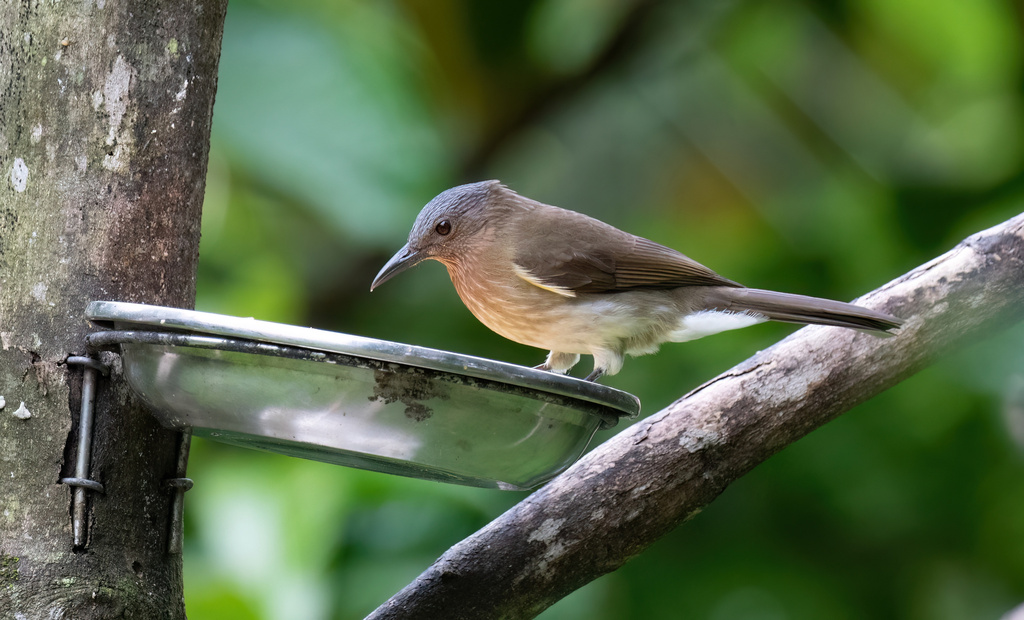
The Philippine bulbul (Hypsipetes philippinus) is a songbird species in the bulbul family (Pycnonotidae). It is often placed in the genus Ixos, but is better retained in Hypsipetes as long as this is not entirely merged into Ixos, as it is quite closely related to the type species of Hypsipetes, the black bulbul (H. leucocephalus).
From the article Philippine bulbul on Wikipedia (CC BY-SA), quoted section by section
Description
The Philippine bulbul was originally described in the genus Turdus and later placed in the genus Ixos. In 2010, it was re-classified to the genus Hypsipetes as it is very closely related to the type species of that genus, the black bulbul. Until 2010, the Mindoro bulbul, Visayan bulbul and Zamboanga bulbul were all considered as subspecies of the Philippine bulbul. The Philippine bulbul differs from the rest with its lighter plummage, smaller bill and different call.
Subspecies. Three subspecies are currently recognized:
Hypsipetes philippinus parkesi - (du Pont, 1980): Found on Burias Hypsipetes philippinus philippinus - (Forster, 1795): Found in northern Philippines Hypsipetes philippinus saturatior - (Hartert, 1916): Found in eastern-central and southern Philippines
Wikipedia: “Description and taxonomy”
Range & habitat
Its natural habitat is tropical moist lowland forest, forest edge, clearings, and coconut groves up to 2,000 meters above sea level. A common and adaptable bird as long as sufficient forest remains, it is not considered a threatened species by the IUCN.
Wikipedia: “Habitat and conservation status”
What it does
It is a generalist that feeds on fruit and insects. Fledglings of the Philippine bulbul were recorded on Mindanao in late April, but the breeding season seems to be prolonged as females with ripe ovarian follicles were still found in April and May. Territorial songs are heard at lower altitudes as late as May, while further upslope the birds are silent at that time of year and presumably engaged in breeding activity. The besra has been recorded as a predator of young Philippine bulbuls, and this or other goshawks might also catch adult birds.
Wikipedia: “Behaviour and ecology”
Listen
Looking for field recordings…
Where it lives
Recorded sightings
—
geo-referenced records in GBIF, from museums, herbaria and field observers.
Drag the globe to turn it. Dots are where records exist, not a range map; darker means more records.
In the stacks
Searching the stacks…
Every page naming Hypsipetes philippinus in the Biodiversity Heritage Library →
This page is assembled live from iNaturalist, GBIF, Wikipedia, the Source Library and the Internet Archive. It is not yet part of the hand-edited codex. iNaturalist taxon 144916.