- Animals
- ›Chordates
- ›Vertebrates
- ›Birds
- ›Perching Birds
- ›Old World Flycatchers, Robins, and Chats
- ›Cercotrichas
On eBird ↗
White-browed Scrub-Robin
Live sightings near you, the range map, bar charts of when it is seen, and Macaulay Library photos and recordings.
White-browed Scrub-Robin
Cercotrichas leucophrys
The white-browed scrub robin (Cercotrichas leucophrys), also known as the red-backed scrub-robin ( Erythropygia leucophrys), is a species of bird in the family Muscicapidae. It is found in Angola, Botswana, Burundi, Republic of the Congo, Democratic Republic of the Congo, Djibouti, Ethiopia, Gabon, Kenya, Malawi, Mozambique, Namibia, Rwanda, Somalia, South Africa, South Sudan, Swaziland, Tanzania, Uganda, Zambia, and Zimbabwe. Its natural habitats are subtropical or tropical dry forests and dry savanna.
From the article White-browed scrub robin on Wikipedia (CC BY-SA), quoted section by section
Description
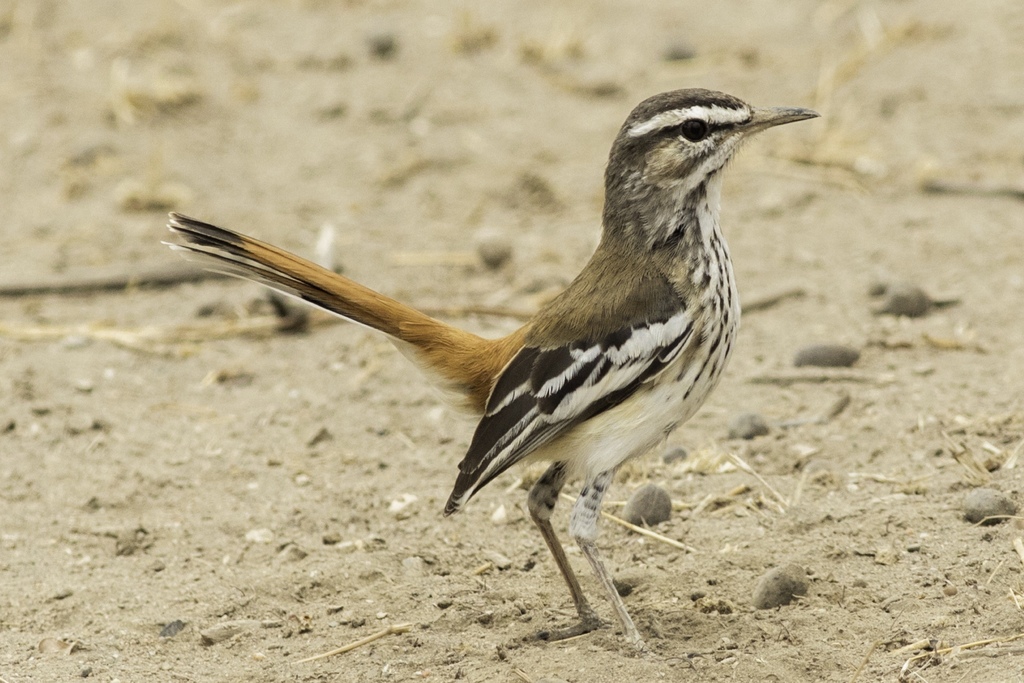
The white-browed scrub robin measures 14.0–16.5 cm from bill tip to tail tip and the sexes are alike. The pale superciliary stripe is distinct, and the crown may be warm brown, olive brown or greyish brown. The wings are dusky but well-marked. Greater and lesser wing coverts are always white-tipped, but the secondaries are with or without white edging. Amount of streaking on the breast is very variable, in subsp. ovamboensis it is reduced to fine streaking encircling the throat. The breast and flanks are washed with a variable amount of tawny buff. The mantle and back is brownish to hazel or rufous, depending on the subspecies. The tail is greyish brown to rufous, with a black subterminal band and white feather tips and corners. Juveniles are mottled but with the tail pattern of adults.
Range & habitat
The white-browed scrub robin is found in Angola, Botswana, Burundi, Republic of the Congo, DRC, Djibouti, Eswatini, Ethiopia, Gabon, Kenya, Malawi, Mozambique, Namibia, Rwanda, Somalia, South Africa, South Sudan, Tanzania, Uganda, Zambia, and Zimbabwe. Its range spans tropical, subtropical and temperate latitudes. It is present and usually common in any mesic to arid woodland or savanna, provided that there is cover, open scrub or thickets. In the Eastern Highlands it is only present up to 1,400 metres, and in East Africa up to 1,500 metres. It is replaced on the Kalahari sands by the Kalahari scrub robin, while in the Horn of Africa it is sympatric with the rufous bush chat, which lacks any white in the wings. Suitable habitat is usually grassy, which facilitates nesting.
Wikipedia: “Distribution and habitat”
What it does
Sedentary except in the far south. A restless but shy species which mostly sings from concealment inside bushes. It hops on the ground when foraging. As with some other scrub robin species, the tail is regularly flicked and fanned, and the wings may be drooped. The alarm is a sharp skirr or skee-ip note. The loud and variable song may include countless, sometimes identical repetitions. The songs of the respective subspecies are believed to be distinguishable, and those of the 'white-winged' group are considered to be shriller. It feeds on insects, especially termites and ants.
Breeding. Pairs are monogamous and nest solitarily from early to midsummer. The nest is built from dry grass by the female only, and is placed some 10 to 20 cm up at the heart of a grass tuft. Usually three eggs are laid and these are incubated by the female only. The cream-coloured eggs, measuring 20 x 14 mm, are blotched with brown and purple around the thicker end. The chicks are reared by both parents. Some nests are parasitised by cuckoos.
Wikipedia: “Behaviour”
Listen
Looking for field recordings…
Where it lives
Recorded sightings
—
geo-referenced records in GBIF, from museums, herbaria and field observers.
Drag the globe to turn it. Dots are where records exist, not a range map; darker means more records.
In the stacks
Searching the stacks…
Every page naming Cercotrichas leucophrys in the Biodiversity Heritage Library →
This page is assembled live from iNaturalist, GBIF, Wikipedia, the Source Library and the Internet Archive. It is not yet part of the hand-edited codex. iNaturalist taxon 145030.