On eBird ↗
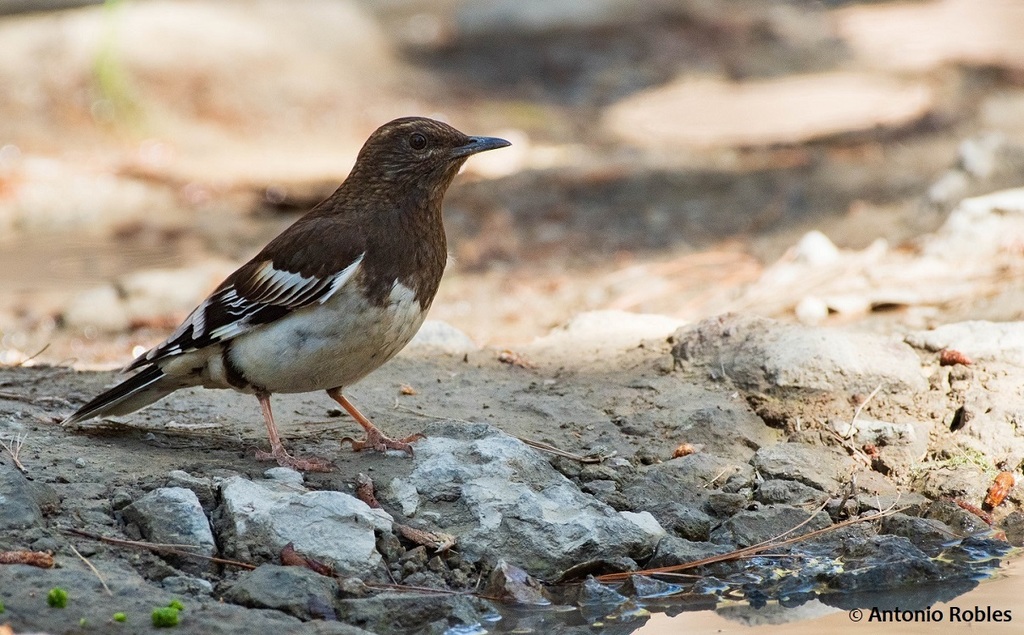
Aztec Thrush
Live sightings near you, the range map, bar charts of when it is seen, and Macaulay Library photos and recordings.
Aztec Thrush
Ridgwayia pinicola
The Aztec thrush (Ridgwayia pinicola) is a species of bird in the family Turdidae. It is found mainly in Mexico, but vagrants are occasionally seen in the United States. Its natural habitat is montane forests. The IUCN Red List denotes it as a least-concern species.
From the article Aztec thrush on Wikipedia (CC BY-SA), quoted section by section
Description
The Aztec thrush is 21.5–24 cm (8.5–9.4 in) long and weighs 67–88 grams (2.4–3.1 oz). The adult male has a dark brown hood, the head, neck and upper mantle being dark brown, with pale flecks or streaks. There may be a pale brown supercilium. The back, scapulars, median coverts and greater coverts are dark brown, the greater coverts having white edges. The primary coverts are black, with grey tips. The flight feathers are black, with some white patches. The lesser and median coverts of the underwing are white, and the greater coverts are blackish grey. The tail is black or blackish brown, with whitish grey tips. The breast is dark brown, and the rest of the underparts is white. The beak is dark brown, and the legs are pale pink. The female does not have a hood, is paler, and has larger streaks. The juvenile bird is blackish, with golden-buff marks on its head and back. It has a cinnamon or reddish-brown lower back, a black tail and scaled underparts.
Range & habitat
The species is found in Mexico, in mountains 1,800–3,500 m (5,900–11,500 ft) above sea level. Its habitat is mostly ravines of pine and pine-oak forests. The Aztec thrush is a vagrant in western Texas to southeastern Arizona. The first record in the United States was an immature bird observed in 1977 in Big Bend National Park, Texas.
Wikipedia: “Distribution and habitat”
What it does
This bird usually associates in small groups, sometimes joining mixed-species foraging flocks. It forages in dense vegetation on the ground and eats berries and insects. It has been observed cocking its head while feeding. Its calls include wheeerr, prreep, whein and sweee-uh, and its song is the call repeated and mixed with some other sounds. In the southern part of its range, breeding takes place from May to June. The nest is cup-shaped and made of grass and moss. The eggs are pale blue.
Wikipedia: “Behaviour”
Listen
Looking for field recordings…
Where it lives
Recorded sightings
—
geo-referenced records in GBIF, from museums, herbaria and field observers.
Drag the globe to turn it. Dots are where records exist, not a range map; darker means more records.
In the stacks
Searching the stacks…
Every page naming Ridgwayia pinicola in the Biodiversity Heritage Library →
This page is assembled live from iNaturalist, GBIF, Wikipedia, the Source Library and the Internet Archive. It is not yet part of the hand-edited codex. iNaturalist taxon 145089.