On eBird ↗
Garden Sunbird
Live sightings near you, the range map, bar charts of when it is seen, and Macaulay Library photos and recordings.
Garden Sunbird
Cinnyris jugularis
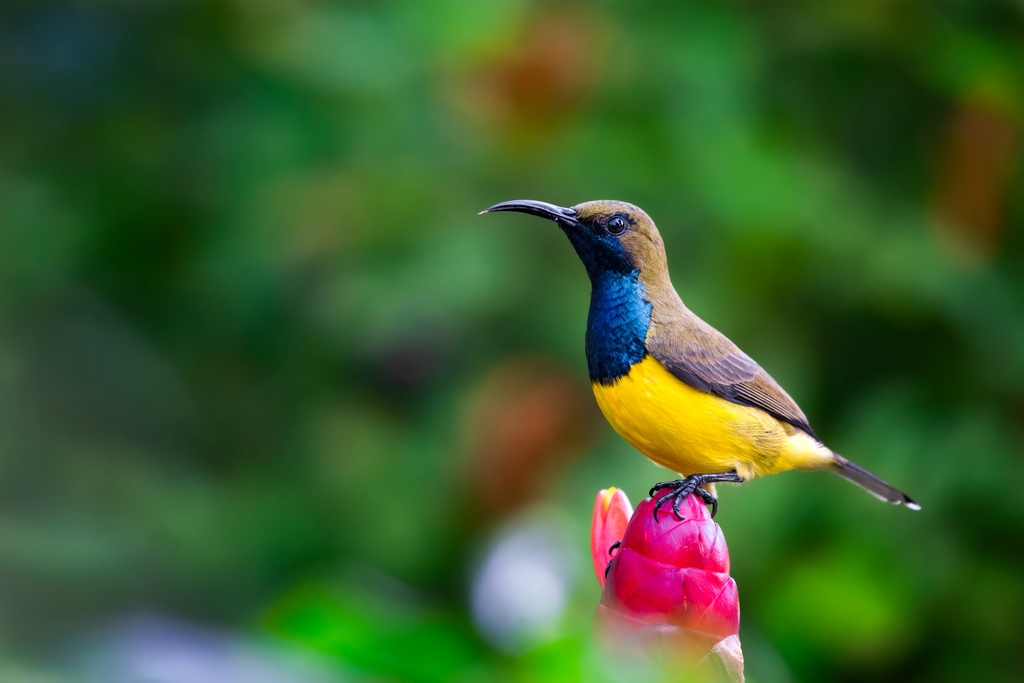
The garden sunbird (Cinnyris jugularis), previously known as the olive-backed sunbird, is a species of passerine bird in the family Nectariniidae that is found in the Philippines except on the Palawan island group. It was formerly considered to be conspecific with seven other species: the ornate sunbird, Palawan sunbird, Sahul sunbird, Tukangbesi sunbird, Flores Sea sunbird, South Moluccan sunbird and the Mamberamo sunbird.
It is a small, brightly coloured bird with olive-green plumage on the wings and back with a bright yellow chest. It has a long downward-curved bill it uses for taking nectar and capturing insects. It is primarily nectarivorous, but will take insects and spiders, particularly when feeding chicks.
From the article Garden sunbird on Wikipedia (CC BY-SA), quoted section by section
Description
The garden sunbird is 10–11.4 cm (3.9–4.5 in) in size; males weigh 6.7–11.9 g (0.24–0.42 oz) and females 6–10 g (0.21–0.35 oz). The male in its nominate (jugularis) form displays an olive hue on its upper body, featuring black wing feathers with green edges and a black tail adorned with white tips. The areas around its eyes (lores), neck, chin, throat, and breast are dark and iridescent, accompanied by yellow pectoral tufts. The lower portion of the bird is dark yellow, sometimes with a brown band encircling the gorget area. The iris is dark brown, while its bill and legs are black. Non-breeding males often have the glossy black coloration limited to the central throat stripe, which may represent juvenile birds transitioning to their adult plumage. In contrast, the female exhibits an upper body of greenish olive, featuring a pale-yellowish stripe above the eyes, yellowish borders on its wing feathers, a tail with black and white markings, and a deep yellow color on the lower portion of its body, slightly lighter on the undertail feathers. Juvenile birds resemble the female but tend to be paler and browner in appearance.
Range & habitat
The garden sunbird is found on the Philippine islands except on the Palawan archipelago which is occupied by the similar Palawan sunbird. It inhabits forests, shrublands, grasslands and artificial habitats. The garden sunbird has adapted well to human environments and is common in fairly densely populated areas, where it builds nests in human settlements.
Wikipedia: “Distribution and habitat”
What it does
The female garden sunbird builds the nest using grass, cotton, moss, lichens, leaf fragments, vegetable fibers, and spider webs, lined with bark or feathers. The nest has the form of a hanging oval pouch with a sheltered side opening, often featuring a dangling "beard." She lays eggs in May and June. Sunbirds feed largely on nectar, although they will also take insects, especially when feeding young. Most species can take nectar by hovering, but usually perch to feed most of the time.
Wikipedia: “Behaviour and ecology”
Listen
Looking for field recordings…
Where it lives
Recorded sightings
—
geo-referenced records in GBIF, from museums, herbaria and field observers.
Drag the globe to turn it. Dots are where records exist, not a range map; darker means more records.
In the stacks
Searching the stacks…
Every page naming Cinnyris jugularis in the Biodiversity Heritage Library →
This page is assembled live from iNaturalist, GBIF, Wikipedia, the Source Library and the Internet Archive. It is not yet part of the hand-edited codex. iNaturalist taxon 145194.