On eBird ↗
Black Guineafowl
Live sightings near you, the range map, bar charts of when it is seen, and Macaulay Library photos and recordings.
Black Guineafowl
Agelastes niger
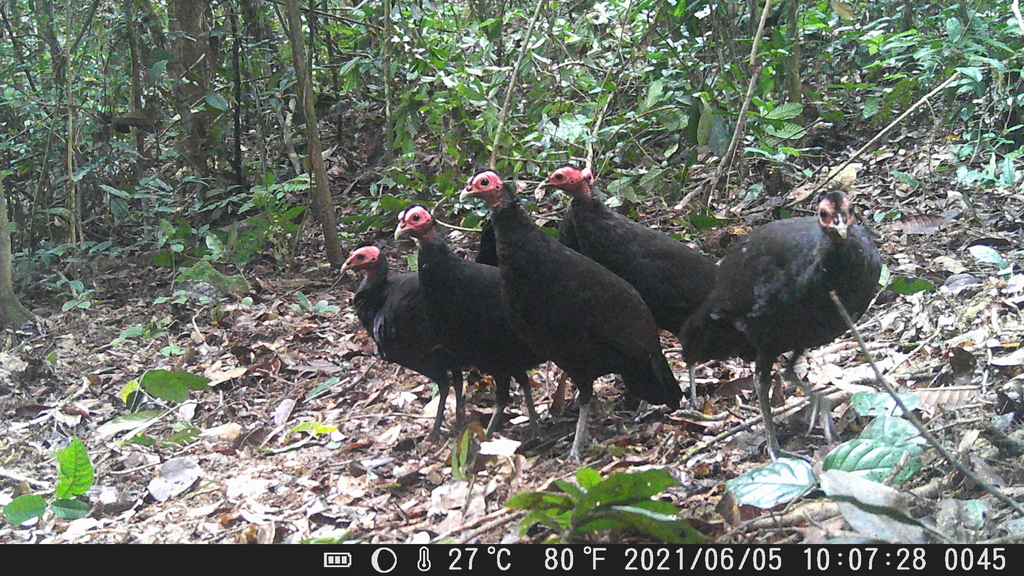
The black guinea fowl (Agelastes niger) is a terrestrial bird of the Numididae (guinea fowl) family found in humid forests in West-Central Africa. It is a medium-sized, black galliforme bird with a bare, orange-pink head and upper neck. As it inhabits dense, potentially inaccessible, regions of equatorial African jungle, little is known of black guinea fowl behaviour or habits. By all accounts, it is a more reclusive, secretive bird when compared to the other, more sociable guinea fowl species; i.e., researchers have been able to successfully observe and document far more information on the confident, gregarious and open grassland-dwelling helmeted guinea fowl (Numidia meleagris), or even the more exotic vulturine guinea fowl (Acryllium vulturinum). Compared to the black guinea fowl, the aforementioned species (and most guinea fowl) tend to be found in more exposed, dry savanna and arid open forest habitat, and congregate in larger communal flocks. Black guinea fowl are seemingly very wary birds, living in smaller social groups than other guinea fowl, and are constantly looking for signs of danger—the slightest hint of which will send the group darting into the bush to hide.
From the article Black guinea fowl on Wikipedia (CC BY-SA), quoted section by section
Description
The head and upper neck of an adult black guinea fowl are unfeathered, revealing the pink skin. A crest of short downy feathers is on the forehead and crown, and the throat and lower neck have a scattering of downy feathers. The body and tail feathers are black with some paler speckled markings on the belly. Males have one to three spurs on their legs, while females either have none or a single short spur. Juveniles are similar, but have buff tips to the feathers on their upper parts, a speckled breast, and white belly. The beak is greenish grey and the legs greyish brown. Males are usually slightly larger than females and measure about 42 cm (17 in) in length, weighing about 700 g (25 oz). The call is a monotonous high-pitched "kwee" repeated at the rate of two to three notes per second. The alarm call is an even shriller sound repeated more rapidly.
Range & habitat
The black guinea fowl is native to the western portions of Central Africa (south of the Sahara), from Nigeria and Cameroon in the west, east and southeast through Equatorial Guinea, Gabon, Angola, Central African Republic, Republic of the Congo, and the Democratic Republic of the Congo. The geographical limit of the species' range is estimated to be around 2,180,000 km2 (840,000 sq mi). The birds are terrestrial, however they can fly short distances. They spend much of their time looking for food on the forest floor, living in primary (old-growth) and secondary tropical rainforest as well as occasionally foraging in cultivated croplands or pastures. Regardless of location, black guinea fowl feel most reassured being in or near-to thick jungle vegetation in order to flee from threats or predators.
Wikipedia: “Distribution and habitat”
What it does
The black guinea fowl has been little studied. It is usually found in pairs or small groups, and is a shy, elusive bird of the forest floor. It occurs in primary and secondary growth woodland, favouring parts with thick undergrowth, but sometimes venturing out onto adjacent cultivated lands. It feeds on invertebrates such as ants, termites, millipedes, and beetles, and also small frogs, seeds, berries, and shoots. The nesting habits of this species are not known, but the eggs are pale reddish-brown, sometimes shaded with yellow or purple. It may breed in the dry season or possibly at any time of year.
Wikipedia: “Behaviour”
Listen
Looking for field recordings…
Where it lives
Recorded sightings
—
geo-referenced records in GBIF, from museums, herbaria and field observers.
Drag the globe to turn it. Dots are where records exist, not a range map; darker means more records.
In the stacks
Searching the stacks…
Every page naming Agelastes niger in the Biodiversity Heritage Library →
This page is assembled live from iNaturalist, GBIF, Wikipedia, the Source Library and the Internet Archive. It is not yet part of the hand-edited codex. iNaturalist taxon 1452.