On eBird ↗
Woodland Pipit
Live sightings near you, the range map, bar charts of when it is seen, and Macaulay Library photos and recordings.
Woodland Pipit
Anthus nyassae
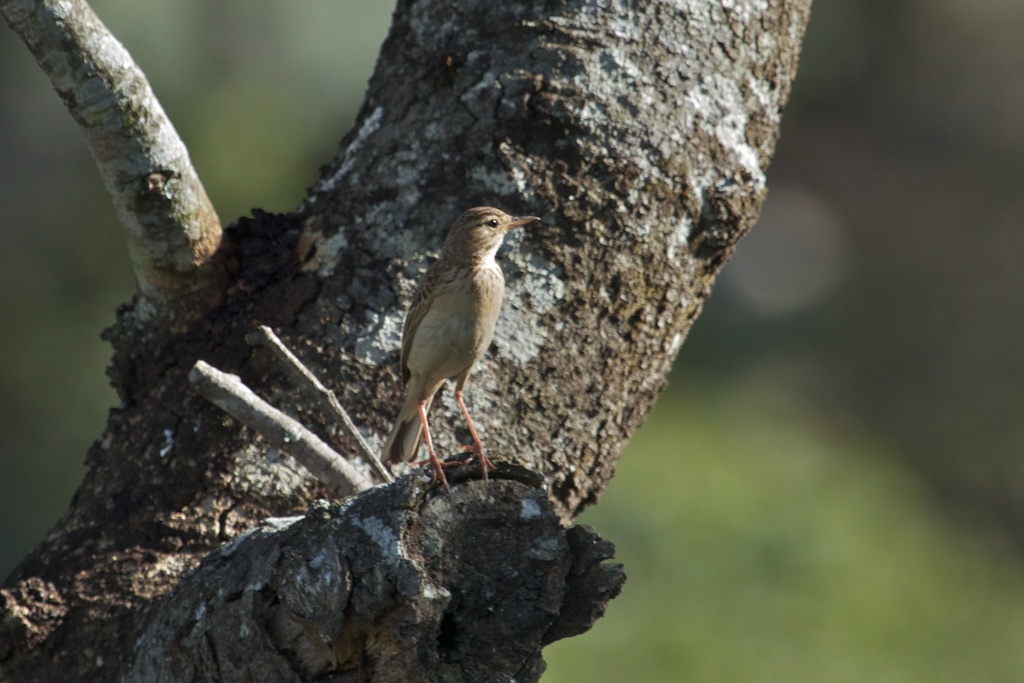
The wood pipit or woodland pipit (Anthus nyassae) is a small passerine bird belonging to the pipit genus Anthus in the family Motacillidae. It was formerly included in the long-billed pipit (Anthus similis) but is now frequently treated as a separate species. It is a bird of miombo woodland in south-central Africa, unlike the long-billed pipit which inhabits open grassland. It perches in trees when flushed but forages on the ground for invertebrates.
From the article Wood pipit on Wikipedia (CC BY-SA), quoted section by section
Description
It is 16-18 centimetres long. The upperparts are warm brown with dark streaks while the underparts are pale with some streaking on the breast. The bird has a dark eyestripe, white supercilium and pale outer tail-feathers. Juveniles have dark spots above and have more streaking below than the adults. The bird's song is high-pitched and monotonous. The long-billed pipit is very similar but has a slightly longer bill and tail, a smaller pale area in the outer tail-feathers and a slightly lower voice.
Range & habitat
The range of the wood pipit extends from south-east Gabon eastwards to southern and western Tanzania and southwards as far as north-east Namibia, northern Botswana, Zimbabwe and north-west Mozambique. At least three subspecies are recognized: A. n. nyassae, A. n. frondicolus and A. n. schoutedeni. Some authors recognize a fourth subspecies, A. n. chersophilus.
Wikipedia: “Range”
Listen
Looking for field recordings…
Where it lives
Recorded sightings
—
geo-referenced records in GBIF, from museums, herbaria and field observers.
Drag the globe to turn it. Dots are where records exist, not a range map; darker means more records.
In the stacks
Searching the stacks…
Every page naming Anthus nyassae in the Biodiversity Heritage Library →
This page is assembled live from iNaturalist, GBIF, Wikipedia, the Source Library and the Internet Archive. It is not yet part of the hand-edited codex. iNaturalist taxon 145210.