On eBird ↗
Blackburnian Warbler
Live sightings near you, the range map, bar charts of when it is seen, and Macaulay Library photos and recordings.
Blackburnian Warbler
Setophaga fusca
The Blackburnian warbler (Setophaga fusca) is a small New World warbler. They breed in eastern North America, from southern Canada, westwards to the southern Canadian Prairies, the Great Lakes region and New England, to North Carolina. They are migratory, wintering in southern Central America and South America, and are very rare vagrants to western Europe. The common name honors the English botanist Anna Blackburne.
From the article Blackburnian warbler on Wikipedia (CC BY-SA), quoted section by section
Description
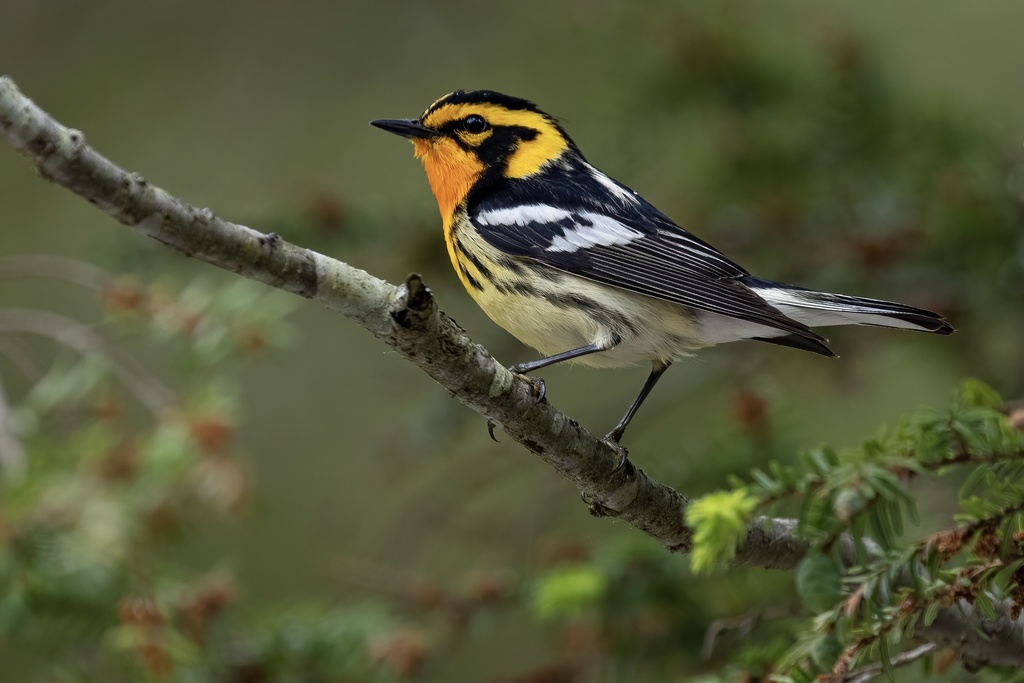
Blackburnian warblers are small passerines and average-sized wood-warblers. They measure around 11 to 13 cm (4.3 to 5.1 in) long, with a 20 to 22 cm (7.9 to 8.7 in) wingspan, and weigh 8 to 13 g (0.28 to 0.46 oz). The average mass of an adult bird is 9.7 g (0.34 oz), although is slightly higher in fall due to fat reserves, averaging 10.2–10.4 g (0.36–0.37 oz). Among standard measurements, the wing chord is 6.3 to 7.3 cm (2.5 to 2.9 in), the tail is 4.2 to 5 cm (1.7 to 2.0 in), the bill is 0.9 to 1 cm (0.35 to 0.39 in) and the tarsus is 1.6 to 1.8 cm (0.63 to 0.71 in). In summer, male Blackburnian warblers display dark gray backs and double white wing bars, with yellowish rumps and dark brown crowns. The underparts of these birds are white and are tinged with yellow and streaked black. The head is strongly patterned in yellow and black, with a flaming-orange throat. It is the only North American warbler with this striking plumage. Other plumages, including the fall male and adult female, are washed-out versions of the summer male, and in particular, lack the bright colors and strong head pattern. The Blackburnian warbler is practically unmistakable if seen well, even the female due to her dull-yellow supercilium, contrasting with greyish cheeks and yellow throat contrasting with the dark streaky sides and back. …
What it does
Blackburnian warblers are solitary during winter, highly territorial on their breeding grounds, and do not mix with other passerine species outside of the migratory period. However, during migration, they often join local mixed foraging flocks of species such as chickadees, kinglets, and nuthatches. Similarly, in the tropics, they were found to be fairly social while engaging in migration but solitary from other passerines while wintering. These birds are basically insectivorous but will include berries in their diets in wintertime. They usually forage by searching for insects or spiders in treetops. Their breeding season diet is dominated by the larvae of Lepidoptera, i.e. moths and butterflies. They may help control the spruce budworm (often considered a harmful pest) when breakouts occur, at the local if not at epidemic level. In one study from Ontario, 98% of the diet was made of insects, the remaining 2% being spiders. Among the migratory Setophaga warblers, it is considered one of the specialists at foraging in the micro-habitat of the tree's top canopy. The breeding habitats of these birds are mature coniferous woodlands, the central part of their breeding range being in the southeastern portion of Canada's boreal forest. …
Wikipedia: “Ecology”
Listen
Looking for field recordings…
Where it lives
Recorded sightings
—
geo-referenced records in GBIF, from museums, herbaria and field observers.
Drag the globe to turn it. Dots are where records exist, not a range map; darker means more records.
In the stacks
Searching the stacks…
Every page naming Setophaga fusca in the Biodiversity Heritage Library →
This page is assembled live from iNaturalist, GBIF, Wikipedia, the Source Library and the Internet Archive. It is not yet part of the hand-edited codex. iNaturalist taxon 145237.