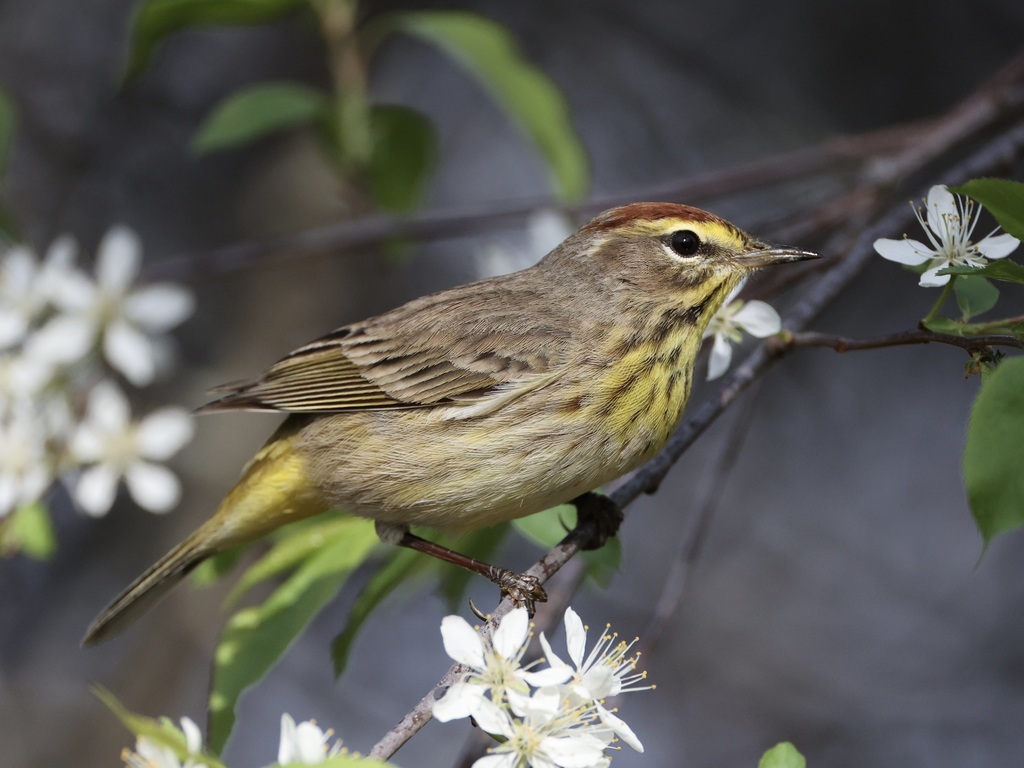
On eBird ↗
Palm Warbler
Live sightings near you, the range map, bar charts of when it is seen, and Macaulay Library photos and recordings.
Palm Warbler
Setophaga palmarum
The palm warbler (Setophaga palmarum) is a small songbird of the New World warbler family.
From the article Palm warbler on Wikipedia (CC BY-SA), quoted section by section
Description
Measurements:
Length: 12–14 cm (4.7–5.5 in) Wingspan: 20–21 cm (7.9–8.3 in) Weight: 8.5–14.2 g (0.30–0.50 oz)
Range & habitat
Palm warblers breed in open coniferous bogs and edge east of the Continental Divide, across Canada and the northeastern United States. The bird breeds in the United States, Canada and Saint Pierre and Miquelon, and is also found in non-breeding populations throughout eastern North America, Central America and the Caribbean, as far south as Panama. There have also been occasional vagrant occurrences in parts of South America, Bermuda, Iceland and the United Kingdom. The palm warbler's habitat includes shrublands, forests, grasslands, wetlands, and human-modified environments. These birds migrate to the southeastern United States, the Yucatán Peninsula, islands of the Caribbean, and eastern Nicaragua south to Panama to winter. They are one of the earlier migrants to return to their breeding grounds in the spring, often completing their migration almost two months before most other warblers. Unlike most Setophaga species, the palm warbler's winter range includes much of the Atlantic coast of North America, extending as far north as southern Nova Scotia. Every year since 1900 the palm warbler has been observed during Christmas Bird Count activities in Massachusetts, and consistently since 1958 in Nova Scotia. …
Wikipedia: “Distribution”
What it does
Palm warbler nests take the form of an open cup, usually situated on or near the ground in an open area. Palm warblers forage on the ground much more than other warblers, sometimes flying to catch insects. These birds mainly eat insects and berries. Their constant tail bobbing is an identifying characteristic. Kirtland's, prairie, and palm warblers are the only Setophaga species that incessantly bob their tails. The song of this bird is a monotonous buzzy trill. The call is a sharp chek.
Wikipedia: “Behavior”
Listen
Looking for field recordings…
Where it lives
Recorded sightings
—
geo-referenced records in GBIF, from museums, herbaria and field observers.
Drag the globe to turn it. Dots are where records exist, not a range map; darker means more records.
In the stacks
Searching the stacks…
Every page naming Setophaga palmarum in the Biodiversity Heritage Library →
This page is assembled live from iNaturalist, GBIF, Wikipedia, the Source Library and the Internet Archive. It is not yet part of the hand-edited codex. iNaturalist taxon 145242.