On eBird ↗
Barbuda Warbler
Live sightings near you, the range map, bar charts of when it is seen, and Macaulay Library photos and recordings.
Barbuda Warbler
Setophaga subita
The Barbuda warbler (Setophaga subita) is a species of bird in the family Parulidae. It is endemic to the island of Barbuda in Antigua and Barbuda. Its natural habitat is tropical dry shrubland near wetland areas. It is threatened by habitat loss. It once was considered a subspecies of the Adelaide's warbler. In September 2017, the warbler's habitat was massively damaged by Hurricane Irma. Despite this, the species was found to have survived the storm and...
From the article Barbuda warbler on Wikipedia (CC BY-SA), quoted section by section
Description
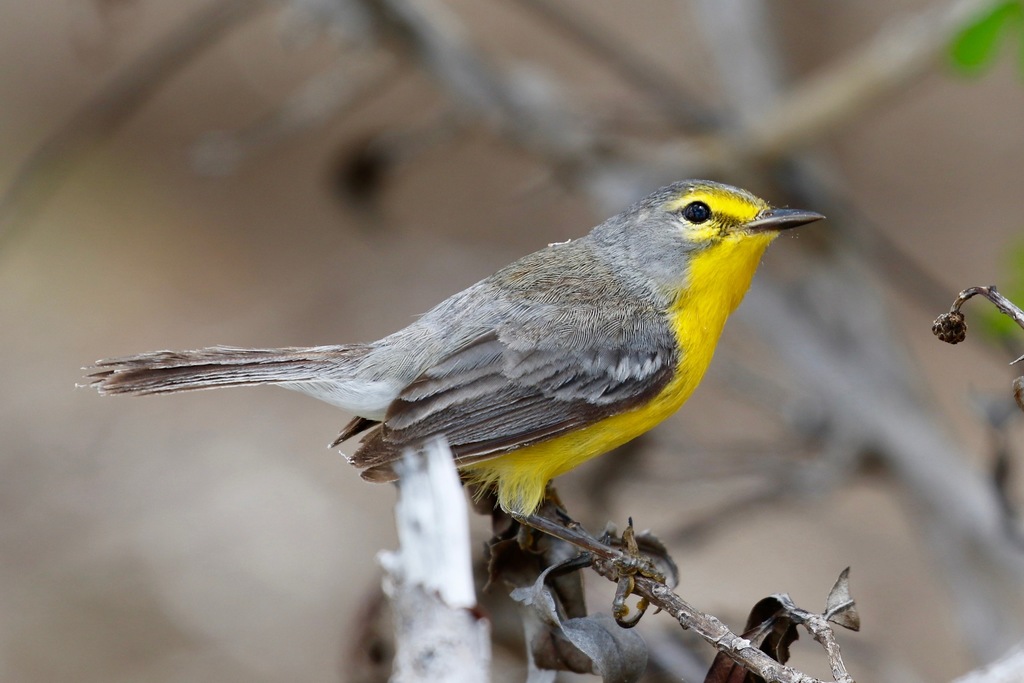
The Barbuda warbler is 12 to 13.5 cm (4.7 to 5.3 in) long and weighs 5.3 to 8 g (0.19 to 0.28 oz). The sexes have the same plumage. Adults have a slightly yellow forehead, a mouse gray crown, dark lores, a wide yellow supercilium to just behind the eye, a yellow arc below the eye, and mouse gray ear coverts. Their back is light gray with a brownish tinge and their rump and uppertail coverts are mouse gray. Their wings are mostly black with thin gray edges on the flight feathers and gray tips on the greater coverts that show as a dusky wing bar. Their tail is black. The outermost three feathers have thin white edges and a large white spot near the end. Their cheeks, chin, throat, and breast are lemon yellow and their belly and undertail coverts white. Both sexes have a dark iris, a blackish bill, and dark grayish pink legs and feet.
Range & habitat
The Barbuda warbler is found only on the island of Barbuda in the small Lesser Antillean country of Antigua and Barbuda. It primarily inhabits dry scrublands and dry forest, and in lesser numbers mangroves and coastal brushlands.
Wikipedia: “Distribution and habitat”
What it does
The Barbuda warbler's diet has not been studied but most observations of feeding show that it feeds on small invertebrates.
Wikipedia: “Feeding”
Listen
Looking for field recordings…
Where it lives
Recorded sightings
—
geo-referenced records in GBIF, from museums, herbaria and field observers.
Drag the globe to turn it. Dots are where records exist, not a range map; darker means more records.
In the stacks
Searching the stacks…
Every page naming Setophaga subita in the Biodiversity Heritage Library →
This page is assembled live from iNaturalist, GBIF, Wikipedia, the Source Library and the Internet Archive. It is not yet part of the hand-edited codex. iNaturalist taxon 145251.