On eBird ↗
Golden-cheeked Warbler
Live sightings near you, the range map, bar charts of when it is seen, and Macaulay Library photos and recordings.
Golden-cheeked Warbler
Setophaga chrysoparia
The golden-cheeked warbler (Setophaga chrysoparia ), also known as the gold finch of Texas, is an endangered species of bird that breeds in Central Texas, from Palo Pinto County southwestward along the eastern and southern edge of the Edwards Plateau to Kinney County. The golden-cheeked warbler is the only bird species with a breeding range confined to Texas.
From the article Golden-cheeked warbler on Wikipedia (CC BY-SA), quoted section by section
Description
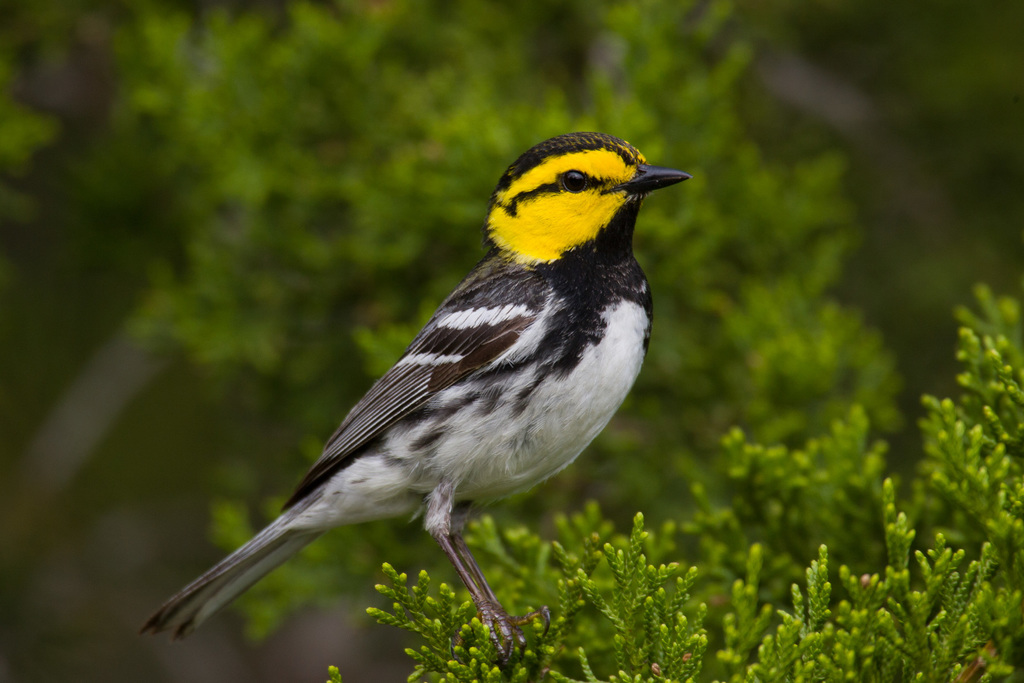
The golden-cheeked warbler is very striking due to its bright yellow cheeks that are contrasted by its black throat and back. It is also identified by its unique buzzing song emerging from the wooded canyons where it breeds. Golden-cheeked warblers breed in 33 counties in central Texas and are dependent on ashe juniper (blueberry juniper or cedar) for their fine bark strips used as nesting material.
Range & habitat
The golden-cheeked warbler can be found in numerous state parks within Texas. These parks include Colorado Bend State Park (SP), Dinosaur Valley SP, Garner SP, Guadalupe River SP, Honey Creek State Natural Area (SNA), Hill Country SNA, Kerr Management Area, Longhorn Cavern SP, Lost Maples SNA, Meridian SP, Pedernales Falls SP, Possum Kingdom SP, and South Llano River SP. The golden-cheeked warbler is endemic to Texas and Mexico. Their habitat can range from moist, to dry areas around central and southern Texas. The nesting habitat in the further moist realms can be discovered in tall, closed canopy, compressed, mature stands of ashe juniper (Juniperus ashei) trees along with Texas, shin, live, lacey, and post oak trees. In the drier spheres of Texas, golden-cheeked warblers can be found in upland juniper-oak woodlands off of flat topography. They use ashe juniper bark and spider webs to build their nests. Females lay three to four eggs. When migration and winter hits the habitat stays relatively similar: a variety of short-lived evergreen forests with pines between 3,300 and 8,300 feet.
Migration. Golden-cheeked warblers will only remain in Texas for the breeding season, from March to June. They will migrate with other songbird species along Mexico's Sierra Madre Oriental. By the first week of March, the warblers will return to Texas to breed. …
Wikipedia: “Distribution and habitat”
What it does
Golden-cheeked warblers only nest in Texas, primarily in juniper trees. However, they have also been found to nest in oak trees and cedar elms. During the winter, warblers seek warmth in Mexico and northern Central America. After winter habitation, adult male warblers beat their population back to central nesting grounds by about 5 days in order to prepare competing for the attention of female warblers. Male warblers win attention of the females through their "chip" sounds which they also make as a warning call during times of possible danger. Though male warblers are found either singing or searching for food, females carry the responsibility of nest building as well as keeping the eggs incubated. Warblers only nest once per season, laying between three and four eggs each time, which take an average of twelve days to hatch. Female warblers are considered shy and go more unnoticed compared to the always-singing males. Warblers typically forage by grabbing insects from foliage and branches (foraging strategy known as gleaning), and by resting at branch edges until the opportunity to snatch insects that fly past (strategy known as sallying).
Diet and feeding. The golden-cheeked warbler is known to feed on various forms of insects and spiders, caterpillars are also noted as a primary source of food during the breeding season. This species is completely insectivorous. …
Wikipedia: “Behavior”
In human culture
In 2023 the golden-cheeked warbler was featured on a United States Postal Service Forever stamp as part of the Endangered Species set, based on a photograph from Joel Sartore's Photo Ark. The stamp was dedicated at a ceremony at the National Grasslands Visitor Center in Wall, South Dakota. As part of an initiative to raise awareness for endangered animals within the continental US, Frontier Airlines debuted a golden-cheeked warbler on the aircraft livery of an Airbus 321 in 2024.
Wikipedia: “In popular culture”
Listen
Looking for field recordings…
Where it lives
Recorded sightings
—
geo-referenced records in GBIF, from museums, herbaria and field observers.
Drag the globe to turn it. Dots are where records exist, not a range map; darker means more records.
In the stacks
Searching the stacks…
Every page naming Setophaga chrysoparia in the Biodiversity Heritage Library →
This page is assembled live from iNaturalist, GBIF, Wikipedia, the Source Library and the Internet Archive. It is not yet part of the hand-edited codex. iNaturalist taxon 145257.