On eBird ↗
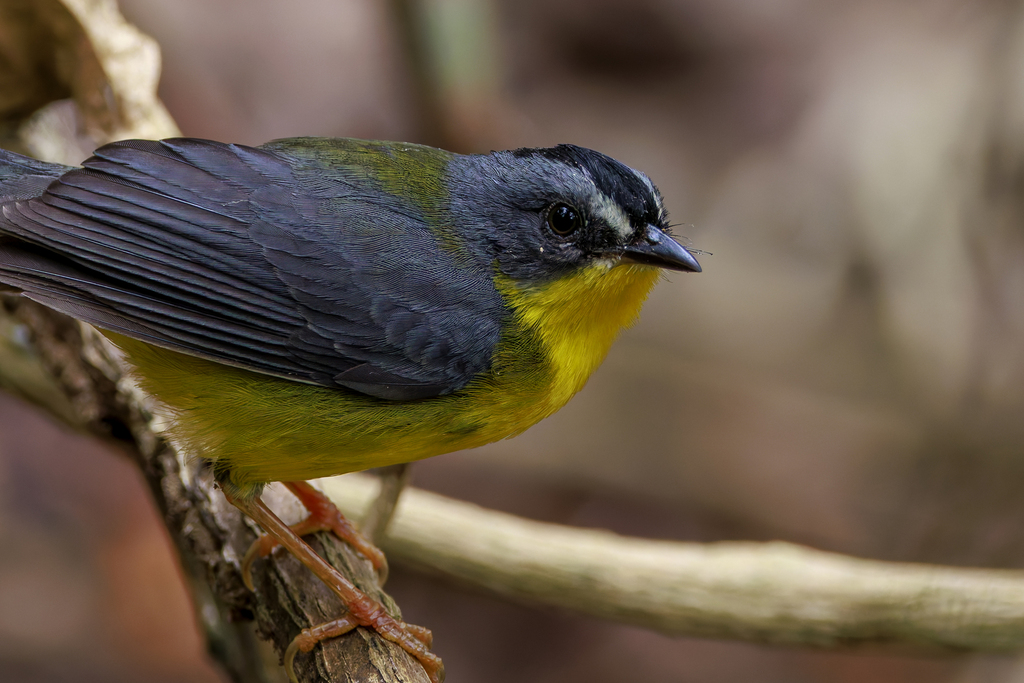
Gray-and-gold Warbler
Live sightings near you, the range map, bar charts of when it is seen, and Macaulay Library photos and recordings.
Gray-and-gold Warbler
Myiothlypis fraseri
The grey-and-gold warbler (Myiothlypis fraseri) is a species of bird in the Parulidae family. It is found in Ecuador and Peru. Its natural habitats are subtropical or tropical dry forests and subtropical or tropical moist lowland forests. Aspects of the grey-and-gold warbler's breeding biology were recently described by Miller et al. (2007), based on a sample of two nests. It was named after British zoologist and collector Louis Fraser.
From the article Grey-and-gold warbler on Wikipedia (CC BY-SA), quoted section by section
Description
The grey-and-gold warbler is about 14 cm (5.5 in) long. Males weigh an average of 12 g (0.42 oz) and females average 12 g (0.42 oz). The sexes have the same plumage. Adults of the nominate subspecies have a lemon-yellow crown stripe with black borders, black lores, and a white streak above the lores on an otherwise blue-gray face. The center of their back is dull olive and the rest of their upperparts are blue-gray. Their wings and tail are blackish gray with blue-gray feather edges. Their chin is white and the rest of their underparts are yellow that is lightest on the undertail coverts. Subspecies M. f. ochraceicrista has an ochraceous-orange crown stripe and is otherwise like the nominate. Both subspecies have a brown iris, a black bill, and yellow-brown legs and feet.
Range & habitat
Subspecies M. f. ochraceicrista of the grey-and-gold warbler is the more northerly of the two. It is found in western Ecuador from southern Esmeraldas Province south at least to southern Guayas Province and on Puna Island in the Gulf of Guayaquil. The nominate is found west of the Andes from Chimborazo Province in central Ecuador south into far northwestern Peru's Lambayeque Department. The species inhabits the understory of a variety of landscapes including drier to humid deciduous forest and scrublands. The two subspecies possibly overlap or meet in El Oro Province. In elevation in Ecuador it is mostly found below 400 m (1,300 ft) but reaches 1,700 m (5,600 ft) in the southwest. In Peru it ranges between 400 and 1,800 m (1,300 and 5,900 ft).
Wikipedia: “Distribution and habitat”
What it does
The grey-and-gold warbler's diet has not been studied though it is known to feed primarily on invertebrates. It forages mostly in the forest's understory and only occasionally joins mixed-species feeding flocks.
Wikipedia: “Feeding”
Listen
Looking for field recordings…
Where it lives
Recorded sightings
—
geo-referenced records in GBIF, from museums, herbaria and field observers.
Drag the globe to turn it. Dots are where records exist, not a range map; darker means more records.
In the stacks
Searching the stacks…
Every page naming Myiothlypis fraseri in the Biodiversity Heritage Library →
This page is assembled live from iNaturalist, GBIF, Wikipedia, the Source Library and the Internet Archive. It is not yet part of the hand-edited codex. iNaturalist taxon 145273.