On eBird ↗
Lawrence's Goldfinch
Live sightings near you, the range map, bar charts of when it is seen, and Macaulay Library photos and recordings.
Lawrence's Goldfinch
Spinus lawrencei
Lawrence's goldfinch (Spinus lawrencei) is a small songbird of erratic distribution that breeds in California and Baja California and winters in the southwestern United States and northern Mexico.
From the article Lawrence's goldfinch on Wikipedia (CC BY-SA), quoted section by section
Description
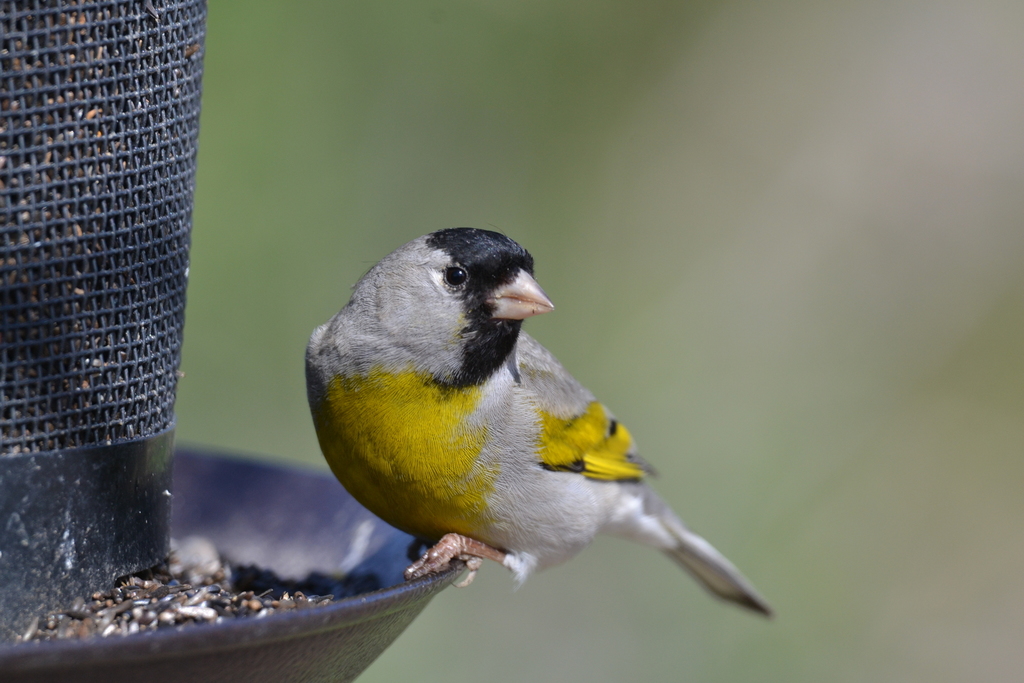
At about 4.75 in (12.1 cm) long and weighing about 0.4 oz (11 g), it is slightly bigger than the lesser goldfinch and slightly smaller than the American goldfinch, with less yellow in the plumage than either. Adults of both sexes are gray with pink to grayish flesh-color bills, stubbier than other goldfinches'. They have yellow rumps and paired yellowish wing-bars, as well as yellow edges on the flight feathers and yellow on the breast. The tail is black, crossed by a white band. Plumage is duller in winter, brightening after a spring molt. Males are paler, with black caps and faces and larger areas of brighter yellow. Females are browner, have less and duller yellow, and lack the black. Juveniles resemble females but are even duller and have faint streaks on the upperparts and especially the underparts. Calls include "a nasal too-err, also a sharp, high PIti and Itititi". The flight call, which is diagnostic, is given as "a high, clear ti-too" or tink-ul "reminiscent of glass wind-chimes". The song is high-pitched, continuous, and limited in frequency range, including wind-chime notes and especially imitations of other species' calls and other simple and distinctive sounds. Males sing in winter but mostly in the breeding season. Females sing occasionally and briefly.
Range & habitat
Lawrence's goldfinch is known for its wandering habits. It breeds from about Shasta County, California to northern Baja California, largely in the Coast Ranges and the foothills of the Sierra Nevada and in the Baja highlands, but also sometimes as far down as the coast; its highest breeding altitude is about 8,800 ft (2,700 m) on Mount Pinos. There are only a few places where it has been observed to nest annually, notably the Carmel Valley and the South Fork Kern River. The choice of areas in its breeding range may depend on climate through the availability of water and preferred foods. Movements to the coast and upslope in the Sierras occur in drought years and movements to the edges of the range and into the Central Valley after wet years, possibly because of an increased food supply. It has been bred a few times in Arizona. Most, but not always all, birds leave northern, central, and inland southern California in winter. They move into the coastal lowlands and into the lower parts of the southeastern California deserts, ranging irregularly (sometimes in large numbers) southeastward to northern Sonora and northwestern Chihuahua and eastward to the southern half of Arizona, southwestern New Mexico, and even the area of El Paso, Texas—roughly the Madrean Sky Islands region. …
Wikipedia: “Range and habitat”
What it does
Lawrence's goldfinch feeds almost entirely on seeds of shrubs and forbs. During the nesting season, it eats seeds of annuals, strongly favoring the common fiddleneck. Birders seeking Lawrence's goldfinch are advised to know this plant. At other seasons in California, it predominantly eats chamise achenes and also berries of mistletoe (Phoradendron) and California Buckthorn. In Arizona, it often eats the seeds of amaranths and inkweed. It is attracted to niger seed at feeders.
Wikipedia: “Diet”
In human culture
This bird's name commemorates the American ornithologist George Newbold Lawrence.
Wikipedia: “Etymology”
Listen
Looking for field recordings…
Where it lives
Recorded sightings
—
geo-referenced records in GBIF, from museums, herbaria and field observers.
Drag the globe to turn it. Dots are where records exist, not a range map; darker means more records.
In the stacks
Searching the stacks…
Every page naming Spinus lawrencei in the Biodiversity Heritage Library →
This page is assembled live from iNaturalist, GBIF, Wikipedia, the Source Library and the Internet Archive. It is not yet part of the hand-edited codex. iNaturalist taxon 145309.