On eBird ↗
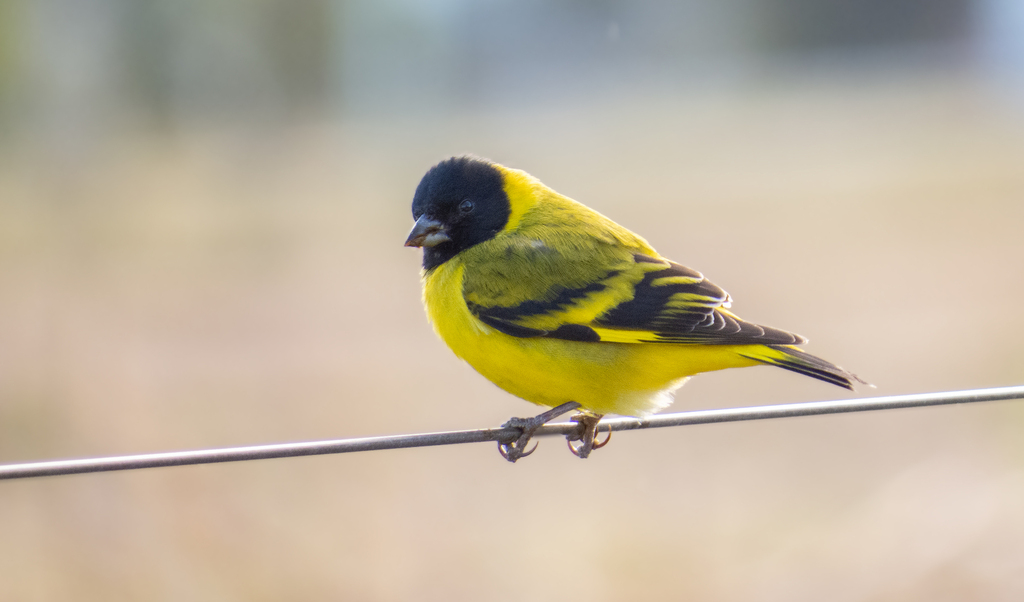
Hooded Siskin
Live sightings near you, the range map, bar charts of when it is seen, and Macaulay Library photos and recordings.
Hooded Siskin
Spinus magellanicus
The hooded siskin (Spinus magellanicus) is a small passerine bird in the finch family (Fringillidae), native to South America. It belongs to the putative clade of neotropical siskins in the genus Spinus sensu lato.
From the article Hooded siskin on Wikipedia (CC BY-SA), quoted section by section
Description
The hooded siskin is 10 to 12 cm (3.9 to 4.7 in) long. and weighs about 11 g (0.39 oz). The species is sexually dimorphic. Adult males of the nominate subspecies S. m. magellanicus have an entirely black head, throat, and upper breast. They have a bright yellow collar on the nape and the sides of their neck. Their lower nape, back, and scapulars are olive green with faint dark streaks. Their rump is bright yellow and their uppertail coverts are olive green. Their tail is mostly black with wide deep yellow edges on all but the innermost pair of feathers. Their wings have a complicated pattern. The upperwing coverts are blackish brown. The greater coverts are blackish brown with pale olive green or bright yellow tips. The primary coverts and flight feathers are mostly black with bright yellow bases on the primaries and secondaries; these form a band across the wing. The tertials are mostly black with yellowish edges at the base and white tips. Their underparts from the lower breast are bright yellow that sometimes has an orange tinge on the sides of the breast and a greenish tinge on the flanks and belly. Adult females have no black on the head; it and their back are dull olive or olive green with a gray tinge. Their rump is yellow or yellowish green and their uppertail coverts green. Their tail is like the male's. …
Range & habitat
The hooded siskin is the most widespread member of genus Spinus. The subspecies are found thus:
S. m. capitalis: from Tolima Department in western Colombia south through Ecuador's central Andes into northwestern Peru's La Libertad Department S. m. paulus: from Guayas Province in southwestern Ecuador south to Arequipa in southwestern Peru S. m. peruanus: central Peru from Huánuco to Ayacucho and Cuzco departments S. m. urubambensis: from Cuzco south into northern Chile's Tarapacá Region S. m. santaecrucis: western Santa Cruz Department in central Bolivia S. m. bolivianus: central and southern Bolivia S. m. hoyi: central Andes in northwestern Argentina S. m. tucumanus: western Andes in northwestern Argentina's Jujuy, Santiago del Estero, and Santa Fe to Mendoza provinces S. m. alleni: southeastern Bolivia east through Paraguay to northeastern Argentina and southern Brazil S. m. ictericus: from Minas Gerais in eastern Brazil south to eastern and southern Paraguay and northeastern Argentina's Misiones and northern Corrientes provinces S. m. magellanicus: Uruguay and northern and eastern Argentina from southern Corrientes to Río Negro Province S. m. longirostris separate from the others; from southeastern Bolívar state in Venezuela east into western Guyana and extreme northern Brazil's Roraima state The hooded siskin inhabits a wide variety of landscapes. …
Wikipedia: “Distribution and habitat”
What it does
The hooded siskin feeds primarily on a wide variety of seeds but also includes buds, leaves, flowers and nectar, fruits, and small arthropods in its diet. It has also been observed ingesting sand, apparently for its gritty texture to aid in breaking down food. In the non-breeding season it often forages in flocks of up to about 13 individuals than may include as many as seven species.
Wikipedia: “Feeding”
Listen
Looking for field recordings…
Where it lives
Recorded sightings
—
geo-referenced records in GBIF, from museums, herbaria and field observers.
Drag the globe to turn it. Dots are where records exist, not a range map; darker means more records.
In the stacks
Searching the stacks…
Every page naming Spinus magellanicus in the Biodiversity Heritage Library →
This page is assembled live from iNaturalist, GBIF, Wikipedia, the Source Library and the Internet Archive. It is not yet part of the hand-edited codex. iNaturalist taxon 145316.